
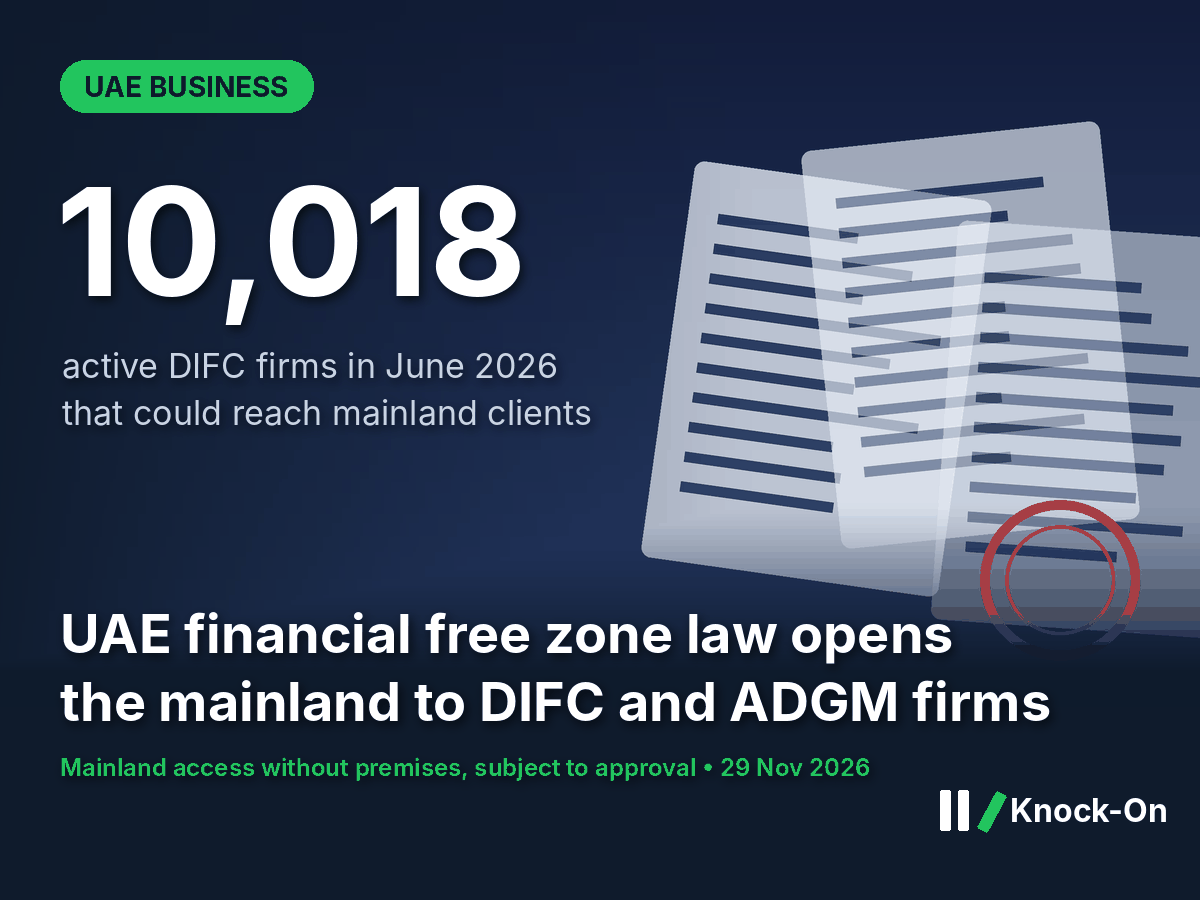
A new UAE financial free zone law lets companies licensed in the country’s financial free zones, chiefly the Dubai International Financial Centre (DIFC) and Abu Dhabi Global Market (ADGM), do more business with customers on the mainland, in some cases without opening an office there. For banks, fintechs, asset managers and the mainland firms that use them, it lowers a long-standing barrier, though the detail depends on regulatory approvals still to come.
The short version
- A federal decree-law announced on 29 November by the UAE Government Media Office widens what financial free zone firms can do on the mainland, subject to regulatory approvals.
- Some firms may serve mainland clients without a physical presence there.
- Free zone fintechs can settle customer payments in dirhams through dedicated accounts at mainland banks; free zone banks may take mainland dirham deposits for regional treasury centre business once a regulatory decision is issued.
- The DIFC alone had 10,018 active companies at the end of June 2026, including 1,134 regulated financial firms.
What happened
The UAE Government issued a federal decree-law on financial free zones on Sunday, 29 November, according to The National and Gulf News, both citing the UAE Government Media Office. Neither report gives the law’s number or the date it takes effect.
As reported, the law does five main things. Companies licensed in financial free zones may carry out activities on the mainland, subject to approvals and conditions, and may be allowed to do so without a physical presence there. Fintech firms set up or licensed in the free zones can execute and settle customers’ dirham transactions through segregated client-money accounts held with banks licensed by the Central Bank of the UAE. Banks licensed in the free zones may be allowed to deal in dirhams and accept deposits from mainland customers, but only for regional treasury centre activities and only once a regulatory decision on this is issued. Institutions and their clients can agree which law and which courts govern treasury centre transactions, including free zone law and courts. And the law widens the rules for offering, listing and trading securities across the mainland and free zone markets, in some cases in dirhams. Mainland Central Bank and Capital Market Authority licence holders also get more room inside the free zones, with approval.
The government said the free zones keep their own legal and regulatory frameworks.
Fintech and AI firms are the DIFC’s biggest group of potential mainland providers
DIFC firms by type, number of companies, end of June 2026 (10,018 active companies in total)
Why it matters
Until now, serving both markets usually meant separate set-ups, and dirham business was largely a mainland affair. Under the UAE financial free zone law, the pool of providers a mainland company can use for banking, payments, fund management or treasury services should widen. The DIFC alone reported 1,134 regulated financial firms and 1,933 AI, fintech and innovation companies at mid-year, according to the Dubai Media Office. The law also follows other steps to deepen the local money market, such as the first digital dirham treasury bonds.
The knock-on effects
First order: wider reach for free zone firms
Free zone banks, fintechs and investment firms can plan to sell to mainland customers without the cost of a second office, once regulators set out the approvals. Payments and fintech firms gain most directly from dirham settlement through mainland bank accounts.
Second order: more choice and competition for mainland clients
Mainland companies, especially regional headquarters running treasury centres, may get more providers competing on fees and service, and more say over which law and courts govern their treasury deals. Mainland banks face new competitors for some corporate business, but also new fee income from holding fintech client-money accounts.
Third order: a deeper dirham capital market
Cross-market securities offerings and listings, some in dirhams, could bring more issuers and investors into local markets over time. That matters for companies raising money on Nasdaq Dubai, the DFM and the ADX. How far this goes depends on rules not yet published.
Who could benefit
- Free zone fintechs and payment firms, which can settle dirham transactions for clients through mainland bank accounts.
- Regional treasury centres of multinational groups, which get more choice of banks and of governing law.
- Asset and wealth managers in the DIFC and ADGM looking for mainland clients.
Who may face pressure
- Mainland banks serving corporate treasuries, which may face more competition on deposits and fees.
- Firms that set up dual structures to serve both markets, which may need to review whether these are still needed.
What to watch
- The law’s text and start date: publication in the Official Gazette, with its number and effective date (not yet announced).
- Central Bank of the UAE decision on free zone banks taking mainland dirham deposits for treasury centre activities (date not set).
- Capital Market Authority, DFSA and FSRA rules on cross-market securities offerings and listings.
- ADGM consultation on employment rules, which closes on 9 December; see our story on ADGM maternity leave proposals.
For more on UAE banking changes, read our analysis of the DIB and Emirates Islamic merger.
Sources
- The National, UAE eases rules for financial free zones to do business on mainland, 29 November 2026
- Gulf News, UAE Enacts Law to Boost Financial Free Zone Access for Mainland Operations, 29 November 2026
- Dubai Media Office, DIFC records industry-leading achievements in H1 2026, 28 July 2026
This is analysis, not investment advice. Figures are as of 29 November 2026.


Leave a Reply