
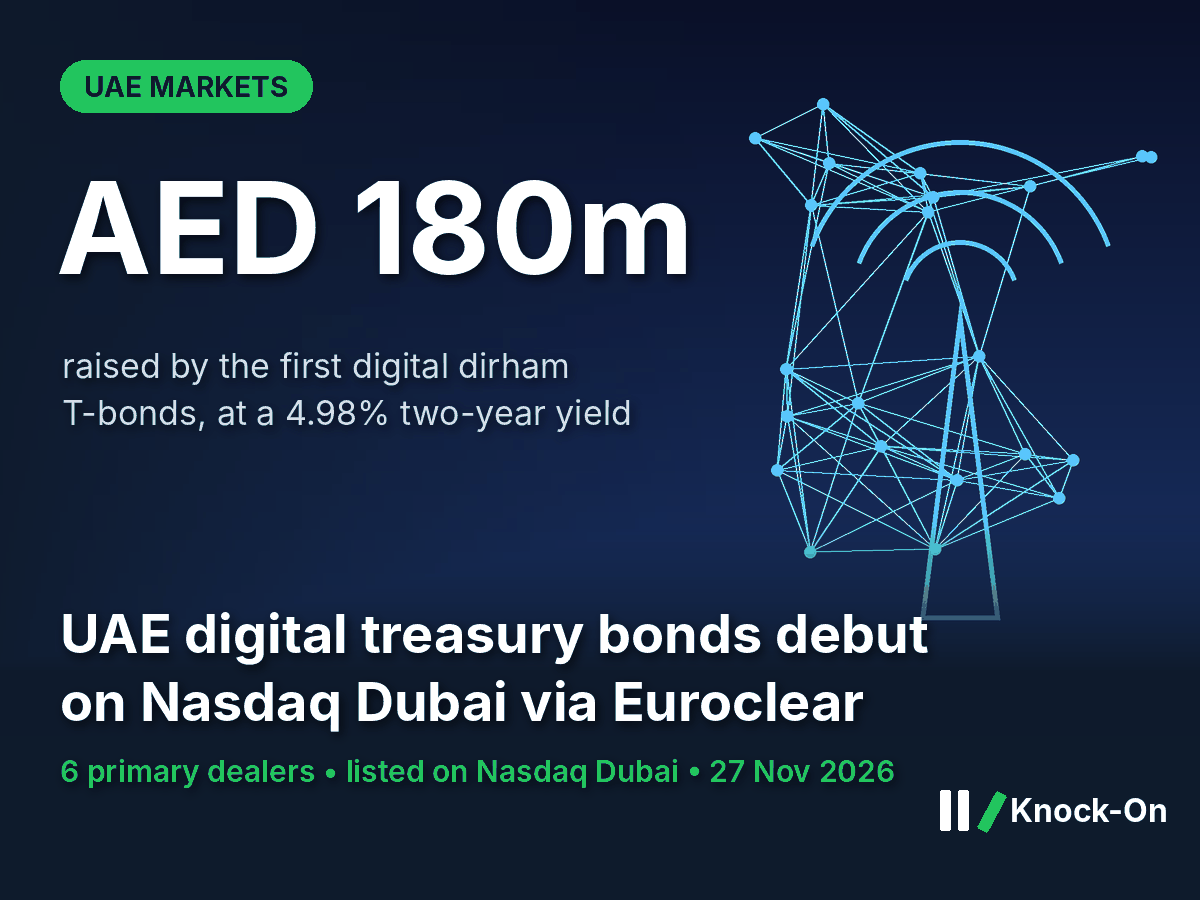
UAE digital treasury bonds made their debut on 27 November, when the Ministry of Finance raised AED 180m through the first dirham-denominated sovereign bonds issued and settled on a digital ledger. The two-year bonds were priced at a 4.98% yield and listed on Nasdaq Dubai. The amount is small next to the ministry’s regular monthly auctions, but for UAE banks, treasurers and bond investors it is a live test of how government debt could be issued, held and settled in future.
The short version
- The Ministry of Finance issued AED 180m of two-year digital T-bonds at a 4.98% yield, using Euroclear’s digital market infrastructure.
- The bonds were split equally among six primary dealers: FAB, Emirates NBD, ADCB, Mashreq, HSBC and Standard Chartered.
- The same month’s conventional auction raised AED 920m from bids of AED 3.04bn.
- The ministry calls it a trial and says lessons will shape future issues.
What happened
According to the Ministry of Finance statement reported by The National and Arab News (which cites WAM), the AED 180m (about US$49m) issue was made under the federal sovereign treasury bonds programme. Euroclear’s Digital Financial Market Infrastructure (D-FMI) handled issuance and settlement, while the bonds trade on Nasdaq Dubai. Standard Chartered acted as settlement agent, Citi as issuing and paying agent and Emirates NBD as structuring agent.
The yield was set from the results of the ministry’s conventional auction. That auction raised AED 920m: AED 550m of T-sukuk maturing in September 2031 at 5% and AED 370m of new T-bonds maturing in November 2028 at 4.98%, against bids totalling AED 3.04bn. Mohamed bin Hadi Al Hussaini, Minister of State for Financial Affairs, called the digital issue “an important milestone in developing the domestic debt market” and said the ministry would assess the results before future issues.
The digital pilot is a small slice of November’s dirham debt sales
UAE Ministry of Finance, November 2026 issuance, AED millions
Why it matters
The federal T-bond programme began in 2022 to build a dirham yield curve, a reference that banks and companies use to price their own loans and bonds. By the end of 2025 the ministry had run 23 T-sukuk auctions worth AED 27bn and eight T-bond auctions worth AED 11.2bn, according to Arab News. Moving part of that issuance onto a digital ledger is about plumbing rather than size: faster settlement, fewer reconciliation steps and, potentially, easier access for investors who hold assets through international custodians. The listing on Nasdaq Dubai also shows that a tokenised government bond can sit on an established exchange, as the exchange’s chief executive Hamed Ali noted.
The knock-on effects
First order: banks get hands-on experience
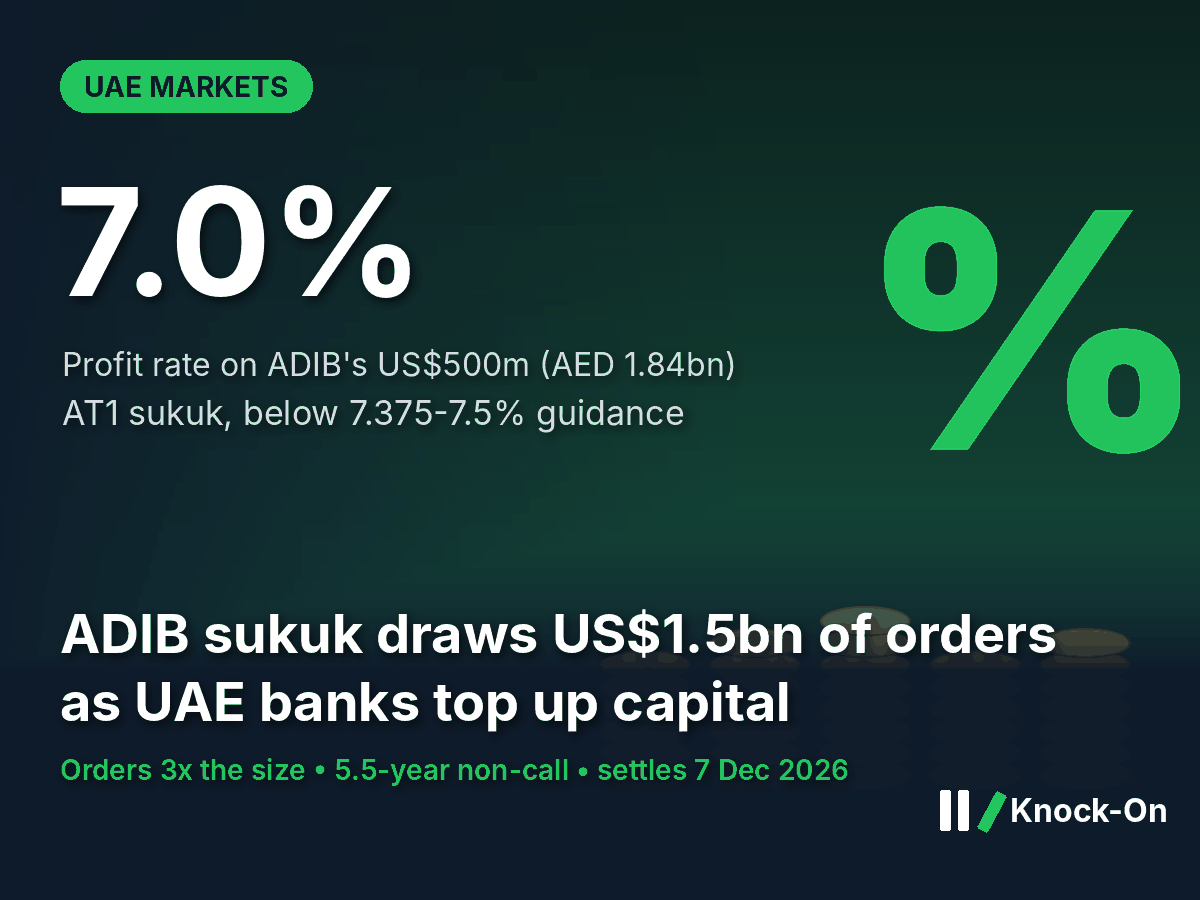
The six primary dealers now hold the instrument and have to run it through their treasury, custody and risk systems. That work, and the lessons from settlement through Euroclear, gives them a head start if the ministry repeats or scales up digital issuance. Banks build capital and liquidity buffers with sovereign paper, as the ADIB sukuk raising US$500m this week showed from the issuer side.
Second order: a reference point for corporate issuers
A government benchmark on digital rails lowers the barrier for UAE banks and large companies considering their own tokenised bonds or sukuk. Lawyers, arrangers and custodians in Dubai and Abu Dhabi can point to a sovereign precedent when advising clients. Pricing will still follow the conventional curve: the digital bonds carried the same 4.98% yield as the conventional November 2028 bonds.
Third order: deeper local capital markets
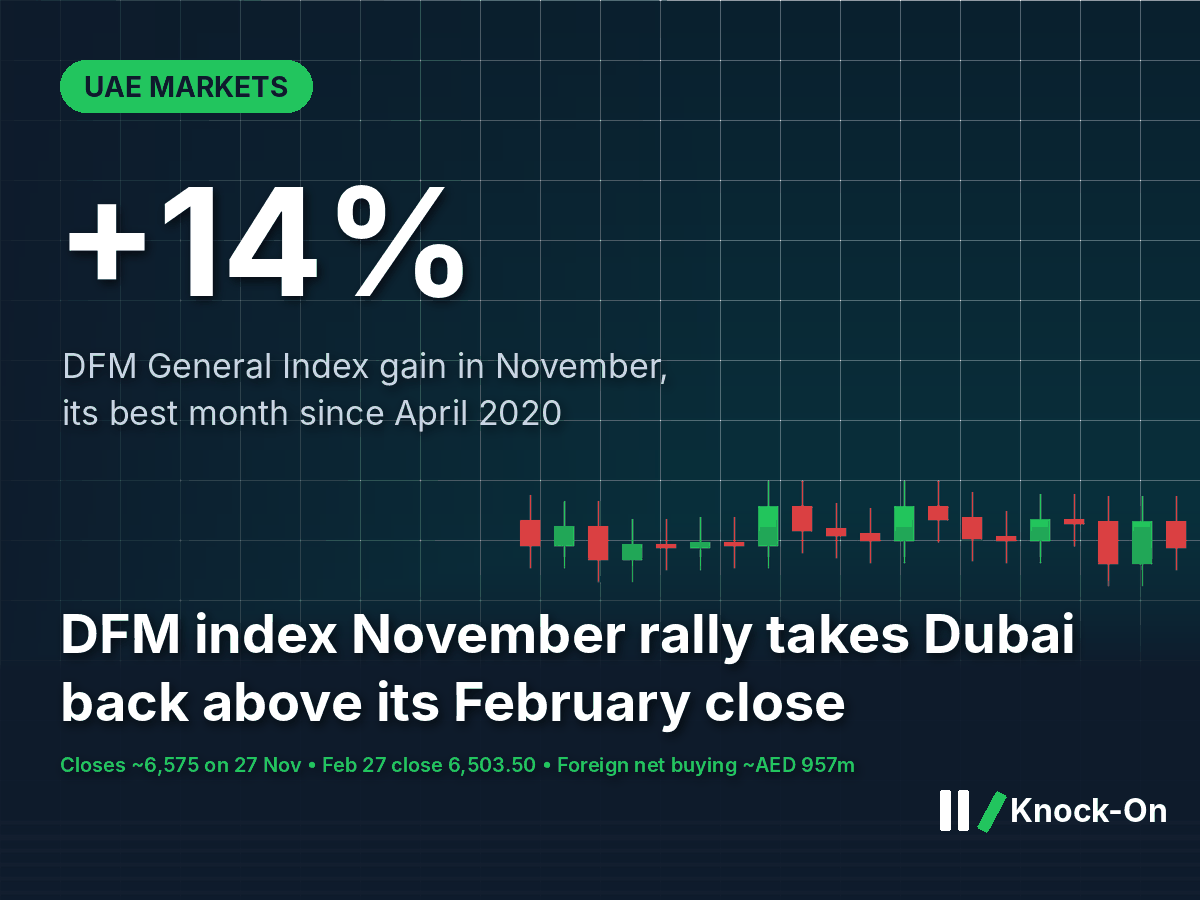
A deeper, more liquid dirham bond market gives pension funds, insurers and corporate treasurers more places to park cash in local currency, and supports the wider push to grow listed markets after the DFM index’s strong November. Any wider effect depends on whether digital issues become regular and larger; that is a forecast, not a plan the ministry has announced.
Who could benefit
- Primary dealer banks: early experience with digital sovereign settlement and a new instrument for liquidity books.
- Nasdaq Dubai and DFM: a listing that positions the exchange for future tokenised debt.
- Fintech and custody providers: demand for systems that link digital ledgers with existing settlement.
- Corporate treasurers: a clearer dirham benchmark for pricing debt.
Who may face pressure
- Smaller banks and brokers: may need to invest in new systems to take part if digital issuance grows.
- Traditional back-office providers: parts of reconciliation and settlement work could shrink over time.
- Retail investors: eligibility for the digital bonds was not stated, so direct access is unclear for now.
What to watch
- December 2026: the Ministry of Finance’s next monthly T-bond and T-sukuk auction, and whether it includes another digital tranche.
- December 2026: the US Federal Reserve’s rate decision, which the Central Bank of the UAE usually follows and which feeds into dirham bond yields.
- 2027: the ministry’s review of the pilot and any decision on larger or regular digital issues.
- Ongoing: secondary trading in the bonds on Nasdaq Dubai. More UAE market coverage is in our UAE Markets section, including Morgan Stanley’s upgrade of UAE stocks.
Sources
- The National, UAE issues first dirham denominated digital sovereign treasury bonds, 27 November 2026
- Arab News, UAE issues first digital treasury bonds in $49m deal, 27 November 2026
- WAM, Ministry of Finance issues first AED-denominated Digital Sovereign Treasury Bonds, 27 November 2026
This is analysis, not investment advice. Figures are as of 27 November 2026.

Leave a Reply