
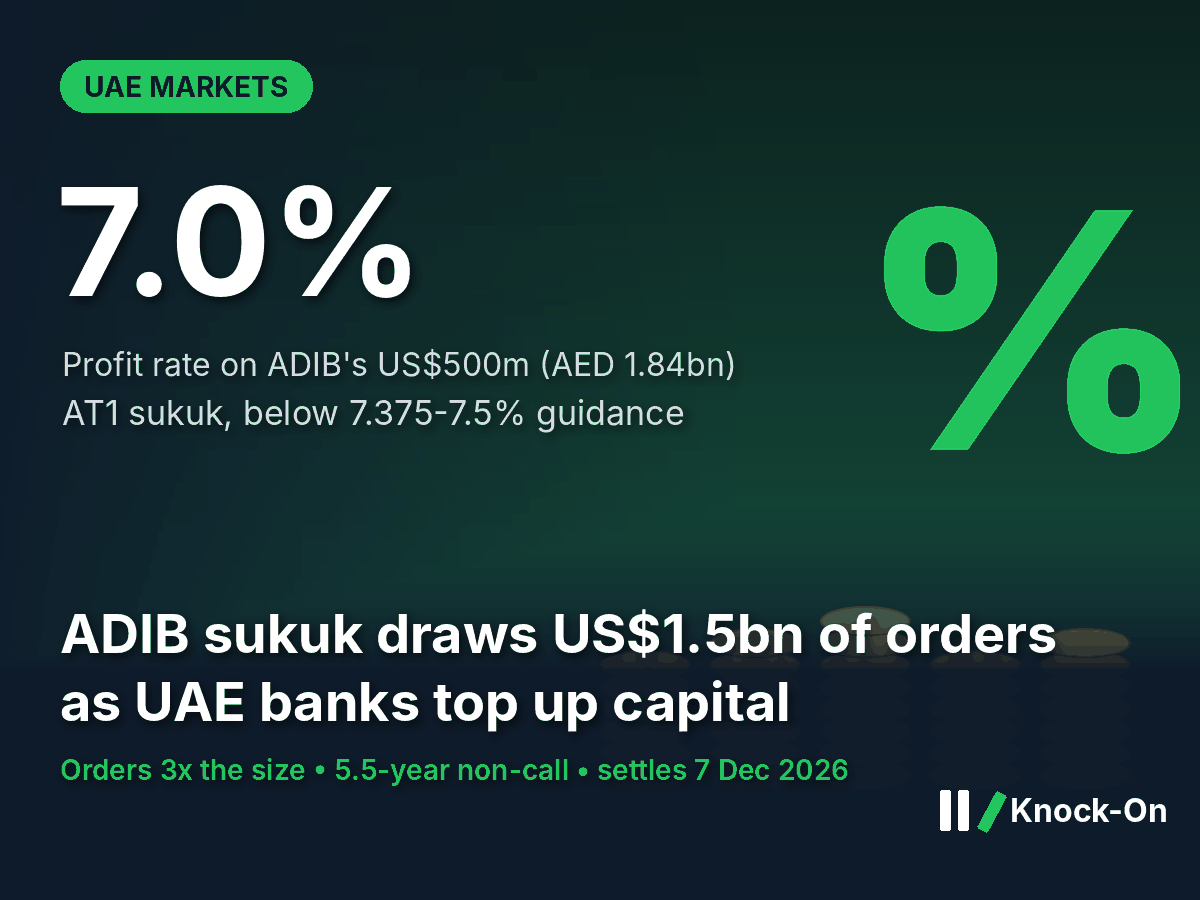
The ADIB sukuk priced on 26 November raised US$500m (about AED 1.84bn) of perpetual additional tier 1 (AT1) capital for Abu Dhabi Islamic Bank at a 7% annual profit rate, with investor orders of more than US$1.5bn. Coming straight after the bank’s AED 1.75bn rights issue on the Abu Dhabi Securities Exchange (ADX), the deal adds about AED 3.6bn of fresh capital in a month. For UAE businesses and households, that capital is what lets a bank keep growing its lending.
The short version
- ADIB sold a US$500m AT1 perpetual sukuk at a 7% profit rate, paid twice a year, with a five-and-a-half-year non-call period.
- Orders topped US$1.5bn (about AED 5.51bn), and pricing was tightened by 37.5 to 50 basis points from initial guidance of 7.375–7.5%.
- The bank raised AED 1.75bn through a rights issue that ran from 4 to 16 November.
- ADCB raised US$700m through an AT1 bond the week before: UAE banks are building capital buffers.
What happened
ADIB priced the US dollar AT1 sukuk at par with a fixed 7% profit rate, a spread of 233.5 basis points over the benchmark, Funds Global MENA reported. The certificates are unrated, settle on 7 December 2026 and are listed on the London Stock Exchange’s International Securities Market. Orders exceeded US$1.5bn excluding interest from the joint lead managers, making the deal more than three times oversubscribed, Khaleej Times reported. ADIB is rated A2 by Moody’s and A+ by Fitch.
The bank said the issue, together with its rights issue, forms part of its broader capital strategy. The rights issue offered 106.4 million new shares at AED 16.45 each. ADIB’s chief executive, Mohamed Abdelbary, said the demand reflected “the confidence investors have in ADIB’s strategy”, according to Khaleej Times. MEED reported that Abu Dhabi Commercial Bank raised US$700m through an AT1 perpetual bond on 20 November. Dirham figures here use the Central Bank of the UAE’s fixed rate of AED 3.6725 per US dollar.
ADIB sukuk orders were three times the amount raised
Bank capital raised and sukuk orders, November 2026, AED bn
Why it matters
AT1 capital is permanent, loss-absorbing money that counts towards a bank’s Tier 1 capital ratio under Basel III rules. More capital lets a bank grow its loan book while staying within regulatory limits. The cost is high: at 7%, ADIB will pay about US$35m (about AED 128.5m) a year in profit to holders (Knock-On calculation). Strong demand saved money too: tightening the rate by 37.5 to 50 basis points is worth roughly AED 6.9m to AED 9.2m a year on US$500m (Knock-On calculation). This follows other moves to strengthen Islamic banking in the UAE, including the planned DIB and Emirates Islamic merger.
The knock-on effects
First order: more room to lend
ADIB said the money supports its expansion. With about AED 318bn of total assets at 30 September, according to Khaleej Times, extra Tier 1 capital gives it room to grow Islamic home, car and business finance.
Second order: a pricing marker for other UAE banks
Two large Abu Dhabi lenders have tapped the AT1 market within a week. The 7% rate becomes a reference for other UAE banks planning capital issues, and heavy demand suggests international investors remain willing to fund UAE lenders, which also sit high in global bank safety rankings.
Third order: shareholders share the bill
AT1 profit payments come out of earnings before ordinary shareholders, and the rights issue added 106.4 million shares. Investors on ADX will judge whether faster growth outweighs the higher capital cost.
Who could benefit
- Borrowers seeking Islamic finance, as banks with more capital can lend more.
- The arranging banks, including FAB, ADCB, Emirates NBD Capital, Mashreq and Sharjah Islamic Bank, which earn fees.
- Sukuk investors seeking a fixed 7% dollar income from a highly rated issuer.
Who may face pressure
- ADIB shareholders who did not take up rights, as their stake is diluted.
- Smaller UAE lenders, which may pay more than 7% for similar capital.
- ADIB’s earnings per share, which carry about AED 128.5m a year of AT1 profit costs (Knock-On calculation).
What to watch
- 7 December 2026: settlement of the sukuk.
- ADIB’s full-year 2026 results, for the capital ratios after both raises and loan growth.
- Further AT1 or sukuk issues by UAE banks, and how their pricing compares with 7%. Follow UAE markets coverage.
- From 7 December 2031: ADIB’s first call window; the rate resets on 7 June 2032 if it is not called.
Sources
- Funds Global MENA, Abu Dhabi Islamic Bank prices $500m AT1 sukuk at 7%, 26 Nov 2026
- Khaleej Times via MENAFN, ADIB Raises $500M In AT1 Sukuk As Investor Demand Tops $1.5 Billion, 26 Nov 2026
- MEED, ADIB raises $500m in perpetual sukuk, 27 Nov 2026
- WAM, ADIB raises $500 million in US dollar-denominated tier-one perpetual sukuk, 26 Nov 2026
This is analysis, not investment advice. Figures are as of 27 November 2026.

Leave a Reply