
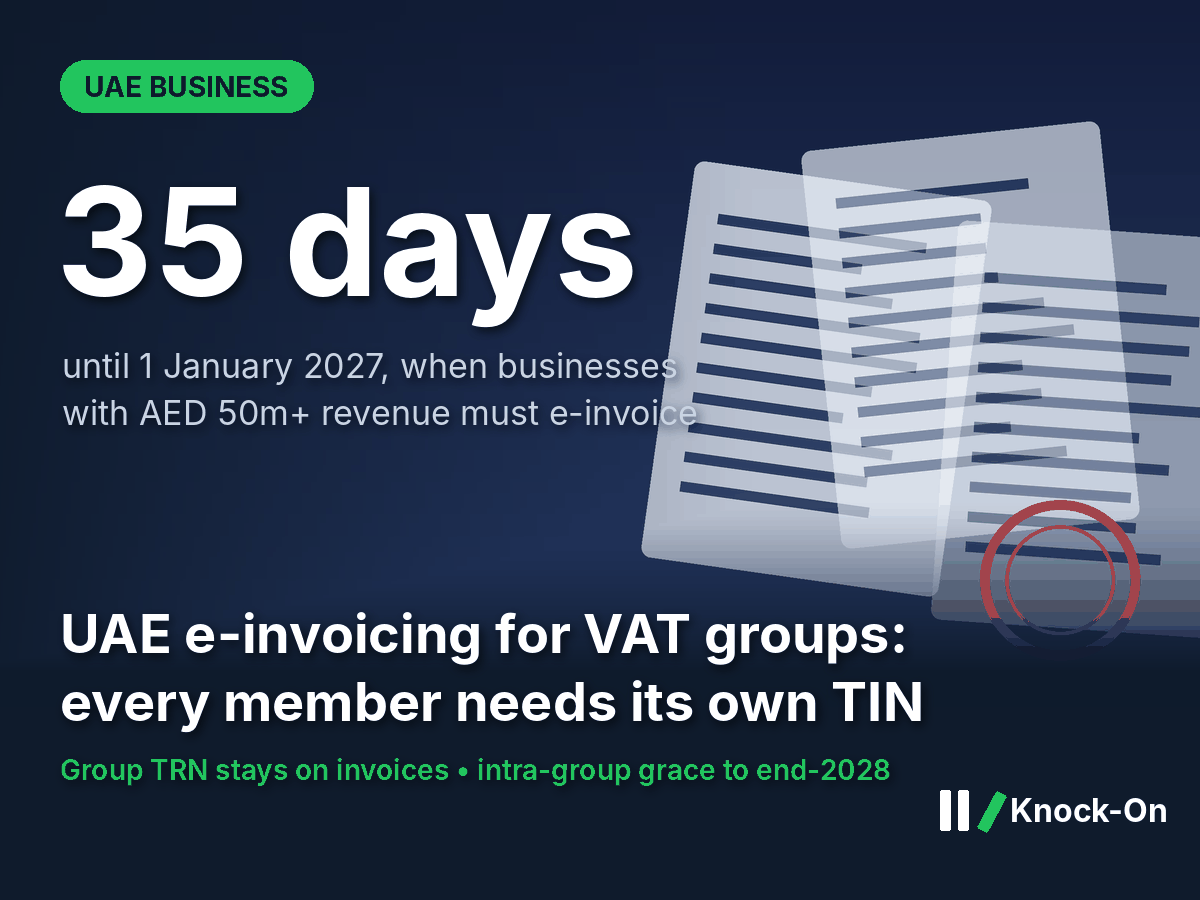
UAE e-invoicing for VAT groups is more work than many finance teams expected. Guidance from the Ministry of Finance and the Federal Tax Authority (FTA), set out by Gulf News on 27 November, makes clear that a group’s single tax registration number (TRN) does not replace each member’s own tax identification number (TIN). Every company in a VAT group needs its own TIN, its own e-invoicing endpoint and its own onboarding with an Accredited Service Provider. For groups whose members have AED 50m or more in revenue, the system goes live on 1 January 2027, 35 days from now.
The short version
- Each VAT-group member must use its own 10-digit TIN, not the first 10 digits of the group representative’s TRN.
- The group TRN still appears on invoices, but the endpoint must identify the member making the sale.
- Businesses with AED 50m+ revenue start on 1 January 2027; smaller ones appoint a provider by 31 March 2027 and start on 1 July 2027.
- Sales between members of the same VAT group get a grace period until 31 December 2028.
What happened
The UAE’s e-invoicing system rests on Ministerial Decision No. 243 of 2025 and Ministerial Decision No. 244 of 2025, with detailed guidelines published by the Ministry of Finance on 23 February 2026. Invoices are exchanged as structured data through the Peppol network via Accredited Service Providers (ASPs) and reported to the FTA. PDFs, scans and emails do not count as e-invoices.
For VAT groups, the Ministry’s guidance is that a member must use its own TIN, which generates its own Peppol participant identifier. KPMG’s summary of the guidelines puts it the same way: members “must use their own TIN and not the TIN of the tax group representative”. The FTA says the group TRN should still appear on an invoice issued by a member, but the invoice’s endpoint must identify the member, and members may choose different ASPs. A branch of the same legal entity uses the head office’s TIN, but must be registered in EmaraTax and show its own address and trade licence number on invoices.
The first e-invoicing deadline is 35 days away
Days remaining from 27 November 2026 to each e-invoicing date
Why it matters
Many UAE groups registered for VAT together to cut paperwork, filing one return for many companies. E-invoicing reverses part of that saving. A group with ten trading companies needs ten TINs confirmed in FTA records, ten endpoints and ten onboarding projects, even if it files one VAT return. Members that are in scope but not registered for a tax type in their own name must register through EmaraTax to obtain a TIN. The deadline for larger businesses to appoint an ASP was 30 October 2026, so groups that have not finished member-by-member setup are already behind. Penalties for non-compliance were capped at AED 50,000 a year earlier this month, but the 1 January date has not moved.
The knock-on effects
First order: a December rush for finance teams
Group finance teams must map each legal entity, confirm its TIN, separate branches from subsidiaries and test invoice data with their ASP before year-end, while the National Day holidays shorten December.
Second order: two invoices for some customers
Ministry guidance says a supplier may still need to issue a conventional tax invoice alongside the e-invoice when the customer is not yet on the system. Suppliers to smaller firms that start in July 2027 could run both processes for six months.
Third order: cleaner tax data
Once every member reports invoice-level data, the FTA sees each company’s sales in near real time. That may speed up refunds and audits, and it raises the cost of errors in master data. It follows other recent changes such as the VAT invoice rules for vending machines.
Who could benefit
- Accredited Service Providers, who sign more endpoints per client.
- Tax advisers and ERP integrators, who handle entity mapping and testing.
- Groups that prepared early, who avoid rushed fixes and missed invoices.
Who may face pressure
- Large family and holding groups with many small subsidiaries in one VAT group.
- Businesses that are not VAT-registered but sell to other businesses, which still need a TIN.
- Shared-service centres that issue invoices for several group companies.
What to watch
- 1 January 2027: e-invoicing starts for businesses with AED 50m or more in revenue; the intra-group grace period begins.
- 31 March 2027: smaller businesses must appoint an ASP.
- 1 July 2027: go-live for businesses below AED 50m.
- Any further FTA clarifications or guideline updates before year-end.
More on UAE tax for business: UAE corporate tax revenue rises to AED 46.5bn and the UAE business section.
Sources
- Gulf News, UAE e-invoicing: Does a group TRN replace subsidiaries’ TINs? What rules reveal, 27 Nov 2026
- EY Global Tax News, UAE Ministry of Finance releases e-invoicing guidelines, 25 Feb 2026
- KPMG, UAE Electronic Invoicing: Ministry of Finance issues detailed implementation guidelines, 2026
- UAE Ministry of Finance, UAE Electronic Invoicing Guidelines, 23 Feb 2026
This is analysis, not investment advice. Figures are as of 27 November 2026.


Leave a Reply