
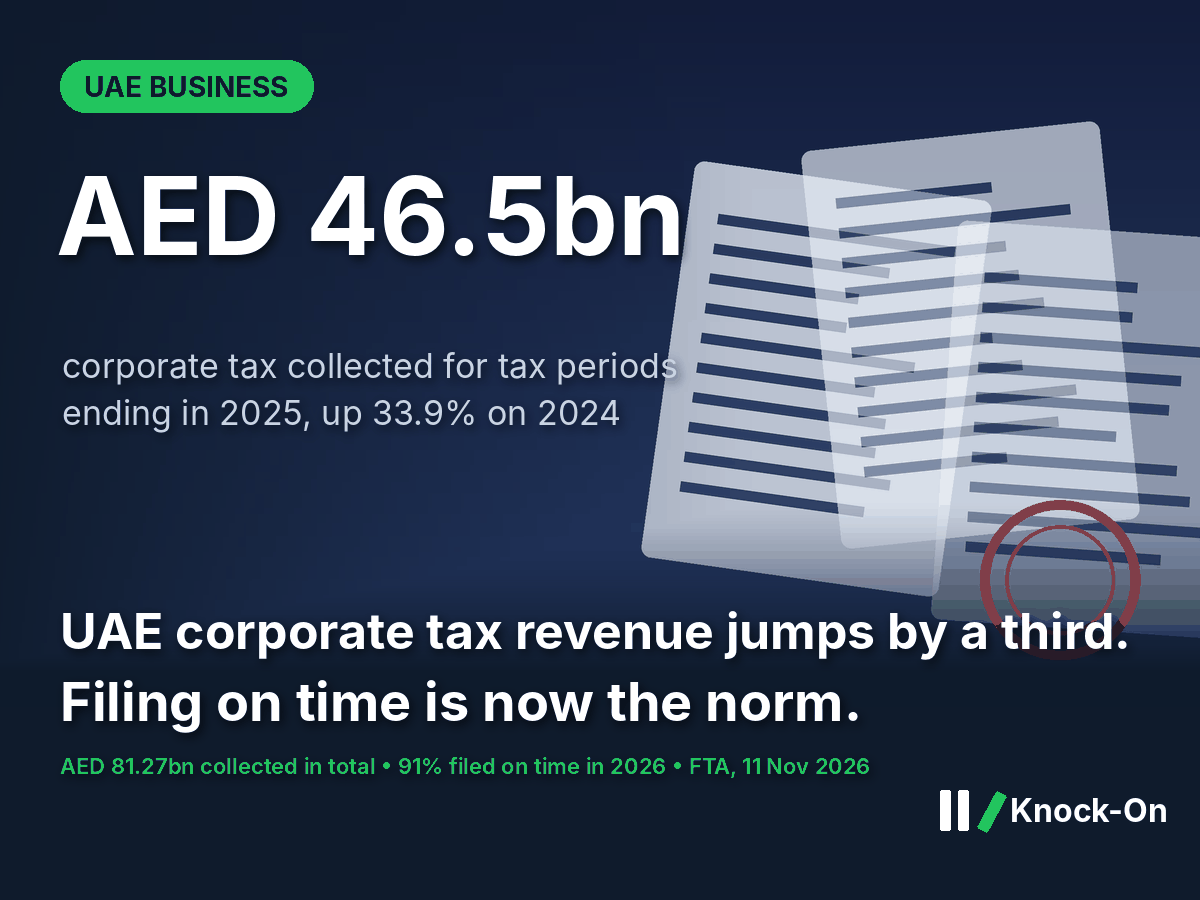
UAE corporate tax revenue rose by almost a third to about AED 46.52bn for tax periods ending in 2025, the Federal Tax Authority (FTA) said on 11 November. For businesses in the UAE, the figure confirms that the 9% federal corporate tax is now a settled part of the cost base, and that the FTA expects returns and payments to arrive on time.
The short version
- Corporate tax collected for tax periods ending in 2025 was about AED 46.52bn, up 33.9% from AED 34.75bn a year earlier.
- Total corporate tax collected since the tax was introduced reached AED 81.27bn by the end of 2025.
- The corporate tax filing rate rose to 91% in 2026 from 87% in 2025; on-time payment stands at 97%.
- VAT for January to August 2026 came to about AED 28.27bn and excise tax to AED 1.4bn.
What happened
In a statement reported by Khaleej Times and The National, the FTA said corporate tax collected for tax periods ending in the 2025 financial year was approximately AED 46.52bn. That compares with AED 34.75bn for periods ending in 2024. Since the tax was introduced, collections have reached AED 81.27bn.
The tax applies to financial years starting on or after 1 June 2023, at 0% on taxable profits up to AED 375,000 and 9% above that. For most companies with a calendar financial year, 2024 was the first taxed year, and the return for the year ended 31 December 2025 was due by 30 September 2026, according to the FTA.
Corporate tax collections rose by a third in the second full year
Corporate tax collected for tax periods ending in each financial year, AED bn (approximate), FTA, 11 Nov 2026
The FTA also reported compliance rates. VAT timely filing rose to 83% in 2026 from 81%, with 98% of VAT paid on time. Excise return filing rose to 92% from 91%, with 98% paid on time. Abdulaziz Al Mulla, the FTA’s director general, said compliance had “improved significantly, supported by greater awareness and a stronger tax culture”.
Why it matters
UAE corporate tax revenue growing by a third in one year tells businesses two things. First, more companies are registering, filing and paying, so the tax is now part of normal financial planning rather than a new project. Second, with nine in ten corporate tax returns now filed and almost all payments made on time, a late or incomplete return stands out more. Companies that still treat tax as a year-end task are now in a shrinking minority.
The figures arrive as finance teams prepare for other changes, including the rules on recovering VAT on employee expenses and the e-invoicing deadline and penalty cap from 1 January.
The knock-on effects
First order: tax is a fixed line in budgets
Companies above the AED 375,000 threshold now plan for 9% of taxable profit each year. Pricing, dividend plans and cash buffers need to allow for the payment, which for calendar-year firms falls nine months after year end.
Second order: demand for tax and accounting skills
Higher filing rates mean more returns, more transfer-pricing files and more audited accounts. Accounting firms, tax advisers and finance software providers have a larger, recurring client base, and in-house finance roles carry more weight.
Third order: better records, easier finance
Firms with clean, filed accounts may find it easier to raise loans, attract investors or sell the business, because lenders and buyers can rely on tax-filed numbers. Over time, this could reward well-run small and mid-sized companies.
Who could benefit
- Accountants and tax advisers: recurring annual work on corporate tax, VAT and e-invoicing.
- Finance software providers: demand for systems that link bookkeeping, VAT and corporate tax returns.
- Compliant companies: filed accounts that lenders and investors can trust.
Who may face pressure
- Late filers: the minority still missing deadlines risks penalties.
- Small firms near the AED 375,000 threshold: extra bookkeeping cost relative to their size.
- Lean finance teams: corporate tax, VAT changes and e-invoicing all land within months of each other.
What to watch
- 16 November 2026: final date for excise tax returns listed by the FTA.
- 30 November 2026: final date for VAT returns listed by the FTA.
- 1 January 2027: the e-invoicing deadline for UAE businesses.
- Full-year 2026 figures: whether VAT and excise collections keep pace with corporate tax. More UAE tax news is in UAE Business.
Sources
- Khaleej Times, UAE Corporate Tax revenue jumps 33.9% to Dh46.52 billion in 2025, 11 November 2026
- The National, UAE corporate tax revenue jumps by a third to Dh46.5bn in 2025, 11 November 2026
- Federal Tax Authority, 30 September 2026 is the deadline for filing Tax Returns and paying Corporate Tax for the financial year ended 31 December 2025, 26 September 2026
- Federal Tax Authority, Corporate Tax news and announcements, accessed 11 November 2026
This is analysis, not investment advice. Figures are as of 11 November 2026.



Leave a Reply