
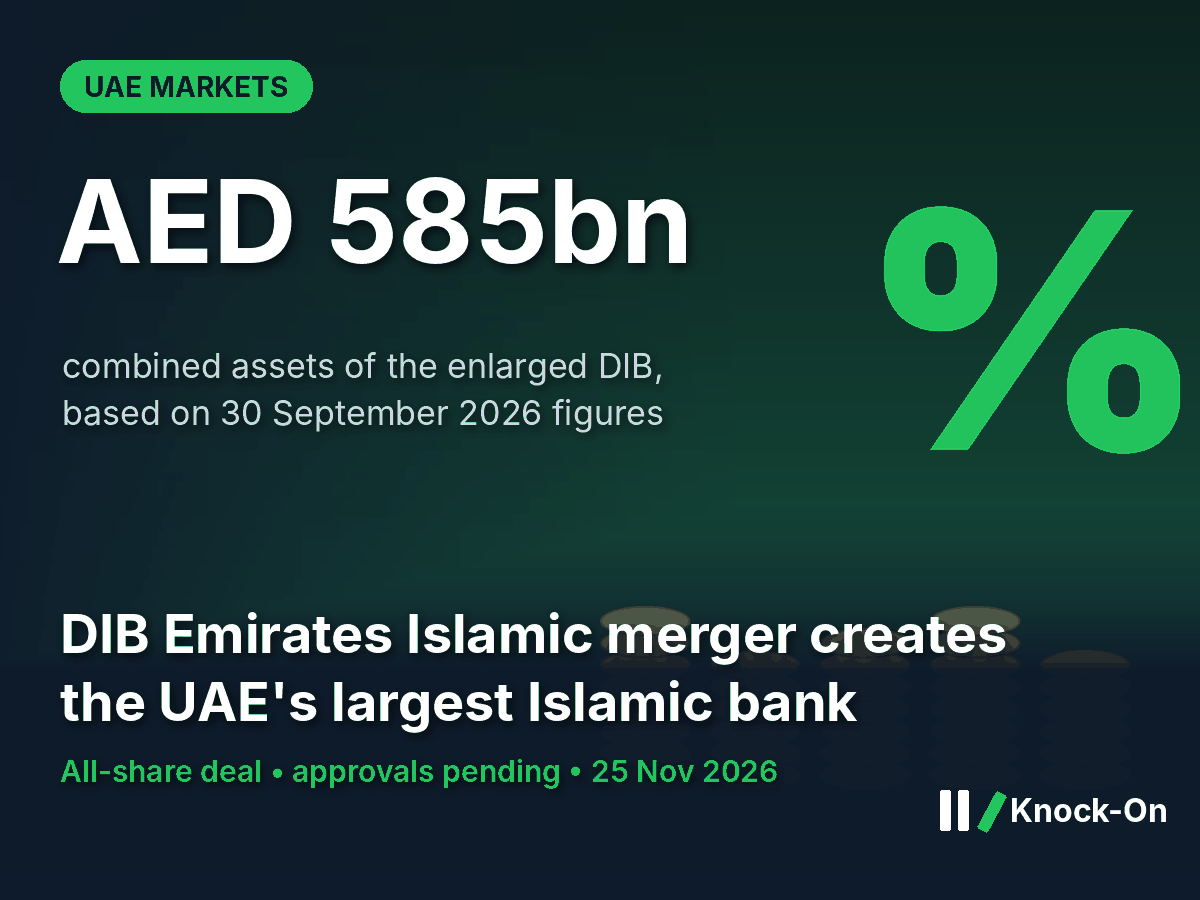
The DIB Emirates Islamic merger will bring two of Dubai’s best-known Sharia-compliant lenders under one roof. Dubai Islamic Bank (DIB) has agreed to buy 100% of Emirates Islamic from Emirates NBD and will pay entirely in new DIB shares, the banks said on Wednesday 25 November. Based on 30 September figures, the enlarged DIB would hold about AED 585bn in assets, making it the largest Islamic banking group in the UAE. For companies, savers and investors, the deal points to a bigger balance sheet, a reshaped branch network and a new major shareholder in one of the DFM’s largest stocks.
The short version
- DIB will acquire all of Emirates Islamic from Emirates NBD in an all-share deal; no cash changes hands.
- The combined group would have about AED 585bn (US$159bn) in assets, about 37% more than DIB alone (Knock-On calculation).
- Emirates NBD becomes a significant strategic shareholder in DIB.
- The deal still needs DIB shareholders, the Central Bank of the UAE and the Capital Market Authority to approve it. No completion date or value has been given.
What happened
Both boards approved a share purchase agreement under which DIB will buy the whole of Emirates Islamic, a wholly owned subsidiary of Emirates NBD, Khaleej Times reported. The price will be paid in new ordinary DIB shares issued to Emirates NBD. Gulf News reported that the joint statement did not give the transaction value or a target closing date, and that DIB will publish shareholder documents “in due course”.
The banks estimate the enlarged DIB would be the second-largest listed Islamic banking group in the world by assets. The AED 585bn figure is based on unaudited 30 September numbers and excludes deal adjustments. Emirates Islamic, founded in 2004, runs 36 branches and 213 ATMs and cash deposit machines in the UAE. DIB has done this before: it completed its purchase of Noor Bank in 2020.
The market moved before the announcement. On Monday 23 November, after DIB told the DFM its board would meet to evaluate a strategic acquisition, its shares rose more than 11%, and as much as 14.8% during the session, Aletihad reported. The DFM General Index rose 1.3% that day to 6,306.87. Emirates NBD slipped 0.8%.
Emirates Islamic would make DIB about 37% bigger
Total assets, AED bn, as at 30 September 2026
Why it matters
UAE banks are growing fast. Lending rose 17.3% in a year to AED 2.9tn by the third quarter, as we covered in our look at UAE bank lending and deposits. Size matters in that race: a bigger balance sheet lets a bank take larger single exposures, join bigger syndicated and sukuk deals, and spread technology costs across more customers. The banks say they expect savings from shared infrastructure, branch changes and simpler operations, though they gave no target. A larger deposit base is also expected to lower funding costs and support the financing margin.
The all-share structure means DIB does not need to raise cash. The trade-off is dilution for existing DIB shareholders, whose exact size will only be clear once the shareholder documents are published.
The knock-on effects
First order: shareholders and the DFM
DIB shareholders will vote on the deal and on the new share issue. Emirates NBD moves from owning a subsidiary outright to holding a large stake in a listed bank, which changes how it reports Islamic banking. Index weights on the DFM may shift once the new shares are issued.
Second order: customers and suppliers
Emirates Islamic’s personal and business customers face no immediate change, but integration usually brings new account systems, cards, apps and branch moves. Companies with facilities at both banks may see their combined limits reviewed. Technology vendors, fit-out firms and outsourcing providers could see contracts consolidated.
Third order: competition
A single larger Islamic lender may compete harder for big corporate and government-related financing and for retail deposits. Rival Islamic banks and Islamic windows of conventional banks may need to sharpen pricing. The deal adds to a busy year for UAE banks, which also features strong safety rankings for UAE lenders.
Who could benefit
- Large corporate borrowers seeking Sharia-compliant financing from a single, bigger balance sheet.
- Emirates NBD, which gains a stake in a larger listed bank without a cash sale.
- Advisers and integration specialists: Merrill Lynch International advises DIB and J.P. Morgan Securities advises Emirates NBD.
Who may face pressure
- Existing DIB shareholders, through dilution from the new shares.
- Smaller Islamic lenders competing with a much larger rival for deposits and corporate business.
- Staff and suppliers in overlapping branch, back-office and technology functions.
What to watch
- DIB’s shareholder circular and general assembly date, which will set out the share issue and terms (date not yet announced).
- Approvals from the Central Bank of the UAE, the Capital Market Authority and other authorities.
- DIB and Emirates NBD trading on the DFM from Thursday 26 November, the first full session after the announcement. Our UAE stocks outlook sets out how brokers view the banks.
- Any statement on the Emirates Islamic brand and customer migration.
Sources
- Gulf News, Dubai Islamic Bank to acquire Emirates Islamic in landmark all-share deal, 25 November 2026
- Khaleej Times, Dubai Islamic Bank to buy Emirates Islamic in all-share deal, 25 November 2026
- Aletihad, DIB jumps 11%, lifts DFM amid reports of acquisition talks, 23 November 2026
- Enterprise AM, Dubai weighs folding Emirates Islamic into DIB to create a USD 159 bn Islamic lender, 24 November 2026
This is analysis, not investment advice. Figures are as of 26 November 2026.

Leave a Reply