
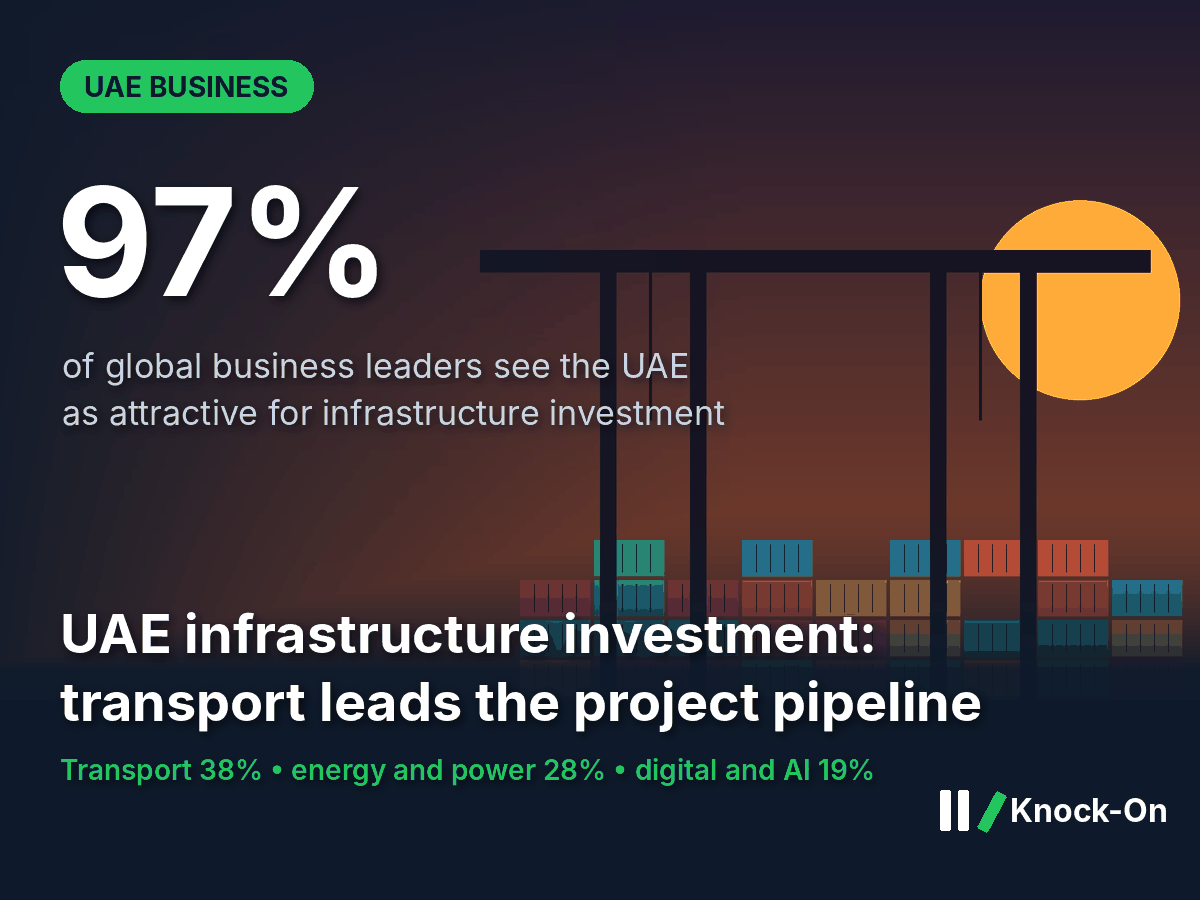
UAE infrastructure investment has strong backing from international business, according to a new HSBC survey: 97% of global business leaders say the UAE is an attractive place to invest in infrastructure over the next four years. For contractors, engineers, equipment suppliers and banks in the UAE, the more useful finding is a warning. Most UAE executives now expect the capacity to deliver projects, not access to money, to be the main constraint.
The short version
- 97% of business leaders surveyed by HSBC rate the UAE attractive for infrastructure investment over the next four years.
- 71% of business leaders and 66% of institutional investors are putting approved or expected infrastructure spending into the UAE for 2026–2028.
- Transport makes up 38% of the UAE’s unawarded project packages, ahead of energy and power at 28%.
- 92% of UAE business leaders expect execution capacity to be a bigger constraint than finance.
What happened
HSBC published “New Networks of Capital: MENAT Infrastructure”, Gulf News reported on 25 November. It is based on a survey of 1,626 senior business leaders and 818 institutional investors in 16 markets, including India, the US, China and the UK, carried out between 18 September and 5 October 2026, according to HSBC-commissioned analysis published by MEED. It also reviews about 4,500 projects in seven markets across the Middle East, North Africa and Türkiye (MENAT).
The region’s pipeline of individual infrastructure packages is worth US$872bn (about AED 3.2tn at the fixed rate of AED 3.6725 to the dollar; Knock-On calculation), and the UAE accounts for about 22% of the regional project finance pipeline. Among business leaders, 75% of those from Europe and 72% from Asia are directing infrastructure spending to the UAE. “Global businesses see a clear and growing infrastructure opportunity in the UAE,” said Mohamed Al Marzooqi, Chief Executive Officer, UAE, HSBC Bank Middle East.
Transport leads the UAE’s unawarded infrastructure work
Share of UAE unawarded individual project packages by sector, %, HSBC analysis, November 2026
Why it matters
The survey suggests the money is lining up. HSBC’s figures show 96% of business leaders and investors expect MENAT to have more capital than investment-ready projects by 2030. That changes the question for UAE firms from “will this be funded?” to “who can build it on time?” Businesses told HSBC they want better risk-sharing, faster permitting and clearer regulation; investors want larger, scalable projects and better reporting on returns.
Transport is the biggest slice of upcoming work, which fits projects already in motion, such as the long-term plans for Al Maktoum airport city terminals and the Dubai air taxi vertiport network.
The knock-on effects
First order: contractors and engineers
If 92% of UAE executives are right that delivery capacity is the bottleneck, firms with proven project teams, local supply chains and good safety and delivery records will have pricing power when packages are awarded.
Second order: talent and materials
Competition for project managers, engineers and skilled trades could push up wage costs. Suppliers of steel, cement, cabling, cooling and data-centre equipment may see firmer demand, especially for the 19% of packages in digital and AI infrastructure.
Third order: banks and capital markets
HSBC-commissioned analysis estimates about US$390bn of the regional packages would likely need third-party financing if awarded. That is work for UAE banks, sukuk and bond arrangers, and infrastructure funds based in DIFC and ADGM.
Who could benefit
- Transport contractors and engineering consultants, given the 38% transport share.
- Power, data-centre and water-technology suppliers, which together cover most of the rest of the pipeline.
- Project-finance banks and advisers arranging loans, bonds and sukuk.
Who may face pressure
- Smaller contractors competing for scarce engineers and site staff.
- Private developers facing higher build costs if public projects absorb capacity.
- Investors seeking quick deployment, if investment-ready projects stay scarcer than capital.
What to watch
- Award announcements for transport and power packages over the coming months, which will test the survey’s optimism.
- Any changes to permitting or public-private partnership rules, the reforms businesses asked for.
- The wider economic backdrop: the IMF’s UAE GDP growth forecast sees 0.2% in 2026 and 7.3% in 2027.
Sources
- Gulf News, 97% of global business leaders see UAE as attractive for infrastructure investment, 25 November 2026
- MEED (HSBC-commissioned), Strong investor confidence in Menat’s $872bn infrastructure market, 26 October 2026
This is analysis, not investment advice. Survey figures are HSBC’s. Figures are as of 26 November 2026.

Leave a Reply