
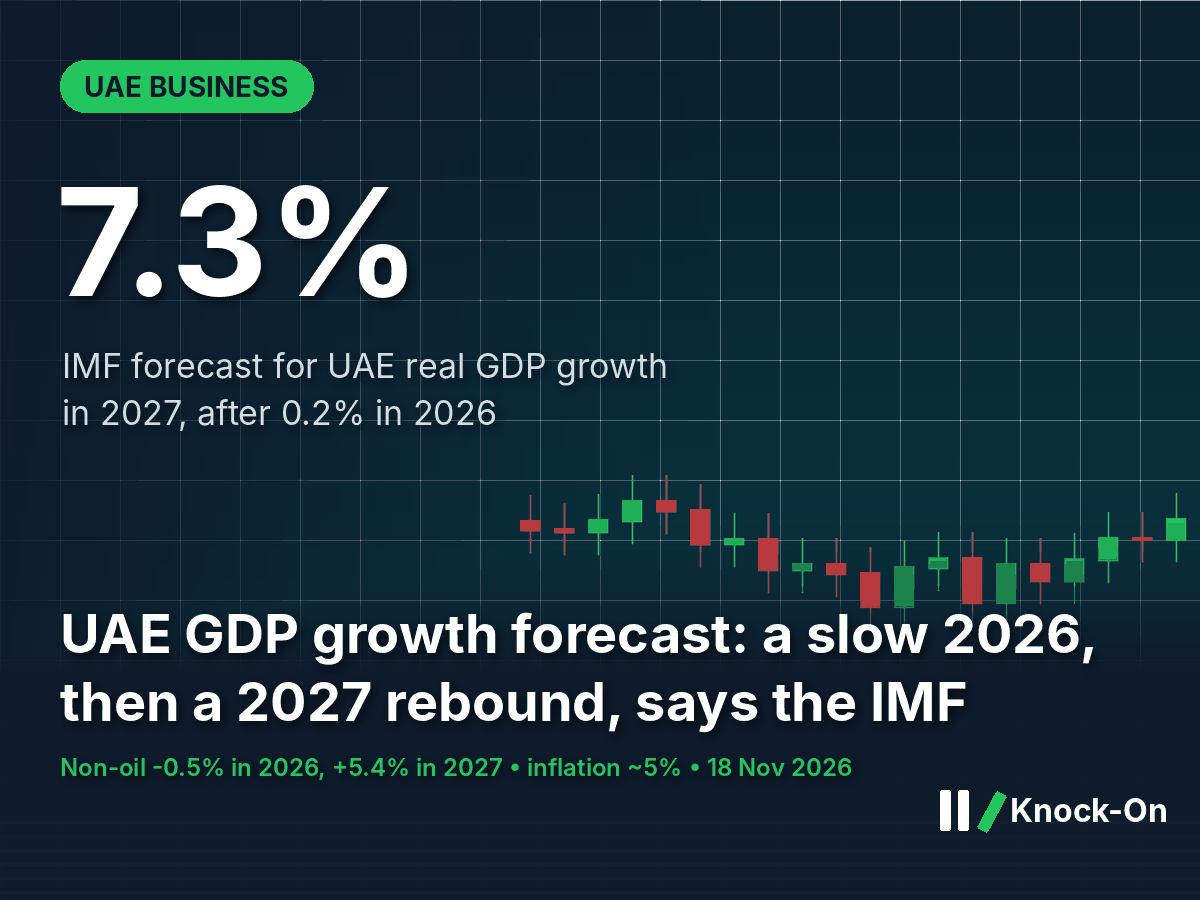
The latest UAE GDP growth forecast from the International Monetary Fund points to a near-flat 2026 followed by a sharp rebound in 2027. IMF staff, ending their 2026 Article IV mission on 17 November, projected real growth of 0.2% this year and 7.3% next year, on the assumption that regional disruptions are lifted. For businesses in the UAE, the message is that 2026 budgets should stay cautious, while 2027 plans can be built around a recovery led by oil, trade, aviation and tourism.
The short version
- The IMF sees UAE real GDP growth of 0.2% in 2026 and 7.3% in 2027.
- Non-oil growth is projected at -0.5% in 2026, recovering to 5.4% in 2027.
- Inflation is expected to average about 5% in 2026, ease to about 3% in 2027 and move towards 2% over the medium term.
- The 2026 figure is a big upgrade on the 3.9% contraction the IMF projected in October.
What happened
An IMF team led by Said Bakhache visited the UAE from 3 to 17 November for the annual Article IV consultation, and published its end-of-mission statement on 18 November. According to the statement, as republished by Mirage News, real GDP growth is projected at 0.2% in 2026 before rising to 7.3% in 2027. Hydrocarbon growth is expected at 2.3% in 2026 and 13.3% in 2027, while the non-hydrocarbon economy is forecast to shrink by 0.5% this year before growing 5.4% next year.
The IMF sees a flat 2026 and a strong 2027 for the UAE
IMF real growth projections, % a year, published 18 Nov 2026
The new 2026 projection is a marked improvement on the 3.9% contraction the IMF projected in October, The National reported. Mr Bakhache said the economy had shown “strong resilience to regional disruptions”, helped by public-sector and external buffers, a well-capitalised banking system and targeted fiscal and financial-sector measures. Gulf News noted that UAE banking assets exceeded AED 5.815tn at the end of September, according to the Central Bank of the UAE.
Why it matters
The split between oil and non-oil activity is the key point for most companies. Oil output is recovering first, but the non-oil economy, where retailers, hotels, airlines, logistics firms and professional services earn their money, is projected to contract slightly this year. The IMF also expects inflation of about 5% in 2026, so costs are rising while demand is soft. That combination squeezes margins, as Dubai’s 5.5% October inflation and 9.1% rise in food prices already show.
Inflation is expected to cool from about 5% towards 2%
IMF UAE inflation projections, average % a year, 18 Nov 2026
The knock-on effects
First order: a slow finish to 2026
With non-oil output forecast to dip, consumer-facing businesses should expect flat volumes for the rest of the year. Finance teams setting 2026 year-end targets may need to lean on cost control rather than sales growth, especially where imported goods are feeding higher prices.
Second order: lenders and landlords reprice risk
The IMF said banks remain resilient but advised close watch on funding, asset quality and real estate and construction exposures, given strong credit growth. With UAE bank lending up 17.3% in a year, borrowers may find banks asking more questions about cash flow. The IMF also said real estate activity has moderated from earlier peaks, with conditions varying by emirate and segment.
Third order: a 2027 recovery shapes hiring and investment
If the 7.3% projection holds, 2027 could bring a strong rebound in trade, aviation and tourism. Companies that keep staff and capacity through the slow months may be better placed to win business when demand returns. The IMF welcomed the UAE’s CEPA trade deals and alternative trade corridors, and encouraged reforms in skills, digital government, logistics and safe AI adoption.
Who could benefit
- Oil and gas suppliers: hydrocarbon growth of a projected 13.3% in 2027 points to more work for oilfield services and shipping.
- Airlines, hotels and travel firms: the IMF expects tourism and aviation to lead the recovery.
- Exporters and logistics firms: wider trade routes and CEPA partners support cross-border volumes.
Who may face pressure
- Retailers and restaurants: softer non-oil demand meets inflation of about 5%.
- Highly geared borrowers: banks are being urged to watch asset quality and sector exposures.
- Property developers in slower segments: the IMF says conditions vary by emirate and segment.
What to watch
- 8–9 December: the US Federal Reserve’s rate decision, which the Central Bank of the UAE usually follows.
- Coming months: whether regional disruptions ease as the IMF assumes; its 7.3% forecast for 2027 depends on it.
- Monthly: PMI and inflation data, for signs that non-oil activity is turning up. See also the Fitch UAE rating and growth outlook.
Sources
- IMF, IMF Staff Completes 2026 Article IV Mission to United Arab Emirates, 18 Nov 2026
- Mirage News, IMF Completes 2026 UAE Article IV Mission, 18 Nov 2026
- The National, UAE economy projected to expand 0.2% in 2026 as disruptions ease, IMF says, 18 Nov 2026
- Gulf News, UAE growth accelerating to 7.3% in 2027 as trade and tourism recover: IMF, 18 Nov 2026
This is analysis, not investment advice. Figures are as of 18 November 2026.

Leave a Reply