
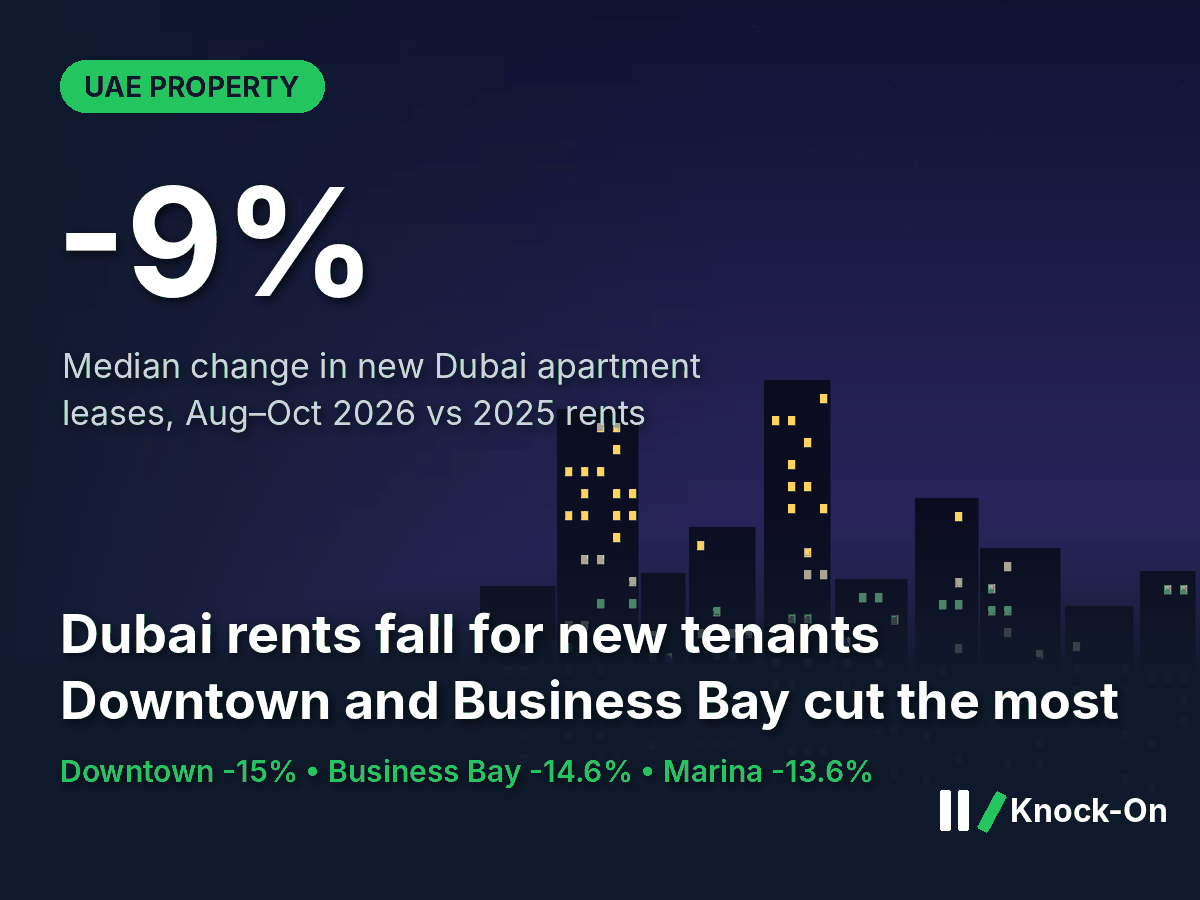
Dubai rents fall for tenants signing new leases: people who took a new apartment between August and October paid a median 9% less than the same home cost in 2025, according to an analysis of Dubai Land Department tenancy contracts by fäm Properties. For businesses in the UAE, the shift matters beyond housing. It changes what staff expect from housing allowances, what landlords and property funds can bank on, and how quickly tenants are willing to move.
The short version
- Some 73% of new apartment leases signed in August–October were below their 2025 level, up from 24% in January–March.
- The median change on new leases moved from +2.6% (Jan–Mar) to −5.5% (Apr–Jul) and −9.1% (Aug–Oct).
- Downtown Dubai (−15%), Business Bay (−14.6%) and Dubai Marina (−13.6%) saw the steepest cuts; International City was flat.
- Renewals held up: 44% were higher than last year and 37% unchanged. JLL says average rents in some areas fell 5.2% in the year to September.
What happened
fäm Properties studied 18,096 new apartment leases and 17,234 renewals registered with the Dubai Land Department from August to October 2026, comparing each unit with its 2025 rent, as reported by Construction World and Gulf News. The share of new leases priced below last year rose to 73% in that period, from 60% in April–July and 24% in January–March.
The biggest falls came in prime and well-supplied mid-market areas. Downtown Dubai led with a 15% drop on new leases, followed by Business Bay, Dubai Marina, Al Merkadh, JLT and JVC, all down more than 11%. More affordable districts moved far less: Dubai Sports City fell 6%, Discovery Gardens 4.7% and Dubai Silicon Oasis 1.9%, while International City was unchanged, with 46% of its new leases above 2025 levels.
Prime areas cut new-lease rents the most
Change in rent on new apartment leases, Aug–Oct 2026 vs the same units in 2025 (%)
JLL’s Living Market Dynamics report for the third quarter, cited by Gulf News, points the same way. It found average rents in certain areas of Dubai fell 5.2% in the 12 months to September, with apartments down 5.3% and villas down 3%. New lease registrations jumped 48.6% on the previous quarter and 13.7% on the year, while renewals grew only 2.4% year on year. JLL counted close to 14,000 new homes delivered in the third quarter and expects around 17,000 more in the fourth.
Why it matters
Early this year, new tenants were still paying more than the previous rent, with a median rise of 2.6% in January–March. That has now reversed for many apartment renters: moving can save money, while most renewals are flat or rising. Rental activity remains high — fäm counts 339,557 freehold rental contracts in the first ten months of 2026, 6.8% more than a year earlier, a trend we covered in Dubai rental contracts reaching a record pace. What has changed is the price. As a Knock-On calculation, a 9% cut on an AED 100,000 annual lease saves a tenant AED 9,000 a year.
The knock-on effects
First order: tenants gain bargaining power
Tenants whose renewal is above market can now point to cheaper new leases nearby. Landlords in Downtown, Business Bay and Dubai Marina face the most pressure to hold rents or offer incentives such as more cheques or a rent-free period.
Second order: yields and housing costs adjust
Lower rents squeeze gross yields for investors who bought at higher prices, at a time when Dubai price per sq ft is at a four-year high. For employers, housing allowances set in 2024 or 2025 now stretch further in prime areas, which may ease salary pressure for some roles.
Third order: more supply tests the market in 2027
With about 17,000 more homes expected in the fourth quarter, the gap between new-lease and renewal rents may widen further. fäm’s chief executive, Firas Al Msaddi, said the market “has shifted significantly during 2026, and we expect it to continue changing through 2027.”
Who could benefit
- Tenants moving home in prime and mid-market districts, who can lock in lower rents.
- Employers housing staff, whose allowances and company leases go further.
- Moving, furnishing and relocation firms, as more tenants switch homes to cut costs.
- Brokers and leasing agents, who earn fees on each new contract.
Who may face pressure
- Buy-to-let investors with high purchase prices and thin yields.
- Landlords in Downtown, Business Bay and Dubai Marina, where the falls are steepest.
- Developers handing over new units, whose buyers will compete for tenants.
What to watch
- Fourth-quarter handovers (JLL expects about 17,000 units) and whether new-lease rents fall further.
- Dubai Land Department rental data for November and December, and whether renewals start to soften.
- ValuStrat and other price indices for November, which will show whether sale prices follow rents; see our October Dubai property prices report.
- Dubai’s November inflation figures, due in December, for any easing in housing costs.
Sources
- Construction World, Dubai new apartment rents fall 9 per cent as renewals hold steady, 24 Nov 2026
- Gulf News, Dubai tenants are switching homes to cut rent, but where are they moving?, 25 Nov 2026
- Travel And Tour World, Dubai rental market sees major shakeup as rents fall by 15 percent, 25 Nov 2026
This is analysis, not investment advice. Figures are as of 25 November 2026.


Leave a Reply