
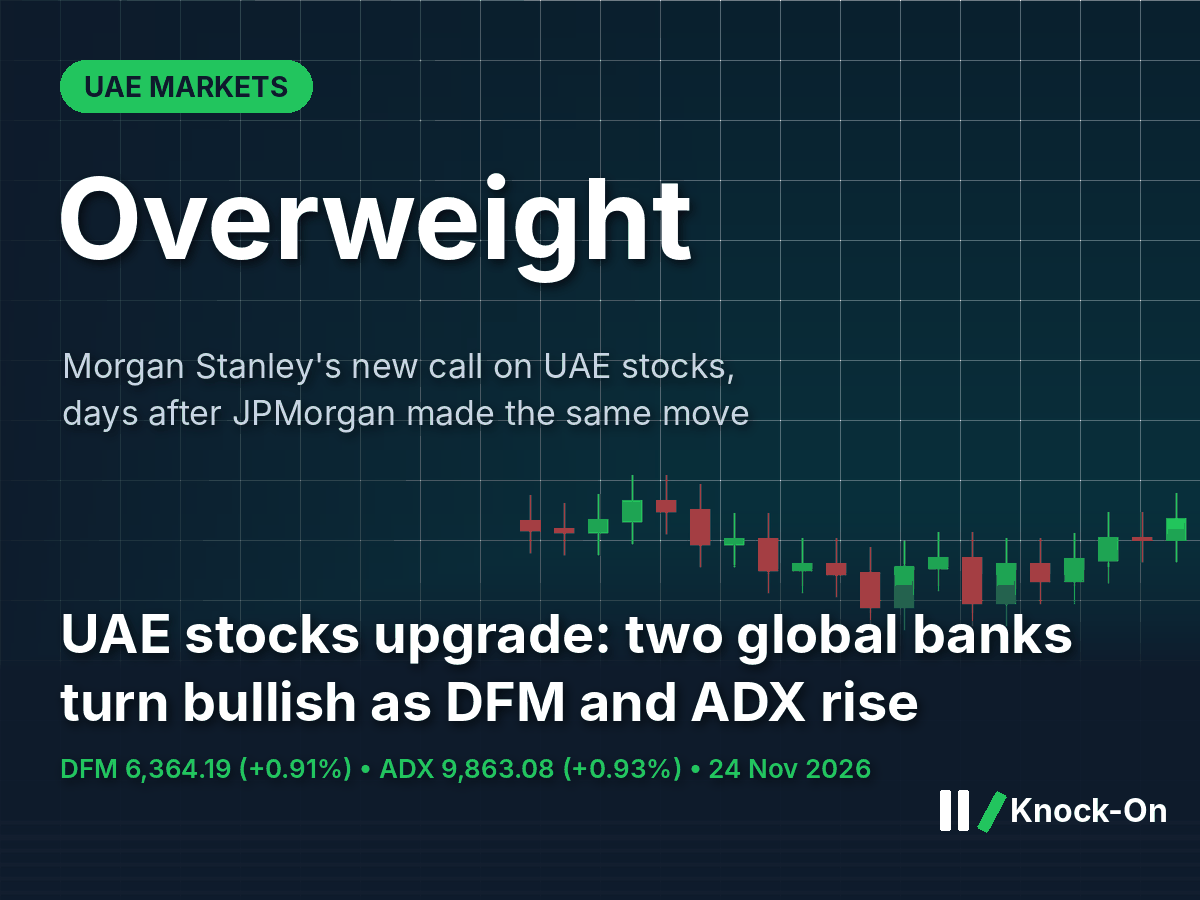
A UAE stocks upgrade from a second global bank in a week has put Dubai and Abu Dhabi shares back on international fund managers’ buy lists. Morgan Stanley moved UAE equities to “overweight” from “equal-weight” on 23 November, days after JPMorgan lifted its MSCI UAE view to “overweight”. For listed companies, brokers and banks in the UAE, the change matters less for one day’s trading than for where foreign money may flow in 2027.
The short version
- Morgan Stanley upgraded UAE equities to overweight on 23 November, following JPMorgan’s upgrade of the MSCI UAE index the week before.
- It named financials as its preferred sector, picking Abu Dhabi Commercial Bank, Abu Dhabi Islamic Bank and First Abu Dhabi Bank.
- The DFM General Index closed 0.91% higher at 6,364.19 and the FTSE ADX General Index rose 0.93% to 9,863.08 on 24 November.
- The calls rest on a recovery the IMF also sees: 0.2% growth for 2026, rising to a forecast 7.3% in 2027.
What happened
Reuters reported on 23 November that Morgan Stanley had raised its rating on UAE equities to “overweight” from “equal-weight”. The bank pointed to Abu Dhabi’s expanding energy production capacity and its multi-year capital spending programme, and to population growth, traffic volumes, tourism and rental trends in Dubai as signs of recovery. “Improving conditions and undemanding valuations point to asymmetric risk-reward,” Morgan Stanley said, according to Reuters. Within the Middle East and North Africa it now favours the UAE and Egypt.
Its preferred sector is financials, with Abu Dhabi Commercial Bank, Abu Dhabi Islamic Bank and First Abu Dhabi Bank named as picks, according to both Reuters and The National. The move follows JPMorgan, which last week lifted the MSCI UAE index to “overweight” from “neutral”, citing what it called the economy’s “impressive” resilience, The National reported.
Local markets were firmer a day later. On Tuesday 24 November the DFM General Index rose 0.91% to close at 6,364.19, and the FTSE ADX General Index gained 0.93% to 9,863.08, according to Business Upturn’s market report, which said no single catalyst was immediately identifiable for the advance.
Why it matters
Large global funds that track emerging-market benchmarks often take their country allocations from strategist calls like these. An overweight rating tells clients to hold more UAE stocks than the benchmark weight. Two such calls in one week raise the chance of steadier foreign buying on DFM and ADX, which supports share prices, trading volumes and the appetite for new listings and bond issues.
The banks’ case rests on the same turn in the economy that the IMF described this month. As Knock-On reported, the IMF’s UAE GDP growth forecast now sees 0.2% growth in 2026, up from a 3.9% contraction it projected earlier, followed by 7.3% in 2027. Official data show GDP grew 0.4% to AED 961.9bn in the first half of 2026, with the non-oil share rising to 79.2%.
The growth outlook behind the upgrades has turned
IMF real GDP growth projections for the UAE, % (as reported November 2026)
The knock-on effects
First order: more foreign attention on UAE stocks
The most direct effect is on demand for large, liquid shares that international funds can buy easily, led by the Abu Dhabi banks Morgan Stanley named. Higher turnover also helps brokerages and the exchanges themselves, whose income rises with trading volumes.
Second order: cheaper capital for listed companies
Firmer share prices make it cheaper for companies to raise equity, whether through new listings, rights issues or share-based deals. Strong bank shares also support lenders’ capital positions, which matters after UAE bank lending rose 17.3% in a year.
Third order: confidence for business spending
If foreign inflows and higher valuations persist, they can feed wider confidence: wealth effects for local investors, more appetite for property and consumer spending, and an easier case for companies planning expansion in 2027. That depends on the recovery the banks describe actually arriving.
Who could benefit
- Large Abu Dhabi banks: named as Morgan Stanley’s preferred picks, they are the first port of call for foreign funds.
- Brokers and exchanges: higher trading volumes lift commission and fee income.
- Companies planning listings or capital raises: a stronger market improves pricing and demand.
- Dubai consumer and tourism firms: the rating change points to Dubai’s population and tourism trends, supporting their story with investors.
Who may face pressure
- Smaller, less liquid listed companies: foreign money tends to concentrate in index heavyweights, which can widen the gap in valuations.
- Investors buying late: broker upgrades can be priced in quickly, and markets can reverse if the outlook changes.
- Other regional markets: Morgan Stanley’s preference for the UAE and Egypt implies less weight elsewhere in the region.
What to watch
- Daily DFM and ADX closes this week: whether the index gains of 24 November hold, and whether foreign net buying shows up in exchange data.
- Bank results and filings: official DFM and ADX disclosures from the listed banks Morgan Stanley favours.
- Federal Competitiveness and Statistics Centre data: the next GDP release will test the recovery the brokers expect.
- Other broker strategy notes for 2027: further upgrades or downgrades in December outlooks. See more in UAE markets.
Sources
- Khaleej Times (Reuters), Morgan Stanley joins J.P. Morgan in turning bullish on UAE equities, 23 November 2026
- BNN Bloomberg (Reuters), Morgan Stanley joins J.P. Morgan in turning bullish on UAE equities, 23 November 2026
- The National, Morgan Stanley joins JPMorgan in upgrading UAE equities to ‘overweight’, 23 November 2026
- Business Upturn, Dubai and Abu Dhabi stocks rise as UAE indices post solid gains, 24 November 2026
This is analysis, not investment advice. Figures are as of 24 November 2026.


Leave a Reply