
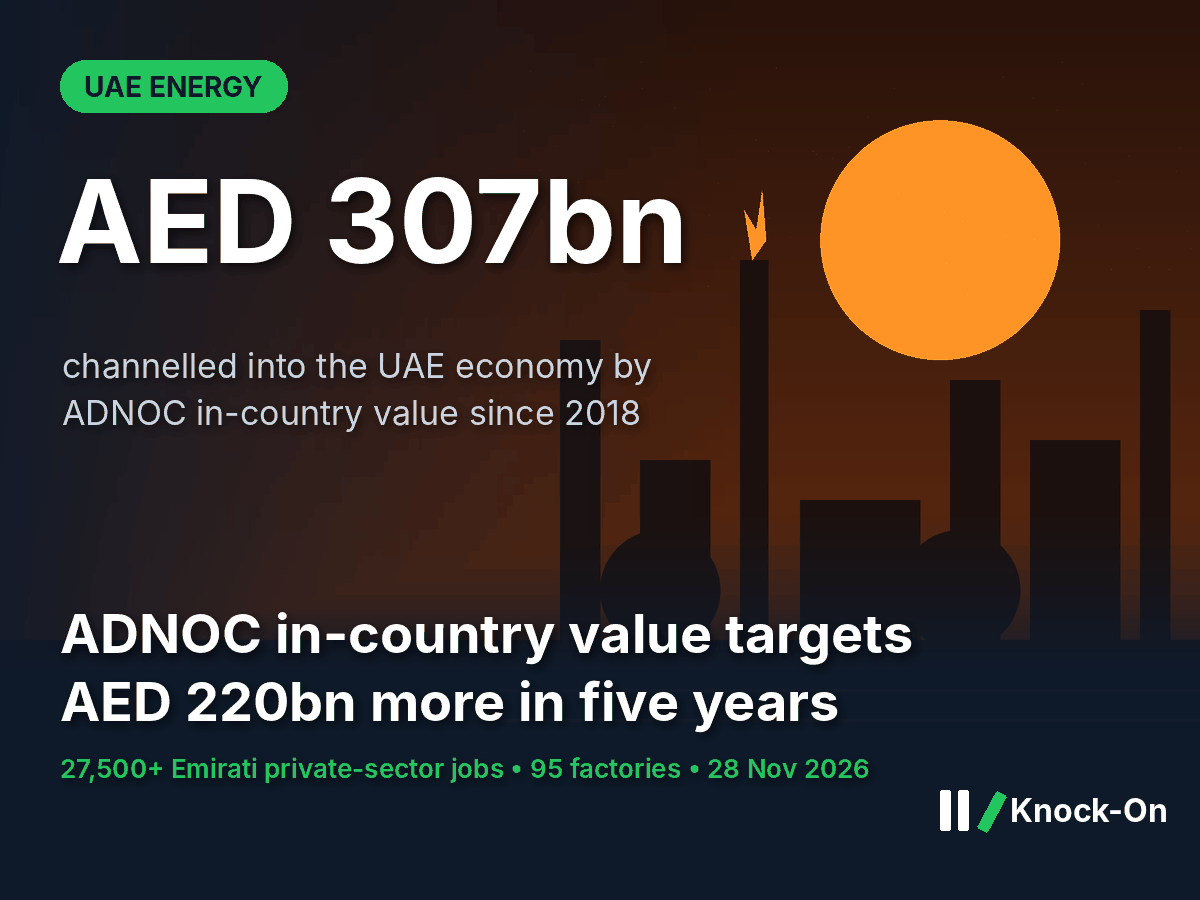
ADNOC in-country value spending has now passed AED 307bn since the programme began in 2018, and the company says it plans to steer another AED 220bn into the UAE economy over the next five years. For UAE manufacturers, contractors and service firms, the message is that a large share of the national oil company’s spending is reserved for businesses that make, hire and buy locally, and that the pipeline is getting bigger rather than smaller.
The short version
- ADNOC says its in-country value (ICV) programme has channelled more than AED 307bn into the UAE economy since 2018, up from AED 242bn at the end of 2024.
- The five-year goal is now AED 220bn, against the AED 200bn target announced in December 2024.
- The programme is credited with more than 27,500 private-sector jobs for Emiratis, and with more than 130 products made in 95 UAE factories.
- Suppliers with strong local content are better placed for ADNOC work; those without it may find it harder to compete.
What happened
On 28 November Gulf News reported figures disclosed by ADNOC: more than AED 307bn channelled into the UAE economy through ICV since 2018, and plans for an additional AED 220bn over the next five years. The company also said the programme has helped create more than 27,500 private-sector jobs for Emiratis and supports local production of more than 130 products across 95 factories in the UAE.
The same report said ADNOC plans to award AED 200bn of projects in 2026 and has identified local manufacturing opportunities worth more than AED 60bn, covering more than 200 products. An earlier Gulf News report on 5 November said the AED 60bn of opportunities run through 2030 and were presented at the Make it with ADNOC Forum on 25 October, which drew more than 1,000 local companies and manufacturers.
ADNOC has added about AED 65bn to its ICV total since end-2024 and raised its five-year goal
ADNOC in-country value, AED bn: cumulative since 2018, and five-year target
For comparison, the Abu Dhabi Media Office said on 30 December 2024 that the programme had delivered AED 242bn and placed 17,000 Emiratis in private-sector jobs since 2018, with AED 55bn reinvested in 2024 alone. By Knock-On calculation, that means roughly AED 65bn and 10,500 jobs have been added to the cumulative totals since then. The sources do not set out how each total is measured, so the comparison is indicative.
Why it matters
ICV is ADNOC’s local-content programme: it measures how much of a supplier’s spending, staffing and production stays in the UAE, and ADNOC presents it as a way for companies to capitalise on its procurement pipeline. When the five-year target rises from AED 200bn to AED 220bn, it signals that more of that pipeline is aimed at firms with local factories, local supply chains and Emirati staff. A five-year goal of AED 220bn averages about AED 44bn a year (Knock-On calculation), alongside a project pipeline that already includes the ADIPEC 2026 deals worth about AED 246bn.
The knock-on effects
First order: suppliers compete on local content
Firms bidding for ADNOC work, from pipe and valve makers to catering, logistics and maintenance contractors, need to show how much of their value stays in the UAE and a credible plan to raise it. Those already manufacturing in the UAE start ahead.
Second order: factories, warehouses and industrial land
More than 200 products have been flagged as local manufacturing opportunities. Companies that move production to the UAE will need industrial plots, warehousing, machinery and trained staff, which supports demand in industrial zones and for the banks that finance equipment.
Third order: hiring and wages
The programme counts Emirati private-sector jobs among its results, so contractors are likely to keep recruiting and training UAE nationals, alongside the 31 December Emiratisation deadline. Smaller sub-suppliers may also see more orders as large contractors look for local inputs. Earlier coverage of ADNOC Gas Q3 results and Ruwais contracts shows how the same spending reaches contractors in Ruwais.
Who could benefit
- UAE manufacturers of industrial equipment, materials and spare parts among the products ADNOC wants made locally.
- Engineering and service contractors with strong local content and established UAE operations.
- Industrial landlords and free zones hosting new factories and storage.
- Banks and lessors financing machinery and working capital for suppliers.
Who may face pressure
- Importers and overseas suppliers without UAE production, who may be at a disadvantage in ADNOC procurement.
- Smaller contractors that lack the systems to document and certify local spending.
- Firms with thin Emirati hiring, as local-content and Emiratisation goals push in the same direction.
What to watch
- ADNOC contract awards in December 2026 and into 2027, against its stated AED 200bn of project awards.
- Any new ICV certification or procurement changes published by ADNOC.
- 31 December 2026: the second-half Emiratisation target for firms with 50 or more staff.
- Further ADNOC supplier and manufacturing news in our UAE energy coverage.
Sources
- Gulf News, Adnoc channels Dh307 billion into UAE economy, targets another Dh220 billion over five years, 28 November 2026
- Gulf News, Inside ADNOC’s growth plans: Stronger UAE supply chains, production and AI, 5 November 2026
- Abu Dhabi Media Office, ADNOC to drive AED200bn into UAE economy over next 5 years through In-Country Value Program, 30 December 2024
- Khaleej Times, In 2024, Adnoc’s ICV programme reinvested Dh55 billion into the UAE economy, 30 December 2024
This is analysis, not investment advice. Figures are as of 28 November 2026.
Leave a Reply