
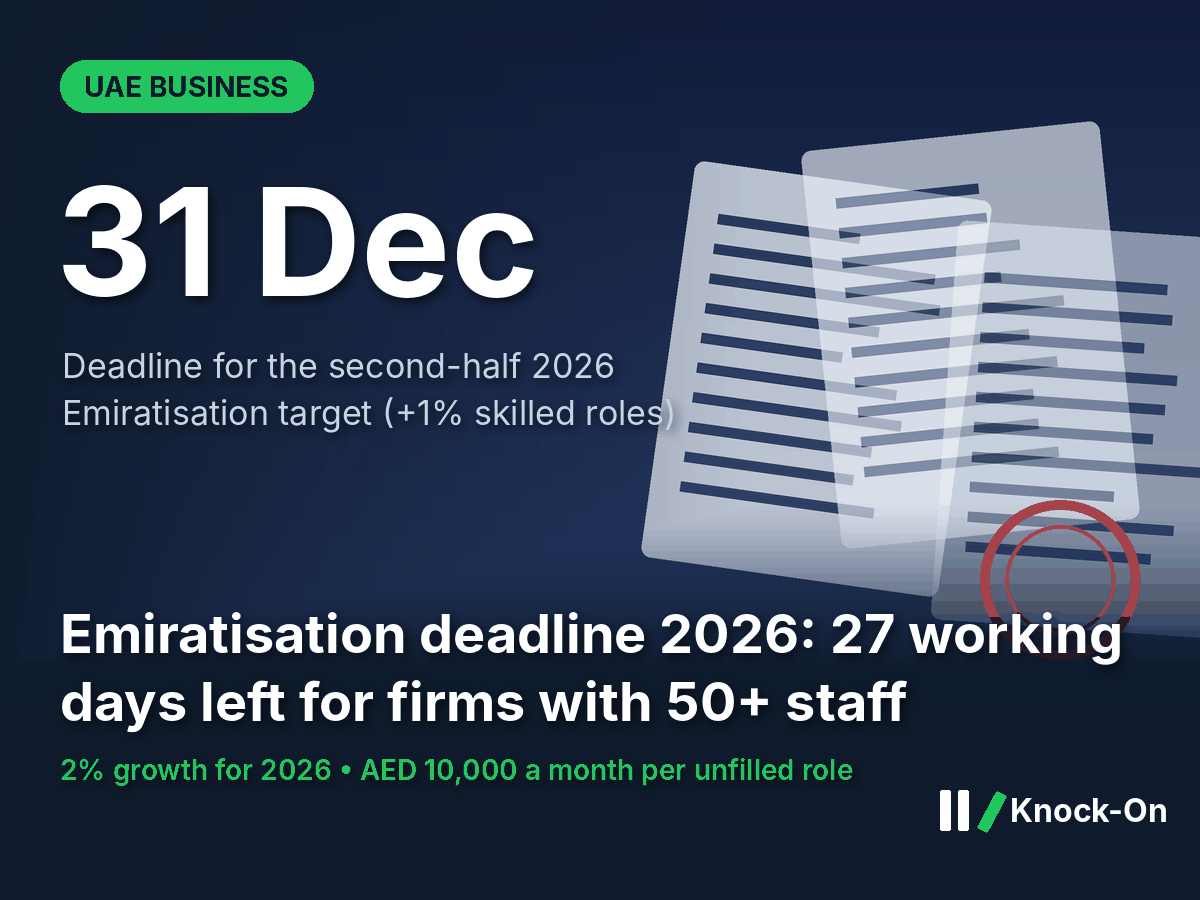
The Emiratisation deadline 2026 for the second half of the year is Thursday 31 December. Private-sector companies with 50 or more employees must raise the share of Emiratis in skilled jobs by a further 1% by then, completing the 2% growth required for 2026, the Ministry of Human Resources and Emiratisation (MoHRE) has reminded employers. From today, that leaves 41 calendar days and, on a Monday-to-Friday week with the two National Day holidays removed, 27 working days (Knock-On calculation). For HR teams, the practical question is no longer whether to hire but whether a new Emirati employee can be recruited, onboarded and registered correctly before the year closes.
The short version
- Firms with 50+ employees must add 1% more Emiratis in skilled roles in the second half of 2026, for 2% growth over the year.
- The deadline is 31 December 2026; about 27 working days remain after the 2–3 December holiday.
- The 2026 contribution for each unfilled position is AED 10,000 a month, or AED 120,000 a year, Gulf News reported.
- Hires must be genuine, registered for pension and social security, and paid through approved wage channels.
What happened
MoHRE urged private-sector establishments with 50 or more employees to meet their 2026 targets by 31 December, according to Sharjah24. Targeted firms must achieve an additional 1% growth in the Emiratisation rate of skilled jobs in the second half of 2026, which together with the first-half target gives 2% for the year. The ministry said compliance means genuine employment, registration in the pension and social security systems, and wages paid through approved procedures. It pointed employers to the Nafis platform, which has been extended until 2040, to find Emirati jobseekers.
The first-half deadline was 30 June. Ahead of it, Gulf News reported that financial contributions for non-compliant firms would apply from 1 July, at AED 10,000 a month, or AED 120,000 a year, for each Emirati position not filled. Companies that exceed their targets can join the Emiratisation Partners Club, which the paper said offers discounts of up to 80% on MoHRE service fees and priority access to government procurement.
Each unfilled Emirati role costs AED 120,000 a year at the 2026 rate
Annual contribution by number of unfilled positions, AED, at AED 10,000 a month per position
Why it matters
The Emiratisation deadline lands in the busiest weeks of the business year. The UAE National Day holiday takes 2 and 3 December out of the calendar, and many staff will add annual leave around it. Recruitment, offer letters, labour contracts, pension registration and the first payroll run all have to fit into roughly five working weeks. A firm that misses by even one role faces a recurring cost of AED 120,000 a year at the reported rate, without adding anyone to its team. Hiring plans for 2027 are also tightening, as the UAE salary increase forecast showed, so finance teams need the Emiratisation line settled before budgets are signed off.
The knock-on effects
First order: a December hiring rush
Companies still short of their target will compete for the same pool of Emirati candidates on Nafis in the same few weeks. Roles that need specific skills, such as finance, engineering or IT, are likely to take longest to fill.
Second order: payroll and compliance checks
Because MoHRE counts only genuine, registered and properly paid employment, HR and payroll teams must make sure pension and social security registration and approved wage payments are in place, not just a signed contract. Recruitment agencies and HR service providers may see more demand for end-to-end onboarding.
Third order: budgets and supplier choices
Firms that exceed their target can gain cheaper MoHRE services and priority in government procurement through the Partners Club. Over time, that can matter when bidding for public contracts, alongside faster licensing such as the Abu Dhabi business setup reforms.
Who could benefit
- Emirati jobseekers: more year-end offers from firms closing their gap.
- Recruitment and HR service firms: demand for sourcing, onboarding and payroll set-up.
- Companies already above target: Partners Club fee discounts and procurement priority.
Who may face pressure
- Mid-sized firms near the 50-employee line: less HR capacity to recruit quickly.
- Specialist employers: skilled roles can take longer to fill than the time left.
- Finance teams: any shortfall adds a recurring cost to 2027 budgets.
What to watch
- 1 December: the last working day before the 2–3 December private-sector holiday.
- 31 December 2026: the second-half Emiratisation deadline for firms with 50 or more employees.
- Early 2027: MoHRE guidance on 2027 targets and any compliance figures for 2026. More in UAE Business.
Sources
- Sharjah24, MoHRE urges private sector to meet Emiratisation targets for 2026, 30 Oct 2026
- Gulf News, MoHRE warns UAE firms ahead of Emiratisation deadline, 22 Jun 2026
- The National, UAE confirms Eid Al Etihad holidays for private sector employees, 13 Nov 2026
This is analysis, not investment advice. Figures are as of 20 November 2026.


Leave a Reply