
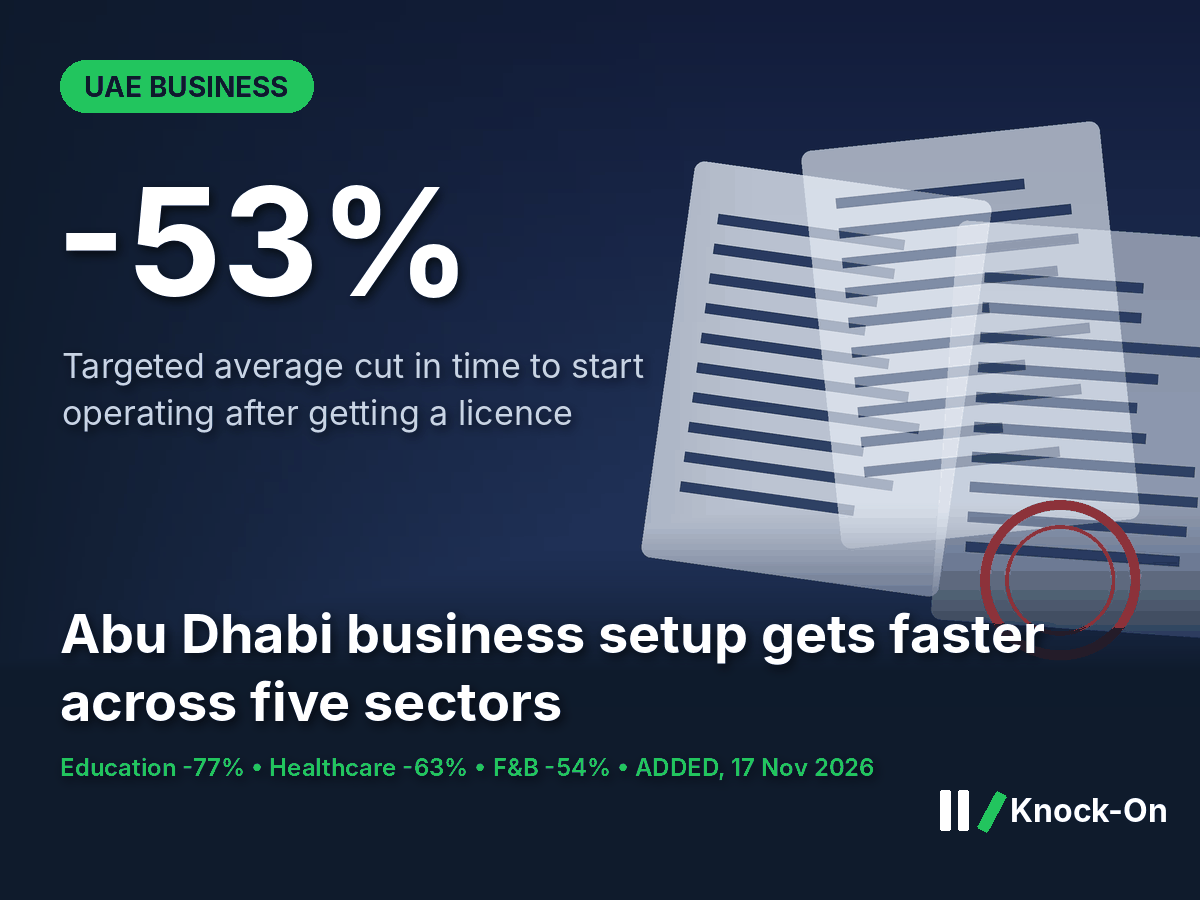
Abu Dhabi business setup is set to get faster. The Abu Dhabi Department of Economic Development (ADDED) says it is targeting an average 53% cut in the time a company needs to start operating after it receives its economic licence, across five sectors: education, healthcare, food and beverage, beauty and wellness, and industrial activities. For founders, franchise operators and investors, the gap between holding a licence and opening the doors is where rent, salaries and loan interest are paid with no revenue coming in. Shrinking it changes the cost of starting up.
The short version
- ADDED targets an average 53% reduction in the time to become operational after licensing, with 31% fewer procedural steps and 77% fewer platforms to deal with.
- The biggest targeted cuts are in education (77%) and healthcare (63%), followed by food and beverage (54%).
- Sixteen local and federal bodies are involved. The share of new licences that allow immediate operation could rise from 51.6% to about 67%, subject to implementation.
- These are targets, not measured results. ADDED has given no start date and says it will report actual reductions as changes are rolled out.
What happened
ADDED set out the plan on 16–17 November, as reported by Gulf News, Entrepreneur Middle East and TradeArabia, which cited the Emirates News Agency (WAM). The work joins up approvals across 16 entities, including ADDED, the Department of Education and Knowledge, the Department of Health – Abu Dhabi, the Department of Municipalities and Transport, the Abu Dhabi Agriculture and Food Safety Authority and the Ministry of Human Resources and Emiratisation.
According to ADDED, 51.6% of new economic licences issued in 2025 let the holder operate straight away, without further approvals from other entities. Applying the planned changes to 2025 data suggests that share could rise to 67%. ADDED chairman Ahmed Jasim Al Zaabi said the aim is to make it easier for businesses to establish, operate and grow.
Education and healthcare get the deepest cuts
Targeted reduction in time to become operational after licensing, by sector (%), announced November 2026
Why it matters
For a new clinic, nursery, restaurant or salon, the licence is only the first step. Health, education, food-safety, municipal and labour approvals decide when the business can actually trade. Every week spent waiting is a week of lease payments, staff costs and financing with no sales. A shorter Abu Dhabi business setup timeline lowers that pre-opening burn and makes the emirate easier to compare with other UAE locations when operators decide where to open their next site.
The sectors chosen are those with heavy regulatory checks, which is why the targeted cuts are large there. Fewer platforms (down 77%) also means less duplicated data entry for PROs and business-setup consultants, a theme that also runs through recent changes in UAE corporate tax compliance.
The knock-on effects
First order: faster openings in regulated sectors
If the targets are met, operators in education, healthcare and food and beverage should be able to start trading sooner after licensing, with fewer handovers between authorities. Planning assumptions for fit-out, hiring and opening dates can be tightened.
Second order: lower start-up cash needs
Less idle time reduces the working capital a founder needs before first revenue. That matters most for small firms, which tend to have thinner cash buffers, and could make lenders and landlords more comfortable with new tenants and borrowers. Small exporters are already being targeted through the UAE export training programme for SMEs.
Third order: more competition for the same customers
Lower barriers to opening can bring more new entrants into crowded segments such as restaurants and beauty. Existing operators may face more competition, while landlords of retail and clinic space could see stronger demand for fitted units.
Who could benefit
- New schools, nurseries and training centres: education has the largest targeted cut, 77%.
- Clinics and healthcare start-ups: a 63% targeted cut in time to operate.
- Restaurant groups and franchisees: a 54% targeted cut speeds multi-site roll-outs.
- Commercial landlords: tenants can start paying from a trading business sooner.
Who may face pressure
- Business-setup intermediaries: fewer steps and platforms may reduce demand for paid processing services.
- Established operators: easier entry may bring new rivals in food and beverage and beauty.
- Firms planning on old timelines: budgets and lease terms built on longer approval periods may need revisiting.
What to watch
- Roll-out timing: ADDED has not given dates; watch for sector-by-sector announcements.
- Reported results: ADDED says it will measure and report actual reductions as changes are implemented.
- Immediate-operation licences: whether the share rises from 51.6% towards the 67% projection.
- Other sectors: whether the approach extends beyond the five priority sectors.
More UAE business coverage: UAE business news and analysis.
Sources
- Gulf News, Starting a business in Abu Dhabi? New reforms aim to cut waiting time by 53%, 16 November 2026
- Entrepreneur Middle East, Abu Dhabi Targets 53% Reduction in Time Required to Start a Business Across Five Sectors, 17 November 2026
- TradeArabia (citing WAM), Abu Dhabi places speed of doing business top priority, 17 November 2026
This is analysis, not investment advice. Figures are as of 17 November 2026.



Leave a Reply