
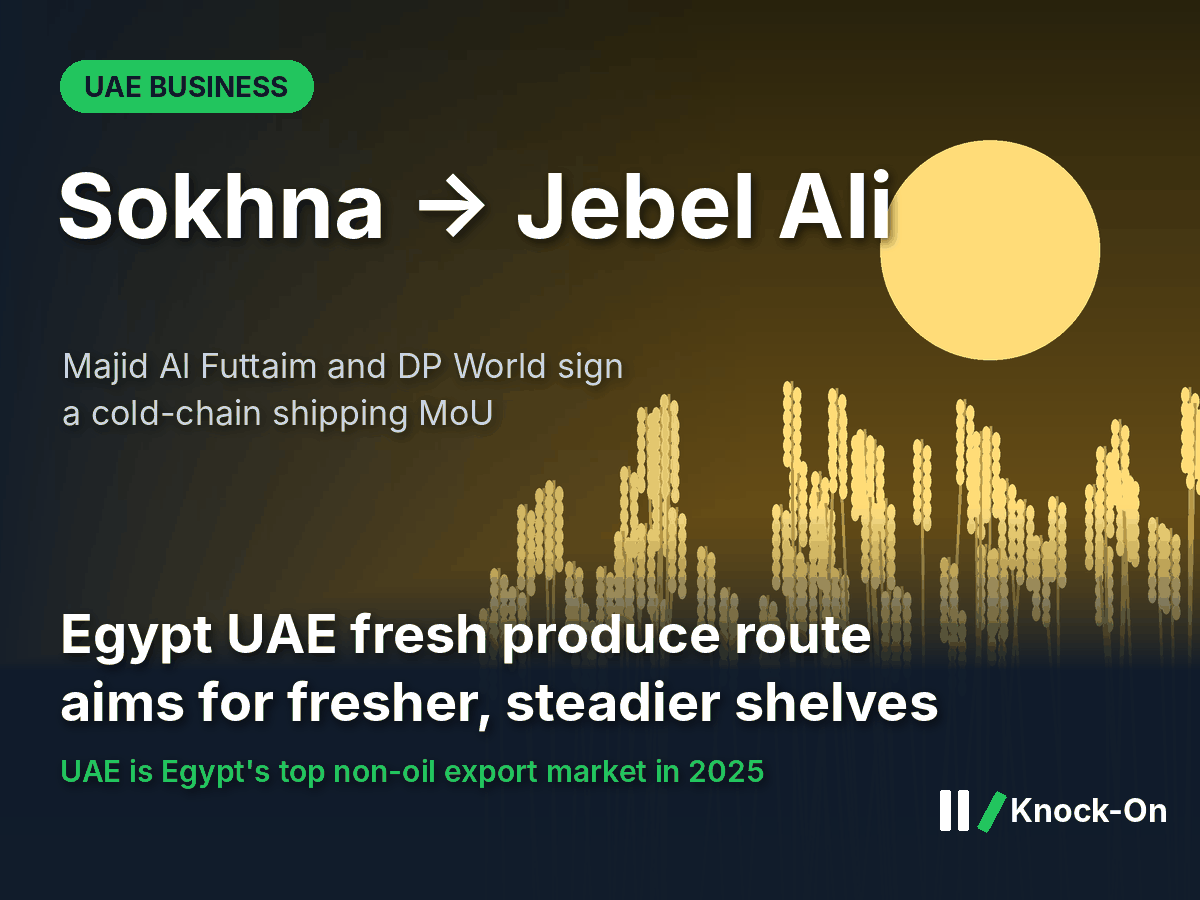
Egypt UAE fresh produce trade is set for a dedicated cold-chain link. Majid Al Futtaim and DP World have signed a memorandum of understanding to increase container shipments of Egyptian fruit and vegetables to the UAE, moving them under refrigeration from Sokhna Port to Jebel Ali and on to Majid Al Futtaim’s stores. For UAE grocers, importers and logistics firms, it points to a more direct, better-controlled supply line from the UAE’s largest market for Egyptian non-oil goods.
The short version
- Majid Al Futtaim and DP World signed a preliminary agreement in Cairo to ship more Egyptian produce to the UAE, starting with fresh fruit and vegetables.
- Goods will be consolidated at DP World’s temperature-controlled facilities in Sokhna, shipped to the UAE and moved under refrigeration to Jebel Ali.
- No start date, volumes or investment figure have been published.
- The UAE was the largest destination for Egypt’s non-oil exports in 2025, which rose 17% to US$48.57bn (about AED 178.4bn).
What happened
The agreement was signed at Mall of Egypt in Cairo by Ahmed Galal Ismail, chief executive of Majid Al Futtaim Holding, and Ahmad Yousef Al-Hassan, chief executive and managing director of DP World GCC, Gulf News reported on 16 November. Produce from Majid Al Futtaim’s Egyptian suppliers will be gathered at DP World’s temperature-controlled facilities in Sokhna, shipped from Sokhna Port to the UAE and then moved under refrigeration to Jebel Ali for distribution to the retailer’s network.
The partners say the set-up covers consolidation, refrigerated transport, customs clearance and distribution, with less cargo handling and easier tracking. Arab Finance reported that other product categories could be added later. EnterpriseAM noted that DP World would run the whole cold chain. The companies have not disclosed shipment targets, sailing frequency or transit times.
Egypt’s non-oil exports grew 17% in 2025, with the UAE as top buyer
Egypt’s non-oil exports, full year, AED bn (converted at the CBUAE peg of AED 3.6725 per US$)
Why it matters
The UAE imports most of its food, so the cost and reliability of each supply route feed directly into shelf prices. Food has been one of the fastest-rising items in household budgets, as our report on Dubai inflation in October showed. A short sea route from Egypt with refrigeration from farm to shelf can cut spoilage, which is one of the hidden costs in fresh produce, and give a large retailer more control over quality and timing.
It also fits a wider push to deepen UAE trade links. The UAE ranked as the largest market for Egypt’s non-oil exports in 2025, according to the Emirates News Agency, and UAE non-oil trade has kept growing this year, as covered in our UAE non-oil foreign trade analysis.
The knock-on effects
First order: more Egyptian produce through Jebel Ali
More reefer containers arriving at Jebel Ali means more work for cold stores, refrigerated trucking and customs brokers in Dubai, once shipments start.
Second order: sharper competition on fresh food
If a large retailer secures steadier supply at lower handling cost, rival grocers and independent importers may need to match on price or freshness, or lock in their own direct sourcing deals.
Third order: a template for other routes
Retailer-led, port-to-shelf corridors could be copied for other sourcing countries and product lines, shifting more of the UAE’s food logistics towards integrated contracts rather than spot shipping.
Who could benefit
- Cold-chain operators: refrigerated warehousing and trucking around Jebel Ali.
- Shoppers and restaurants: potentially fresher produce with fewer supply gaps.
- Customs and freight brokers: more regular perishable cargo to clear and book.
Who may face pressure
- Smaller produce importers: competing with a retailer that controls its own supply line.
- Wholesale market traders: less volume if large retailers buy direct from source.
What to watch
- A start date and volume targets for the first shipments, not yet announced.
- Whether dairy and other categories are added, as the partners have signalled.
- Dubai’s November inflation figures, due in December, for any easing in food prices.
Sources
- Gulf News, Majid Al Futtaim, DP World plan Egypt-UAE fresh produce route, 16 November 2026
- EnterpriseAM, Majid Al Futtaim taps DP World to move Egyptian fresh produce onto UAE shelves, 17 November 2026
- Arab Finance, Majid Al Futtaim, DP World to expand Egyptian exports to regional markets, 16 November 2026
- HiDubai Focus (Emirates News Agency), UAE Emerges as Top Destination for Egypt’s Non-Oil Exports in 2025, 28 January 2026
- Zawya, UAE tops markets for Egypt’s non-oil exports in 2025, January 2026
This is analysis, not investment advice. Figures are as of 17 November 2026. More in UAE business.


Leave a Reply