
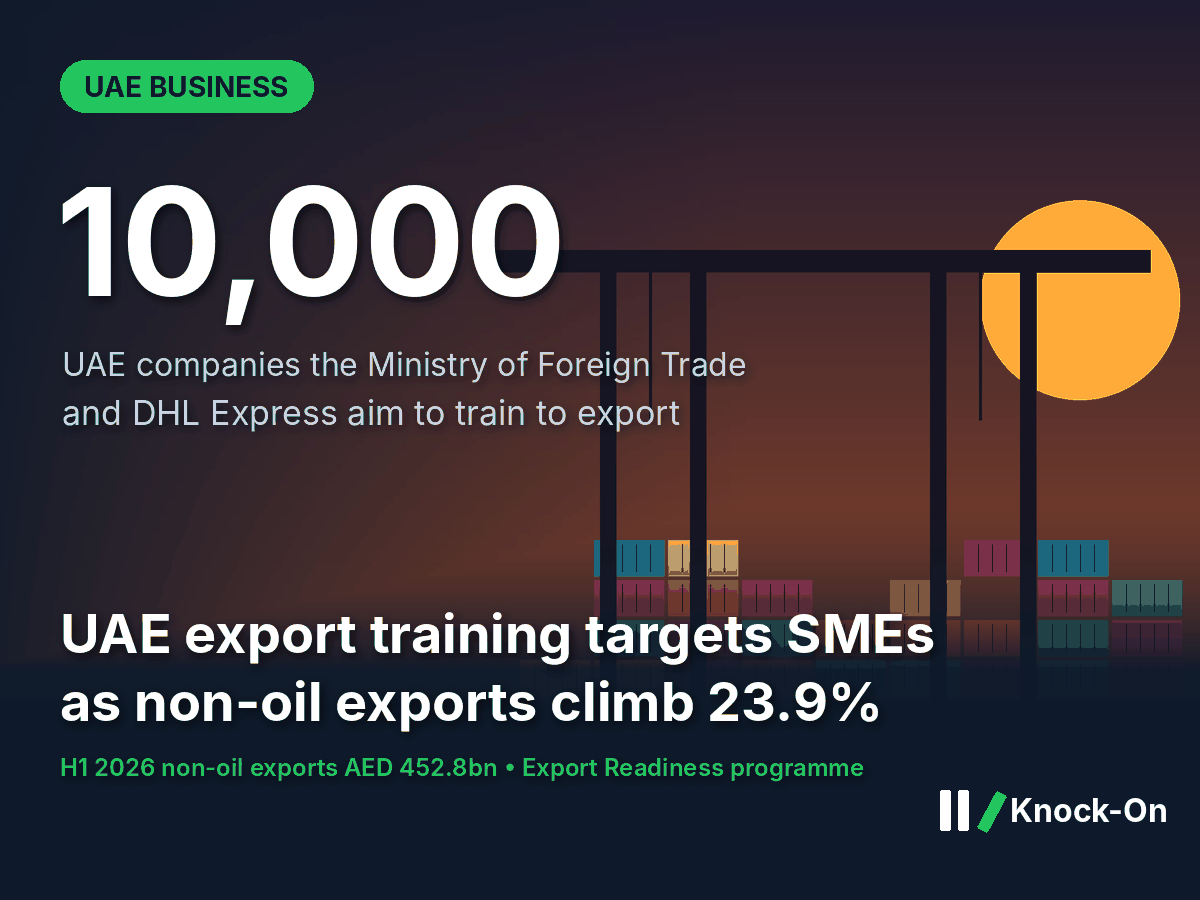
A new UAE export training programme aims to train more than 10,000 companies, mostly small and medium-sized enterprises, to sell their goods and services abroad. The Ministry of Foreign Trade signed the agreement with DHL Express at its Dubai headquarters, according to Arabian Business and a report credited to the Emirates News Agency. For UAE business owners who have thought about exporting but lack the know-how on documents, finance and logistics, it offers practical, government-backed training.
The short version
- The “Export Readiness” initiative is the third programme under the UAE Global Trade Hub and targets more than 10,000 companies.
- DHL’s GoTrade programme will be folded into the Ministry’s Ready2Trade initiative, with virtual and in-person sessions.
- UAE non-oil exports reached AED 452.8bn in the first half of 2026, up 23.9% on a year earlier.
- No launch date, fees or sign-up process have been published yet.
What happened
The agreement was signed by Fahad Al Gergawi, Undersecretary of the Ministry of Foreign Trade, and Abdulaziz Busbate, chief executive of DHL Express MENA. Training will be led by DHL facilitators and tailored to the UAE, with local case studies, according to the announcement published by Mid-East.info. Topics include choosing export markets, assessing demand, export procedures and compliance, trade documents, trade finance and insurance, logistics, e-commerce and the opportunities created by the UAE’s Comprehensive Economic Partnership Agreements (CEPAs).
The design draws on a training-needs survey with 328 responses from UAE companies, carried out with more than 16 organisations, and the initiative lists 25 awareness and implementation partners, including government bodies, chambers of commerce and free zones. Non-oil exports also rose to 23.4% of the UAE’s non-oil trade in the first half, from 21.3% a year earlier, according to the same announcement.
UAE non-oil exports are up about 77% in two years
UAE non-oil exports, first half of each year, AED bn
Why it matters
Most UAE companies are small, and many sell only at home or re-export goods made elsewhere. Exporting their own products and services is harder: it needs market research, paperwork, compliance with foreign standards and reliable logistics. The programme targets exactly those gaps. It builds on the growth in UAE non-oil foreign trade and on recent steps to make cross-border business easier, such as the digital ATA Carnet for moving samples and exhibition goods.
The knock-on effects
First order: skills for small exporters
SMEs get structured training on the steps that most often stop a first export order, from customs documents to choosing a trade-finance product.
Second order: more demand for trade services
More first-time exporters means more business for freight forwarders, couriers, customs brokers, trade-finance desks, export-credit insurers and certification firms.
Third order: CEPA deals put to use
The UAE’s trade agreements only pay off if firms use the tariff cuts. Training that explains CEPA rules could lift the number of small companies claiming those benefits.
Who could benefit
- UAE manufacturers and food producers ready to sell beyond the domestic market.
- E-commerce sellers looking to ship to GCC and CEPA partner markets.
- Logistics firms, banks and insurers that serve new exporters.
Who may face pressure
- Private export consultants whose basic advisory work overlaps with government-backed training.
- Small firms with limited staff time, which may struggle to take part without clear dates and formats.
- Competing courier and logistics providers, as one partner gains early contact with thousands of exporters.
What to watch
- Coming weeks: the Ministry of Foreign Trade’s details on start dates, eligibility and how companies can register.
- 2 to 3 December: the National Day private-sector holiday, which may affect the first session dates.
- Early 2027: full-year 2026 non-oil trade figures, the first test of whether export growth holds.
Sources
- Arabian Business, UAE to train 10,000 companies to expand overseas as exports reach $123bn, 15 November 2026
- Mid-East.info, Ministry of Foreign Trade and DHL Express Strengthen UAE Exporters’ Readiness to Compete and Expand Globally, 12 November 2026
- HiDubai Focus (Emirates News Agency), Ministry of Foreign Trade Partners With DHL Express to Train 10,000 Companies on Exporting, 13 November 2026
This is analysis, not investment advice. Figures are as of 16 November 2026.


Leave a Reply