
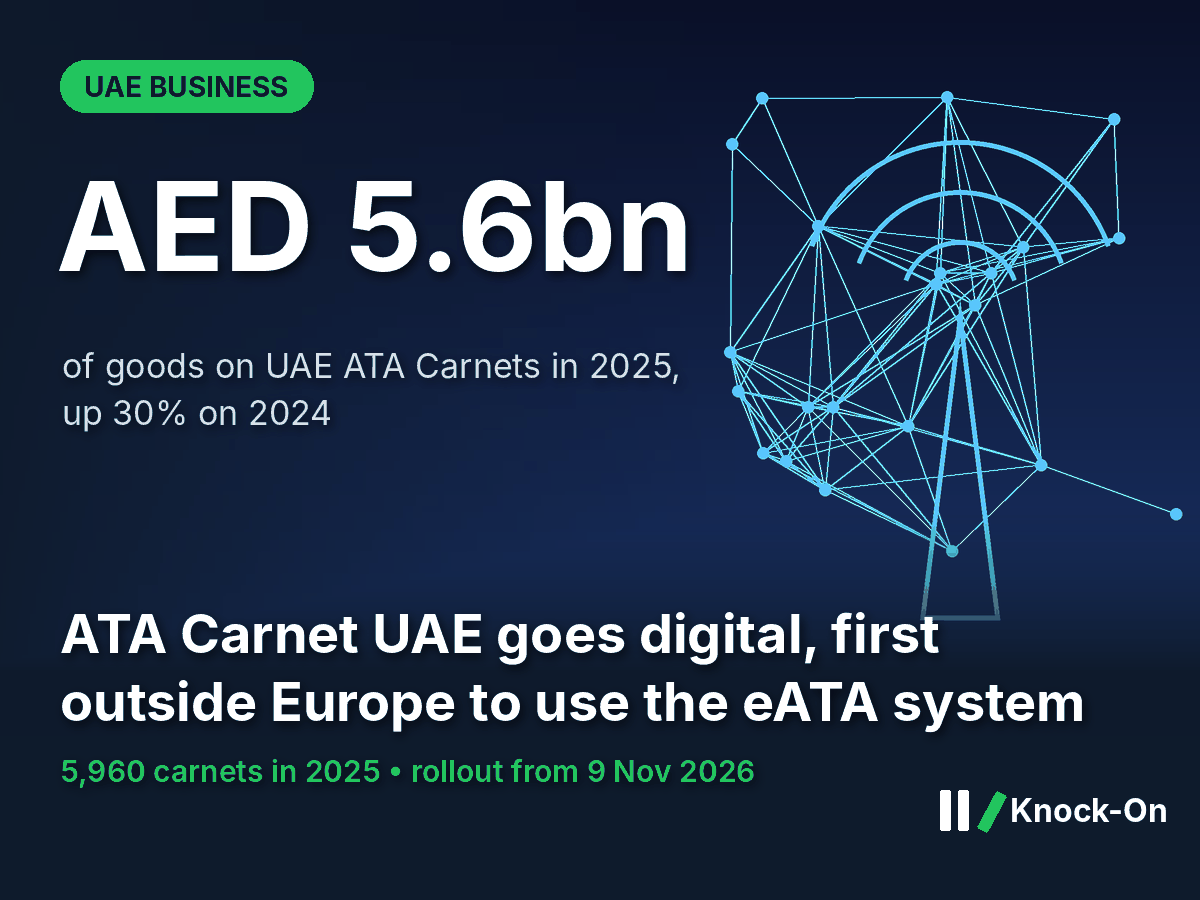
The ATA Carnet UAE system went digital on 9 November 2026. The UAE began rolling out the electronic eATA Carnet, becoming the first country outside Europe to adopt it, according to Dubai Chambers. For exhibitors, firms sending commercial samples and companies flying in professional equipment, it replaces paper customs documents with digital declarations and QR codes, which is designed to speed up clearance at the border.
The short version
- The UAE started rolling out the digital eATA Carnet on 9 November 2026, after 30 European countries in June 2026.
- ATA Carnets let goods enter a country temporarily without paying customs duties or taxes, as long as they are re-exported.
- Dubai Chamber of Commerce issued and received 5,960 carnets covering AED 5.6bn of goods in 2025, up 30% in value.
- Full global digitalisation of the system is expected by 1 January 2028.
What happened
Dubai Chambers said the rollout was carried out with the Federal Authority for Identity, Citizenship, Customs and Port Security (ICP) and Dubai Customs. Dubai Chamber of Commerce has been the UAE’s national guaranteeing and issuing body for ATA Carnets since 2011 and worked with customs authorities and the International Chamber of Commerce on consultations, training and testing before launch. The new system uses digital declarations, QR codes and electronic transaction records in place of paper.
The volumes are growing fast. In 2025 the chamber issued and received 5,960 carnets covering goods worth AED 5.6bn, up 11.2% by number and 30% by value on 2024. Between 2011 and the end of 2025, 63,591 carnets covering AED 54.4bn of goods passed through the system.
Goods moving on UAE ATA Carnets rose 30% in a year
Value of goods covered by carnets issued and received by Dubai Chamber of Commerce, AED bn
Why it matters
The carnet is a passport for goods. Without one, a company bringing display stock to a trade fair, samples to a client meeting or cameras and equipment for a project usually has to pay duties or lodge a customs guarantee, then reclaim it when the goods leave. A carnet removes that step and, according to Dubai Chambers, cuts paperwork and the need for separate customs guarantees. Carnets are valid for up to a year.
That matters in a country that runs a heavy exhibitions calendar. Large shows such as ADIPEC, covered in our analysis of ADIPEC 2026 deals, depend on equipment and stock arriving and leaving quickly. Moving the process online also fits the wider digital push in UAE compliance, including the move to UAE e-invoicing from 1 January.
The knock-on effects
First order: less paper at the border
Firms using carnets for the UAE and for the European countries already on eATA can handle declarations digitally rather than carrying and stamping paper documents. Electronic transaction records also give companies and customs a clearer audit trail of when goods entered and left, which Dubai Chambers says improves transparency.
Second order: cheaper, faster trade-fair logistics
Event organisers, freight forwarders and stand builders handle much of the customs work for exhibitors. Faster clearance can shorten set-up times and reduce the cost of moving equipment in and out of the UAE, which may make it easier to attract overseas exhibitors.
Third order: a stronger case for regional hubs
Companies that tour samples or equipment across markets from a Dubai or Abu Dhabi base gain from simpler temporary imports. Over time, and as more countries go digital before the 2028 target, that could support the UAE’s role as a base for regional sales and service teams. This is an expectation, not a measured result.
Who could benefit
- Exhibitors and event organisers bringing stock and displays into the UAE.
- Sales teams carrying commercial samples to clients in the UAE and Europe.
- Media, film and engineering firms moving professional equipment for short projects.
- Freight forwarders and customs brokers that adapt quickly to digital carnets.
Who may face pressure
- Firms travelling to countries still on paper, which will need to run both systems until global digitalisation is complete.
- Smaller brokers that rely on manual document handling and must update their processes.
What to watch
- Guidance from Dubai Chambers and Dubai Customs on applying for eATA Carnets in the weeks after the 9 November 2026 launch.
- Carnet volumes for 2026, likely to be published early in 2027.
- Other countries joining eATA ahead of the 1 January 2028 target for full global digitalisation.
For more on UAE trade flows, see our analysis of UAE non-oil foreign trade and the UAE Business section.
Sources
- Dubai Chambers via PR Newswire, UAE becomes first country outside Europe to implement eATA Carnet system, 9 November 2026
This is analysis, not investment advice. Figures are as of 9 November 2026.


Leave a Reply