
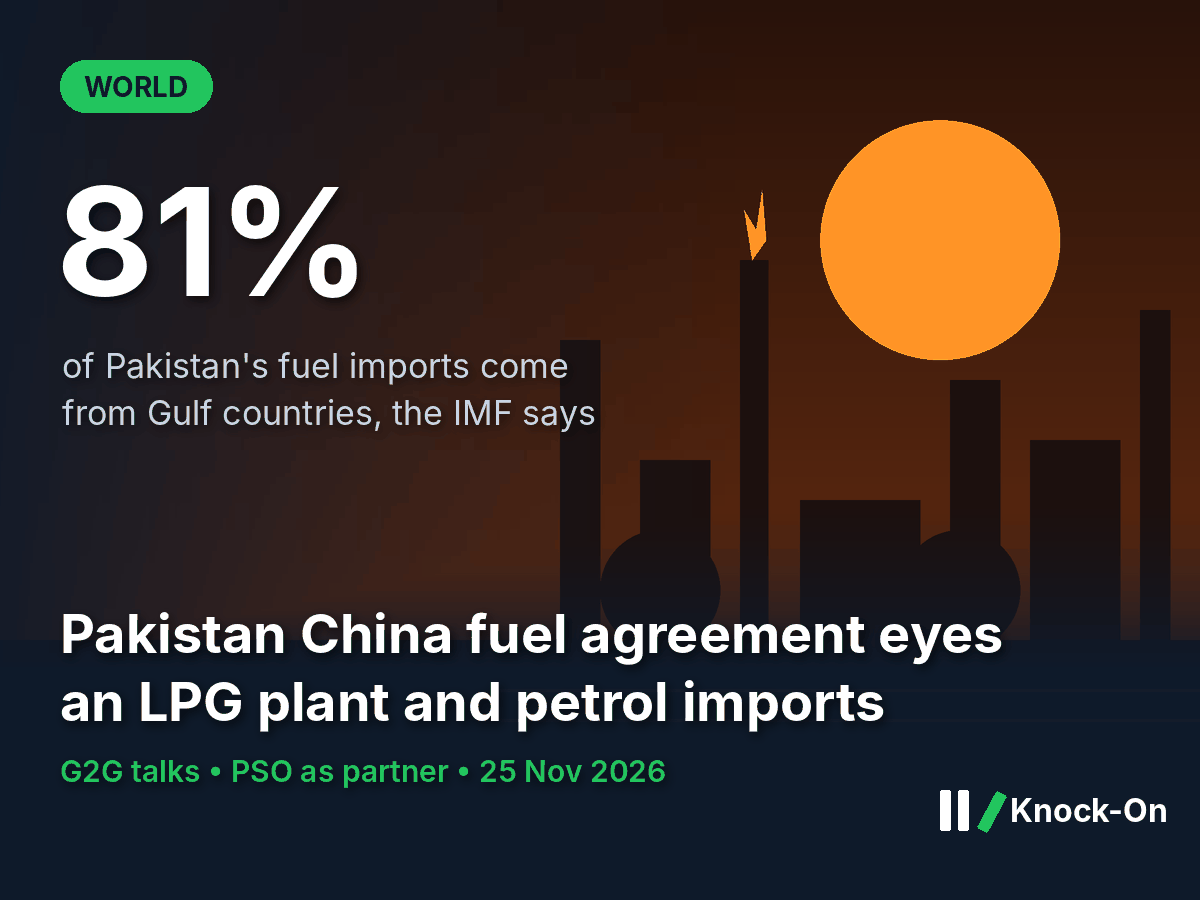
A Pakistan China fuel agreement reached in Islamabad on Wednesday, 25 November, aims to fast-track two government-to-government (G2G) projects: an LPG plant with storage and terminals, and arrangements to import motor gasoline (petrol). Petroleum Minister Ali Pervaiz Malik agreed the priorities with China’s ambassador, Jiang Zaidong, according to a Petroleum Division statement. The business significance is diversification: the IMF says 81% of Pakistan’s fuel imports come from Gulf countries, a route that has been under strain since the US–Iran conflict.
The short version
- Pakistan and China agreed to pursue G2G arrangements for Chinese investment in petrol and LPG storage and terminals.
- Two early priorities: an LPG plant with storage and terminals, and petrol (MoGas) imports including sourcing, storage and logistics.
- PSO is named as the key commercial partner; a joint commercial team will draw up a roadmap.
- No volumes, capacities, prices or timelines have been disclosed.
What happened
Dawn reported that the minister and PSO chief executive Jawwad Ahmed Cheema met the Chinese ambassador and his commercial team. The two G2G priorities are an LPG plant “to expand domestic supply, improve access to cleaner fuel and ease peak-season shortages”, and petrol imports “to strengthen fuel security and ensure a reliable supply at competitive prices”. Chinese downstream companies are expected to enter or expand through partnerships with PSO, with OGDCL also named for upstream work.
A joint commercial team will assess investment and partnership models and build a roadmap covering upstream, offshore and downstream energy, plus minerals and mining. Radio Pakistan said both sides agreed to fast-track implementation. Mr Malik said Pakistan was “committed to creating a transparent, facilitative and secure investment environment” and repeated the government’s aim of progressive deregulation of the petroleum sector. The ambassador reaffirmed China’s continued support for Pakistan, according to the statement.
Why it matters
Pakistan is a net importer of oil and gas. At a UN Security Council briefing this week, Pakistan’s envoy Syed Haider Shah warned that the country is particularly vulnerable to supply disruption, and Dawn noted the IMF’s finding that 81% of fuel imports originate in the six Gulf Cooperation Council states. A Pakistan China fuel agreement does not change that overnight, but it opens a second channel for petrol and LPG at a time when Gulf shipping carries a risk premium.
Four-fifths of Pakistan’s fuel imports come from one region
Share of Pakistan’s fuel imports by origin, % (IMF figure reported November 2026)
The knock-on effects
First order: PSO gains a Chinese partner
PSO becomes the gateway for Chinese downstream investment. New storage and terminal capacity would let it hold larger buffers, which matters after this year’s supply scares. It follows the $200m Oman credit facility for PSO, another step to widen the supply base.
Second order: LPG supply and prices
A domestic LPG plant with terminals targets the winter shortages that have pushed LPG cylinder prices sharply higher. More local supply could ease peak-season price spikes for households, restaurants and small industry, though any effect depends on capacity and timing, which have not been announced.
Third order: deregulation and competition
The minister linked the talks to opening the energy market to more competition. If Chinese firms enter fuel import and storage, private oil marketing companies and terminal operators could face new competitors, while a deeper China energy link adds to CPEC-era commitments that Pakistan must manage alongside its Gulf partners.
Who could benefit
- PSO, as the named commercial partner for storage, terminals and imports.
- LPG users, if new supply eases winter shortages.
- Port and logistics firms that could build or operate new terminals.
Who may face pressure
- Private LPG importers and marketers, if a state-backed plant changes supply and pricing.
- Smaller oil marketing companies facing new well-funded entrants.
- Government finances, if G2G deals carry guarantees or payment commitments not yet disclosed.
What to watch
- The joint commercial team’s roadmap: plant capacity, import volumes and pricing terms.
- Which Chinese companies partner with PSO, and on what financing.
- Gulf shipping risk and Brent prices, which decide how urgent diversification is.
- Winter LPG prices as demand peaks in December and January.
Sources
- Dawn, Pakistan, China agree on arrangements for fuel storage, terminals, 25 November 2026
- Radio Pakistan, Pakistan, China agree to fast-track implementation of key energy projects, 25 November 2026
- ARY News, Pakistan and China discuss new opportunities in energy and mining sectors, 25 November 2026
- Dawn, Pakistan warns of global energy crisis as conflicts disrupt supplies, 25 November 2026
This is analysis, not investment advice. Figures are as of 25 November 2026. Knock-On is not affiliated with any political party.

Leave a Reply