
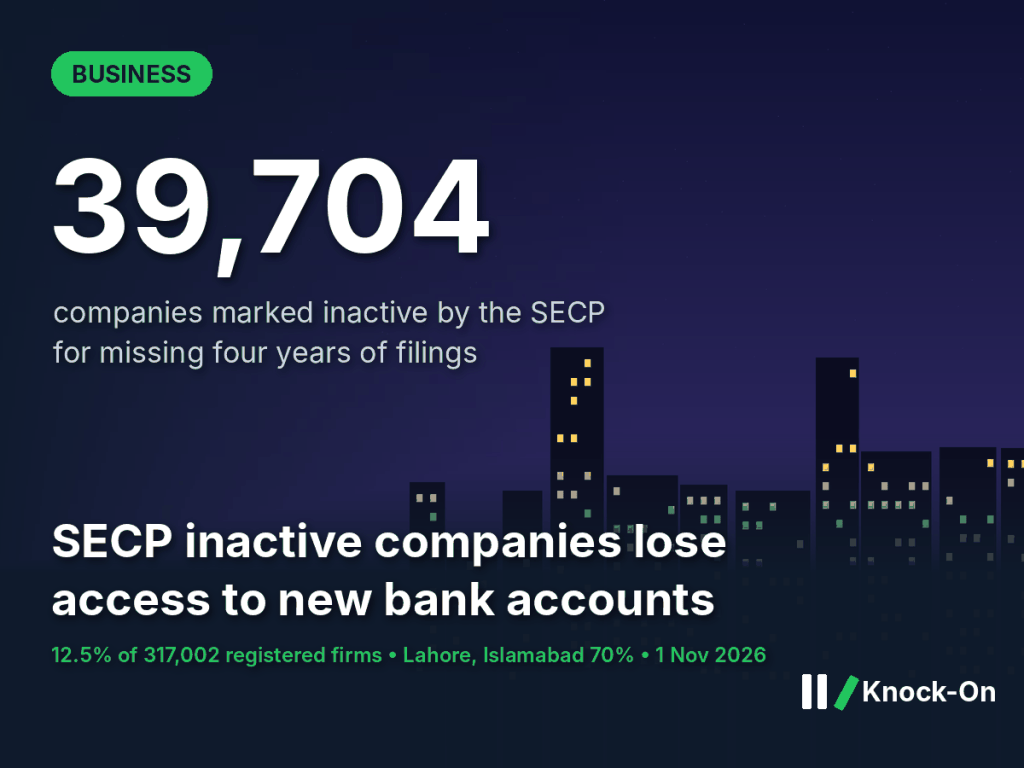
The list of SECP inactive companies now runs to 39,704 names. For the first time, the Securities and Exchange Commission of Pakistan (SECP) has marked these firms “inactive by registrar” because they failed to file annual returns or financial statements for four years, Dawn reported on 1 November. The status is visible to banks, and until the companies file their overdue documents they cannot open new bank accounts, use other financial services or register changes to their directors. That is about one in eight of the 317,002 companies on Pakistan’s register.
The short version
- The SECP has marked 39,704 companies inactive for missing four years of annual returns or financial statements.
- They cannot open new bank accounts, access financial services or change directors until they file.
- Lahore (13,927) and Islamabad (13,859) account for 70% of the list (Knock-On calculation).
- The clean-up comes as company registrations keep rising: 43,559 new firms in FY26, up 24%.
What happened
Filing annual returns, and where required financial statements, is a legal duty under the Companies Act 2017. The SECP has used a clause in the law to gradually remove inactive companies, and this is the first time it has applied the “inactive by registrar” label at this scale, according to Dawn. The status appears in the SECP’s system and can be seen by banks and other stakeholders. The SECP inactive companies regain normal status once they file their overdue documents.
SECP Chairman Dr Kabir Ahmed Sidhu said “a clean and credible registry is the bedrock of trust in the corporate sector”, and the regulator described the move as giving companies a clear opportunity to return to compliance. Pakistan had 317,002 registered companies as of 30 September. The SECP registered 43,559 new companies in FY26, 24% more than the year before, and 99.9% of new registrations are now done online. Monthly registrations have stayed strong; Knock-On looked at the 5,241 new companies registered in September and where founders are heading.
The inactive list is concentrated in two cities. Dawn’s breakdown shows Lahore and Islamabad with almost 28,000 between them, while Karachi, the country’s commercial capital, has 4,868.
Lahore and Islamabad hold 70% of the inactive companies
Companies marked “inactive by registrar” by the SECP, by city, as reported 1 Nov 2026
Why it matters
A company register is only useful if it is accurate. Banks, suppliers, landlords and lenders use SECP records to check who they are dealing with, and tens of thousands of dormant shells make that harder and create room for misuse. By tying the inactive label to bank accounts, the SECP has given dormant firms a practical reason to file or close, rather than relying on fines alone. The move also fits a wider push to document the economy, at a time when the FBR is struggling to meet targets; its revenue shortfall reached Rs96bn in the first four months.
The knock-on effects
First order: SECP inactive companies must file or stay frozen
Owners of the 39,704 firms now face a choice: bring four years of returns and accounts up to date, or accept that the company cannot open new bank accounts or change directors. Some will be genuinely dormant and may be wound up; others are trading businesses that have simply ignored filings and will need accountants quickly.
Second order: banks get a cleaner signal
Because the status is visible to banks, it becomes a simple check during account opening and customer due diligence. That should help banks screen out shell companies, though it also adds a step for any legitimate firm that has fallen behind on paperwork.
Third order: a more reliable corporate base
A register with fewer dead entries gives a truer picture of how many firms are actually operating, which matters for tax policy, credit data and investor confidence. Firms raising money through bank loans or Pakistan’s growing corporate debt market all depend on credible company records.
Who could benefit
- Banks get an official flag to use in customer checks.
- Accountants and corporate advisers are likely to see demand for overdue filings and company closures.
- Compliant businesses gain from a register that makes it easier to verify customers and suppliers.
Who may face pressure
- Owners of dormant or non-filing firms, especially in Lahore and Islamabad, who must file or lose access to new bank accounts.
- Small companies that registered online cheaply but never kept up annual compliance.
- Directors who need to change a board but cannot until filings are complete.
What to watch
- Whether the SECP publishes how many inactive companies return to compliance, and how fast.
- Whether firms that stay inactive are struck off the register next.
- How banks apply the status to existing accounts, not just new ones.
- The SECP’s monthly company registration data for October, due in the coming weeks.
Sources
- Dawn, 39,704 firms declared ‘inactive’, 1 November 2026
This is analysis, not investment advice. Figures are as of 1 November 2026.



Leave a Reply