
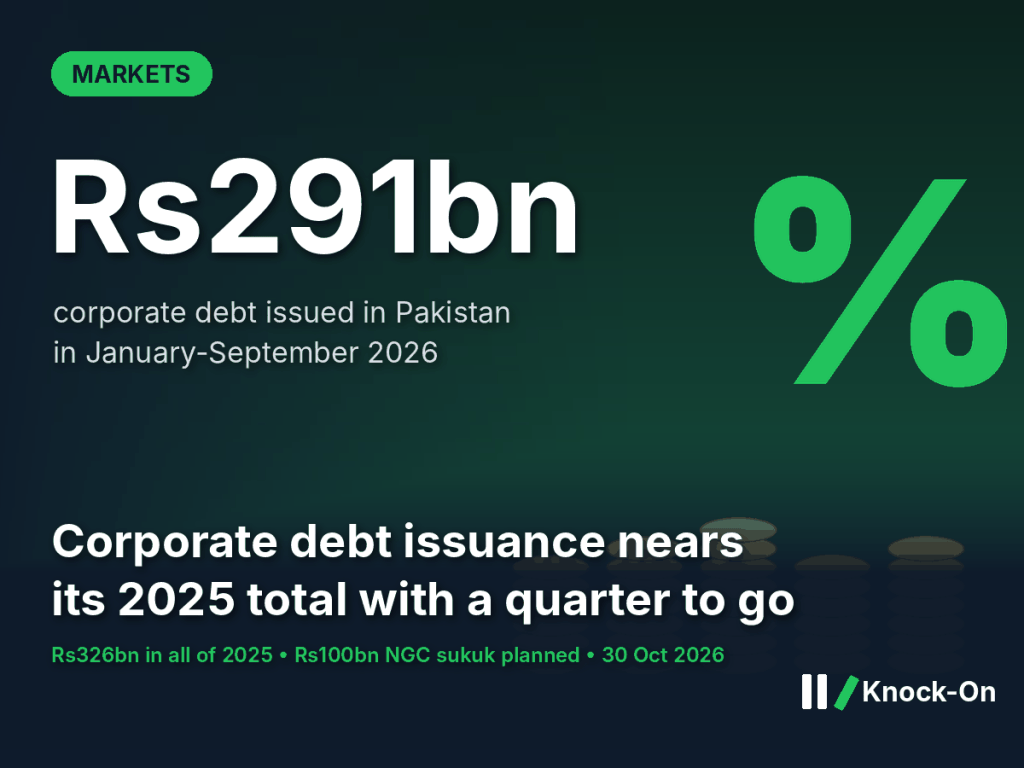
Corporate debt in Pakistan reached Rs291bn in issuance in January–September 2026, the Finance Division said on 30 October. That is already 89% of the Rs326bn issued in the whole of 2025, with a quarter still to go. The figures were presented at a Capital Market Development Council meeting chaired by Finance Minister Muhammad Aurangzeb, which also discussed a planned sukuk of up to Rs100bn by the National Grid Company. For companies, a deeper bond market means another way to borrow besides bank loans.
The short version
- Corporate debt issuance was Rs291bn in January–September 2026, against Rs326bn in all of 2025.
- 2025 issuance was itself up 30% from 2024.
- Average daily secondary-market trading rose from Rs3.93bn in FY2026 to more than Rs10bn so far in FY2027.
- NGC plans a listed sukuk programme of up to Rs100bn, starting with up to Rs20bn for up to 10 years.
What happened
At the fourth meeting of the Capital Market Development Council, the Finance Division reported that corporate debt issuance in Pakistan reached Rs291bn in the first nine months of 2026, Business Recorder reported. Issuance in 2025 was Rs326bn, up 30% from 2024. Between February 2025 and September 2026, 12 new listed corporate debt issues worth Rs45.4bn came to market.
Trading is also picking up. Average daily traded value in the secondary market rose from Rs3.93bn in FY2026 to more than Rs10bn in FY2027 as of 15 October. Thirteen banks have been brought onto secondary-market trading, and the SECP has consulted 17 pension fund managers and 44 insurance companies, the Finance Division said.
Nine months of 2026 have nearly matched all of 2025
Corporate debt issuance in Pakistan, Rs billion
Why it matters
The pace is the story. Issuance has averaged about Rs32.3bn a month in 2026, against Rs27.2bn a month in 2025, roughly 19% faster (Knock-On calculation). If that pace holds, corporate debt in Pakistan would pass the 2025 total in November. Still, the market remains small: most company borrowing goes through banks, which have preferred to lend to the government. Knock-On’s look at this week’s T-bill auction, which drew Rs4.87trn in bids, shows where bank cash is going.
Aurangzeb said the next phase of capital market development should turn regulatory reforms into higher issuance, deeper liquidity and broader investor participation, and called for more help for small and medium-sized enterprises, according to the Finance Division. He welcomed the NGC sukuk as a way to show what listed debt can do.
The knock-on effects
First order: more choice for large borrowers
Big, well-rated companies and state firms such as NGC can raise long-term money directly from investors, with tenors of up to 10 years that banks rarely offer.
Second order: new buyers for long-term paper
Bringing in pension funds and insurers gives the market buyers who hold bonds for years. More trading, now above Rs10bn a day, makes it easier for them to buy and sell.
Third order: pressure on bank pricing
If more firms can borrow from the market, banks may face more competition for corporate lending. That matters as smaller banks raise capital to meet the new Rs20bn minimum capital requirement.
Who could benefit
- Power and infrastructure firms: NGC’s sukuk could open a template for long-term funding.
- Brokers and the PSX: more listed debt and trading means more fee income.
- Pension funds and insurers: a wider range of long-term assets to hold.
Who may face pressure
- Smaller firms and SMEs, which still struggle to issue bonds; the minister himself called for more support.
- Issuers in general, while the policy rate stands at 12% and inflation near 10%, keeping borrowing costs high.
What to watch
- NGC sukuk: timing and pricing of the first issue of up to Rs20bn.
- Full-year 2026: whether issuance passes the Rs326bn of 2025.
- Tax treatment: any changes from the Tax Policy Office, which also took part in the council, and the wider private equity policy.
Sources
- Business Recorder, Corporate debt issuance reaches Rs291bn in Jan-Sept 2026: Finance Division, 30 October 2026
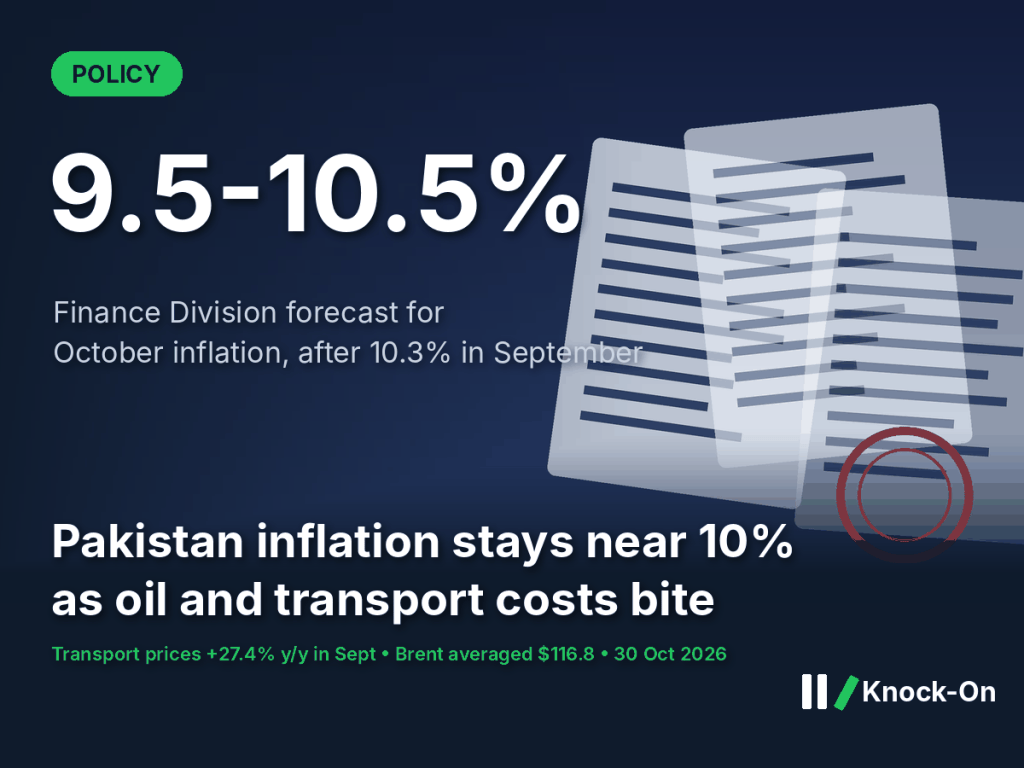
- Business Recorder, FD’s update: Oct inflation projected to stay elevated at 9.5-10.5pc, 30 October 2026
This is analysis, not investment advice. Figures are as of 30 October 2026.


Leave a Reply