
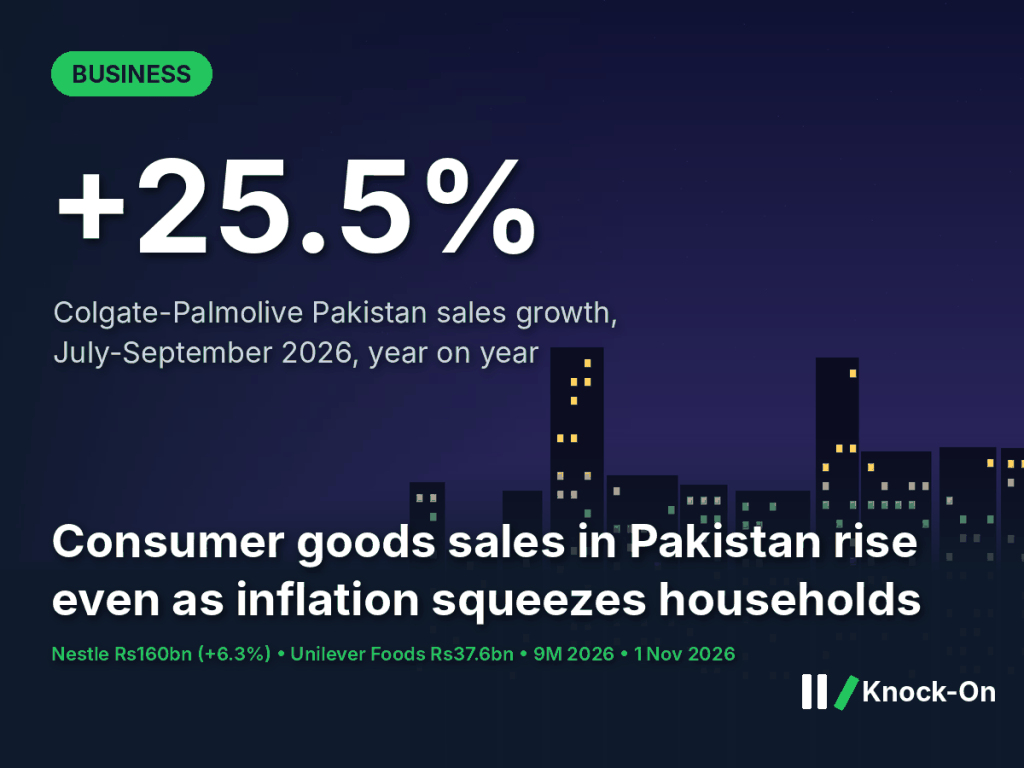
Consumer goods sales in Pakistan grew strongly in 2026, even as food inflation and higher fuel costs squeezed household budgets. Results from six listed food and personal-care companies, compiled by Dawn on 1 November, show sales up between 6% and 26%. But much of that growth came from higher prices, profits did not all follow, and several companies are openly cautious about what comes next.
The short version
- Colgate-Palmolive Pakistan’s sales rose 25.5% to Rs52.7bn in July–September 2026, helped by higher prices and volumes.
- Nestle Pakistan’s nine-month sales reached Rs160bn, up 6.3%; Unilever Pakistan Foods rose to Rs37.6bn from Rs30bn.
- Profits were mixed: FrieslandCampina Engro’s rose to Rs6.5bn from Rs2bn, while Fauji Foods’ fell to Rs666m from Rs945m.
- Companies blame the Middle East war for higher energy, freight and input costs; National Foods says freight rose from $500–600 to $5,000 a container.
What happened
Pakistan’s packaged-food and household-goods makers have reported their results for the first nine months of calendar 2026, or the first quarter of the 2026-27 financial year, depending on their accounting year. Across the six companies, consumer goods sales in Pakistan rose in every case, despite what the companies describe as persistent inflation and weaker purchasing power since the US-Israel war on Iran began on 28 February.
Every company grew sales, but the pace ranged from 6% to 26%
Sales growth, % year on year, latest reported period (9M = Jan–Sep 2026; Q = Jul–Sep 2026)
Nestle Pakistan said growth came from brand investment, product innovation, better execution, exports and “disciplined pricing”, and that it had localised more inputs and built inventories to reduce exposure to the rupee. Its profit after tax rose 3.1% to Rs14.53bn. Unilever Pakistan Foods’ profit rose to Rs6.33bn from Rs4.6bn. Colgate-Palmolive’s profit rose 8% to Rs4.9bn, far slower than its sales. Fauji Foods posted its highest-ever nine-month revenue but a lower profit. National Foods’ quarterly profit rose to Rs888m from Rs801m, and its management, at its annual general meeting, guided for 15% revenue growth in FY27.
Why it matters
These companies sell the everyday basics of Pakistani households: milk, tea whitener, spices, cooking products and toothpaste. Their results show that demand for staples has held up in rupee terms, but they also show how much of the growth is price rather than volume. With the October inflation forecast near 10%, a 6% sales rise, as at Nestle, may mean flat or lower volumes in real terms. Colgate is the clearest case where the company itself credits both higher prices and higher volumes.
The knock-on effects
First order: consumer goods sales in Pakistan rise mostly on price
Higher shelf prices protect revenue, but margins depend on whether costs rise faster. Colgate’s profit grew at less than a third of its sales rate, and Fauji Foods’ profit fell about 30% (Knock-On calculation), showing that pricing power is not universal.
Second order: freight and imported inputs
National Foods says container freight jumped from $500–600 to $5,000, which hits both imported raw materials and exports. Colgate pointed to its reliance on Gulf countries for essential raw materials, a supply-chain risk while shipping around the Gulf remains disrupted.
Third order: tax and the stock market
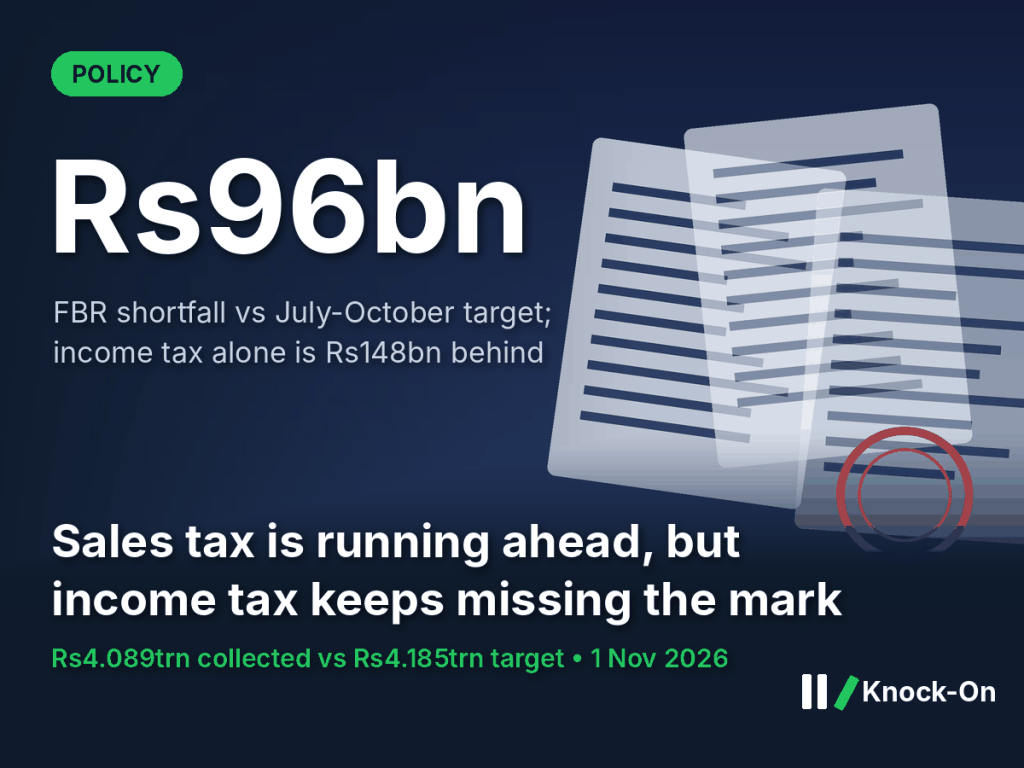
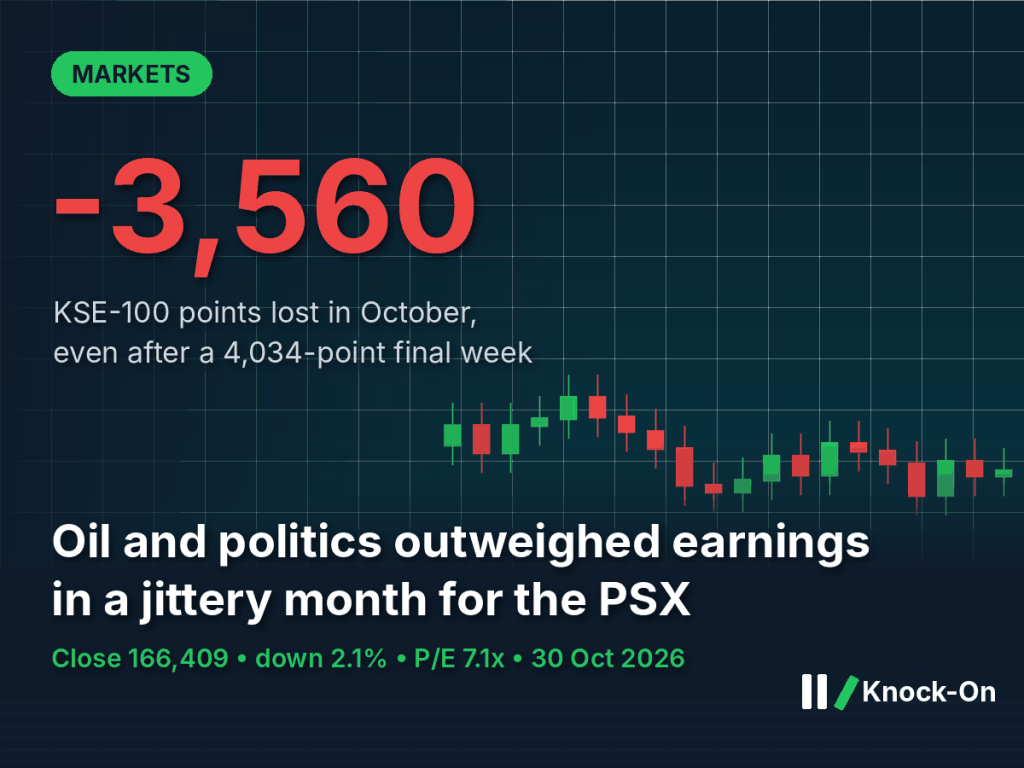
Higher nominal sales lift sales-tax receipts, consistent with the FBR’s four-month figures, where sales tax is running ahead of target. For investors, consumer stocks offer earnings growth in a market that lost 3,560 points in October, though their margins are exposed to the same oil shock.
Who could benefit
- Large brands with pricing power: companies able to pass on costs, as Colgate and Unilever Foods appear to have done.
- Local suppliers: firms supplying inputs as Nestle and others localise to cut foreign-exchange exposure.
- Government revenue: sales tax collected on higher-priced goods.
Who may face pressure
- Households: paying more for the same basket of essentials.
- Smaller and margin-thin producers: those that cannot raise prices as fast as costs, as Fauji Foods’ profit fall suggests.
- Food exporters: facing container costs several times higher than before the war.
What to watch
- Early November: October CPI inflation from the Pakistan Bureau of Statistics, which will show how much of sales growth is price.
- Gulf shipping: any reopening of the Strait of Hormuz, which would ease freight and raw-material costs.
- Fourth-quarter results: whether Nestle’s cautious 2026 outlook, citing energy and input costs, shows up in margins.
- National Foods: progress against its 15% FY27 revenue growth guidance and its plan to launch more than 25 products.
Sources
- Dawn, Consumer firms defy economic headwinds, 1 November 2026
This is analysis, not investment advice. Figures are as of 1 November 2026.


Leave a Reply