
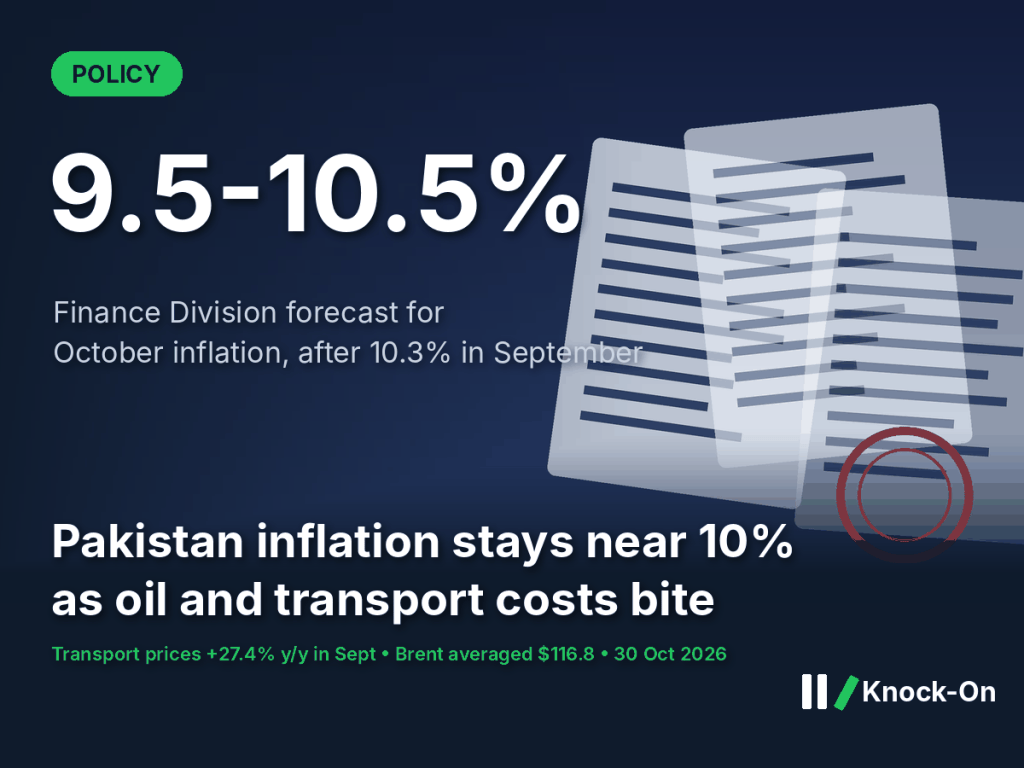
The Pakistan inflation forecast for October is 9.5–10.5%, the Finance Division said in its monthly economic outlook published on 30 October. That keeps prices rising at close to 10% a year for a third straight month, after 11.1% in August and 10.3% in September. The ministry blames the Gulf conflict, volatile oil prices and trade disruption, and calls inflation a downside risk for the economy. For businesses, it means another month of rising costs and borrowing rates that are moving up, not down.
The short version
- The Finance Division expects October CPI inflation of 9.5–10.5%, after 10.3% in September.
- Inflation averaged 10.2% in July–September, against 4.3% a year earlier.
- Transport prices rose 27.4% year on year in September; Brent averaged $116.8 a barrel that month.
- The SBP raised its policy rate by 50 basis points to 12.0% from 27 October.
What happened
The Finance Division’s Monthly Economic Update and Outlook for October 2026, reported by Business Recorder, projects that inflation will stay “elevated” at 9.5–10.5% this month. The report says headline inflation eased to 10.3% in September from 11.1% in August, but the average for the first quarter of FY2027 was 10.2%, more than double the 4.3% of the same period last year.
Energy is the main driver. Transport prices were up 27.4% year on year in September, and Brent crude averaged $116.8 a barrel, 28.4% higher than in August. The report also lists housing, water, electricity, gas and fuel up 12.4%, perishable food up 11.8% and non-perishable food up 7.6%. Pump prices have kept climbing since: Knock-On reported this week that the diesel price in Pakistan rose to Rs398.07 a litre.
Inflation has more than doubled from a year ago, and October will stay near 10%
CPI inflation, % year on year; October is the Finance Division’s forecast range
Why it matters
The Pakistan inflation forecast shapes what the State Bank does next. The Monetary Policy Committee raised the policy rate by 50 basis points to 12.0% from 27 October. With September inflation at 10.3%, the real policy rate is about 1.7 percentage points (Knock-On calculation). If October lands at the top of the forecast range, that cushion shrinks to 1.5 points, which leaves little room for rate cuts. As Knock-On noted after the US Federal Reserve’s decision, the gap between Pakistani and US rates also matters for foreign money in government debt.
Other numbers in the report show the cost. Large-scale manufacturing grew only 1.9% in July–August, against 4.8% a year earlier. Imports rose 14.3% to $17.8bn in the first quarter while exports grew 7.7% to $8.5bn, and the current account deficit widened to $874m from $755m.
The knock-on effects
First order: costs stay high
Fuel, freight and power make up a growing share of business costs. With transport inflation at 27.4%, distributors, retailers and manufacturers that move goods by road face the sharpest increase.
Second order: borrowing gets dearer
With the policy rate at 12.0% and inflation near 10%, bank lending rates are unlikely to fall soon. That weighs on firms that fund stock and working capital with short-term loans.
Third order: demand slows
Households spending more on transport and utilities have less left for other goods. Weak manufacturing growth suggests this is already showing up in output. Further energy price moves, such as the LPG pricing change due on 1 November, could add to the pressure.
Who could benefit
- Savers and banks: higher policy rates lift returns on deposits and government securities.
- Exporters with dollar income: remittances rose 14% to $10.9bn and exports grew, which supports firms earning foreign currency.
- Farm producers: maize and sugarcane output rose 12.1% and 8.8%, and food prices are still climbing.
Who may face pressure
- Transport and logistics firms facing fuel costs that are rising faster than their rates.
- Manufacturers that rely on bank credit, as LSM growth slows.
- Fixed-income households, whose purchasing power is falling.
What to watch
- Early November: the Pakistan Bureau of Statistics releases October CPI, which will test the 9.5–10.5% forecast.
- 1 November: the new fortnightly fuel prices and the LPG pricing formula.
- Gulf talks: any progress in US–Iran mediation could ease oil prices, the biggest single risk named in the report.
Sources
- Business Recorder, FD’s update: Oct inflation projected to stay elevated at 9.5-10.5pc, 30 October 2026
This is analysis, not investment advice. Figures are as of 30 October 2026.

Leave a Reply