
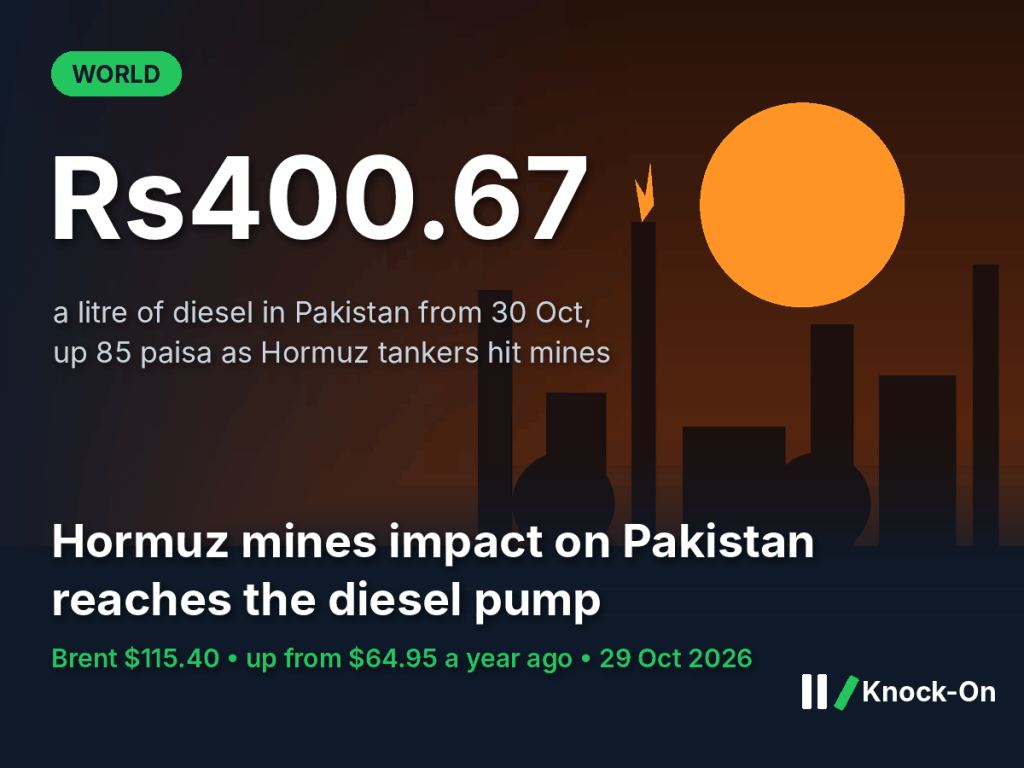
The Hormuz mines impact on Pakistan is now visible at the pump. Iran’s navy said on Thursday that four oil tankers had struck sea mines in and near the Strait of Hormuz, and on Friday the price of high-speed diesel in Pakistan rose to Rs400.67 a litre under the daily pricing system. Brent crude stayed above $114 a barrel, close to double its level a year ago. Whether that eases now depends partly on Iran’s reply to a Qatari peace draft, which officials expect by Saturday.
The short version
- Iran’s navy claimed four tankers hit mines while using a US-promoted route through the Strait of Hormuz; UKMTO confirmed one vessel on fire.
- Diesel in Pakistan rose 85 paisa to Rs400.67 a litre on 30 October; petrol was unchanged at Rs377.91.
- Brent was $115.40 on Thursday morning, against $64.95 a year earlier.
- Qatar has given Iran a new draft deal; Pakistan, a co-mediator, has urged both sides to honour their commitments.
What happened
Iran’s Revolutionary Guards said three oil tankers exploded and caught fire after striking naval mines while using an “unauthorized southern route” through the strait, CBS News reported. Iran’s navy later said a fourth tanker was damaged east of the strait and that the waterway was closed “to violating vessels”. The UK Maritime Trade Operations centre (UKMTO) confirmed one vessel seen on fire nine nautical miles north of Khasab, Oman, and separately reported a tanker struck by a projectile while leaving the strait, with no injuries reported. The Iranian claims have not been independently verified, and the Guards challenged US Central Command to prove its mine-clearing claims.
In Pakistan, the Petroleum Division’s notification raised diesel from Rs399.82 to Rs400.67 a litre for 30 October, The Express Tribune reported. A day earlier diesel had risen Rs1.75 and petrol Rs1.85, according to Profit. Since July, fuel prices have been reset daily, so moves in Gulf oil now reach the pump within days, as Knock-On explained when daily pricing pushed diesel up for a fifth time in a row.
Brent is 78% dearer than a year ago, despite this week’s small dip
Brent crude, US$ per barrel, morning prices as of 29 October 2026
Why it matters
Diesel moves goods, runs tractors and powers backup generators, so a price above Rs400 a litre feeds into freight, farm and factory costs across the economy. Oil actually slipped on Thursday: Reuters put Brent at $114.92 in New York afternoon trade, down 0.35%, with UBS analyst Giovanni Staunovo saying prices were “under pressure today amid renewed diplomatic efforts”. But each mine or missile report keeps a risk premium in the price, and Pakistan’s daily formula passes it on. The same risk hangs over gas: QatarEnergy’s chief, Saad Sherida Al-Kaabi, told Reuters that a closure of the strait would bring an immediate “spike in gas price”, which matters because Pakistan’s winter LNG supply still rests on Qatar and the spot market.
The knock-on effects
First order: the Hormuz mines impact on Pakistan’s fuel bill
Diesel has risen Rs2.60 a litre in two days, from Rs398.07 on 28 October (Knock-On calculation from Profit and Express Tribune figures). Transporters, farmers and industries running generators pay first.
Second order: freight and food prices
Higher diesel tends to show up in goods transport fares and then in food and retail prices, which keeps pressure on inflation after the State Bank’s recent rate rise.
Third order: the post-midterm risk
US officials have told Middle Eastern allies to prepare for possible strikes on Iran after the 3 November midterm elections, AP reported, though President Trump has not made a final decision. Knock-On looked at that scenario in what renewed fighting could mean for Pakistan. A deal through the Qatar and Pakistan mediation track would point the other way.
Who could benefit
- Oil and gas producers earn more per barrel while prices stay high.
- Fuel marketers can gain on inventory when prices rise between resets.
- Solar and battery suppliers may see more demand from businesses cutting generator use.
Who may face pressure
- Goods transporters and logistics firms, whose biggest cost is diesel.
- Farmers preparing land and running tubewells for the wheat season.
- Gas-dependent industry, if LNG prices jump on any wider closure of the strait.
What to watch
- Saturday 31 October: Iran’s expected response to the Qatari draft, which envisages a seven-day timetable for confidence-building measures, according to The Nation.
- Sunday 1 November: the OPEC+ meeting on supply targets; see Knock-On’s oil price forecast for Pakistan.
- Tuesday 3 November: the US midterms, after which strikes are reportedly being considered.
- Daily: OGRA and Petroleum Division price notifications for diesel and petrol.
Sources
- CBS News, Tankers strike mines in Strait of Hormuz, Iran says, as Hegseth fires top general, 29 October 2026
- The Express Tribune, Diesel crosses Rs400 mark, petrol remains unchanged for Oct 30, 30 October 2026
- Profit, Govt hikes petrol price by Rs1.85, diesel by Rs1.75 per litre for October 29, 29 October 2026
- The Express Tribune (Reuters), Oil falls as diplomacy hopes outweigh Middle East escalation fears, 29 October 2026
- The Express Tribune (Reuters), QatarEnergy buys US, other LNG to hedge future Hormuz disruptions, 29 October 2026
- The Nation, US weighs fresh strikes on Iran as Qatar pushes peace deal, 29 October 2026
- Fortune, Current price of oil as of October 29, 2026, 29 October 2026
This is analysis, not investment advice. Figures are as of 30 October 2026. Knock-On is not affiliated with any political party.

Leave a Reply