
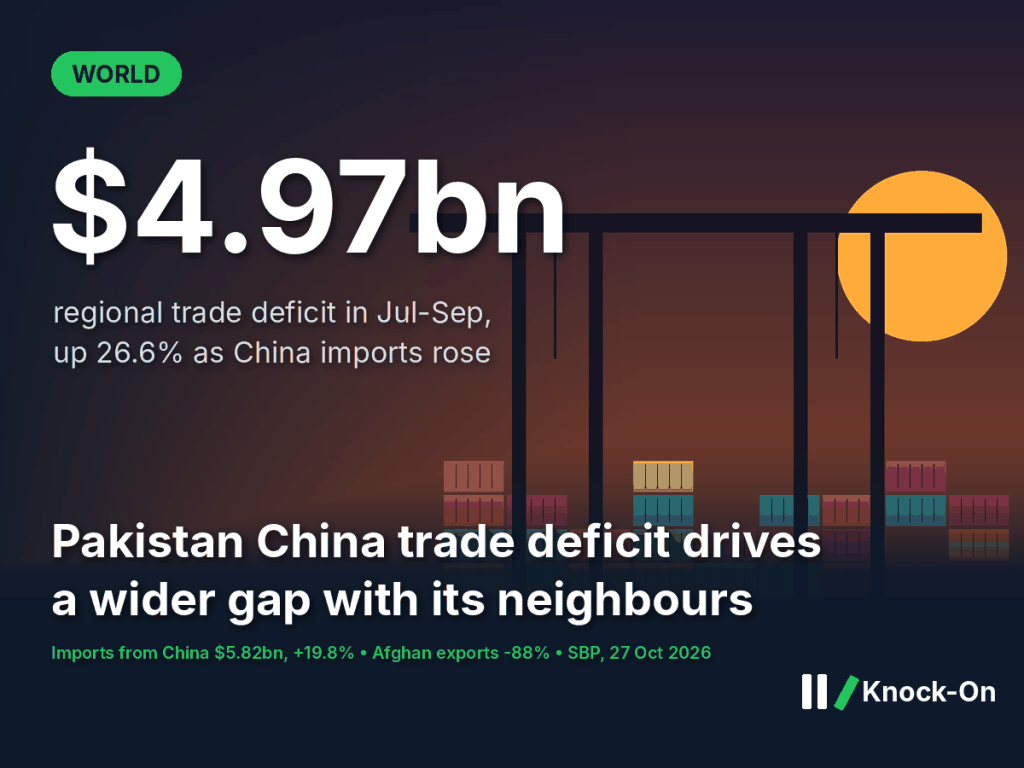
The Pakistan China trade deficit is now the main reason Pakistan’s trade gap with its neighbours is growing. State Bank of Pakistan data compiled by Dawn shows the deficit with nine regional countries rose 26.62% to $4.97bn in July–September 2026, the first quarter of FY27. Imports from China rose by almost $1bn, while exports to Afghanistan, where trade has been suspended for a year, fell by 88%.
The short version
- Pakistan’s trade deficit with nine regional countries widened 26.62% to $4.97bn in the first quarter of FY27, from $3.93bn a year earlier.
- Imports from China rose 19.76% to $5.82bn; the China deficit alone accounts for about 82% of the increase.
- Exports to the region fell 6.72% to $944m, dragged down by Afghanistan (down 88.34%) and Bangladesh.
- Exports to China did grow, by 17.95% to $664m, but from a base too small to close the gap.
What happened
According to the latest SBP figures reported by Dawn on 27 October, Pakistan imported $5.92bn of goods from its nine regional neighbours (Afghanistan, China, Bangladesh, Sri Lanka, India, Iran, Nepal, Bhutan and the Maldives) in July–September, up 19.79% from $4.94bn. Exports to the same group fell to $944.24m from $1.01bn.
China dominates both sides of the ledger. Imports from China rose to $5.82bn from $4.85bn, while exports to China rose to $663.57m from $562.56m. The bilateral deficit widened by $858.8m, which Dawn calculates as about 82.18% of the total increase in the regional deficit.
Imports from China grew far faster than regional exports
Pakistan’s trade with nine regional countries, US$ billions, July–September (Q1) of FY26 and FY27
Elsewhere, the picture is mostly one of shrinking sales. Exports to Afghanistan collapsed to $18.86m from $161.76m, as trade across the border has been suspended since 10 October 2025 (Knock-On covered the Pakistan–Afghanistan border closure and trade talks earlier this month). Exports to Bangladesh slipped 2.96% to $174.77m. Pakistan recorded no exports to India, while imports from India rose 68.9% to $61.74m.
Why it matters
A wider Pakistan China trade deficit means more dollars leaving the country to pay for imports, at a time when the oil bill is already high. The same pattern showed up in the Gulf, where Knock-On found that the Pakistan Gulf trade deficit narrowed only because imports fell. In both cases, exports are not doing the work. That matters for the government’s stated goal of export-led growth in Pakistan: the region next door is becoming a harder market, not an easier one.
The knock-on effects
First order: more dollar demand for Chinese imports
Importers paying for Chinese goods need more foreign exchange. The data does not break the imports down by product, so it is not yet clear how much is industrial inputs that support future output and how much is consumer goods.
Second order: lost markets for border exporters
Exporters who used to sell to Afghanistan have lost about $143m in quarterly sales compared with a year ago (Knock-On calculation). Bangladesh, the other large regional buyer, is also buying slightly less.
Third order: pressure on the wider trade balance
If regional imports keep rising while exports fall, the gap has to be covered by remittances, Gulf trade or financing. That makes Pakistan’s external position more sensitive to oil prices and to the rupee.
Who could benefit
- Exporters to China: sales rose almost 18%, showing demand for some Pakistani goods is growing.
- Importers and traders of Chinese goods: volumes are higher, which supports logistics, ports and distribution.
- Manufacturers using Chinese inputs: if the imports are mainly machinery and raw materials, they could support future production.
Who may face pressure
- Firms that sold to Afghanistan: exports there are down 88% with no reopening date.
- Local producers competing with Chinese imports: more imported goods mean more competition at home.
- The rupee and foreign reserves: a wider deficit adds to demand for dollars.
What to watch
- October trade data from PBS in early November, to see if imports from China keep rising.
- Any move to reopen trade with Afghanistan. Pakistan said on 26 October that its cross-border strikes targeted militants and rejected Afghan claims of civilian casualties; it has said normal trade and transit depend on action against anti-Pakistan groups.
- A product breakdown of Chinese imports, which would show whether they are inputs or finished goods.
Sources
- Dawn, Regional trade deficit widens sharply, 27 October 2026
- Business Recorder, Pakistan says cross-border strikes targeted terrorists, rejects Afghanistan’s allegations, 26 October 2026
This is analysis, not investment advice. Figures are as of 27 October 2026. Knock-On is not affiliated with any political party.


Leave a Reply