
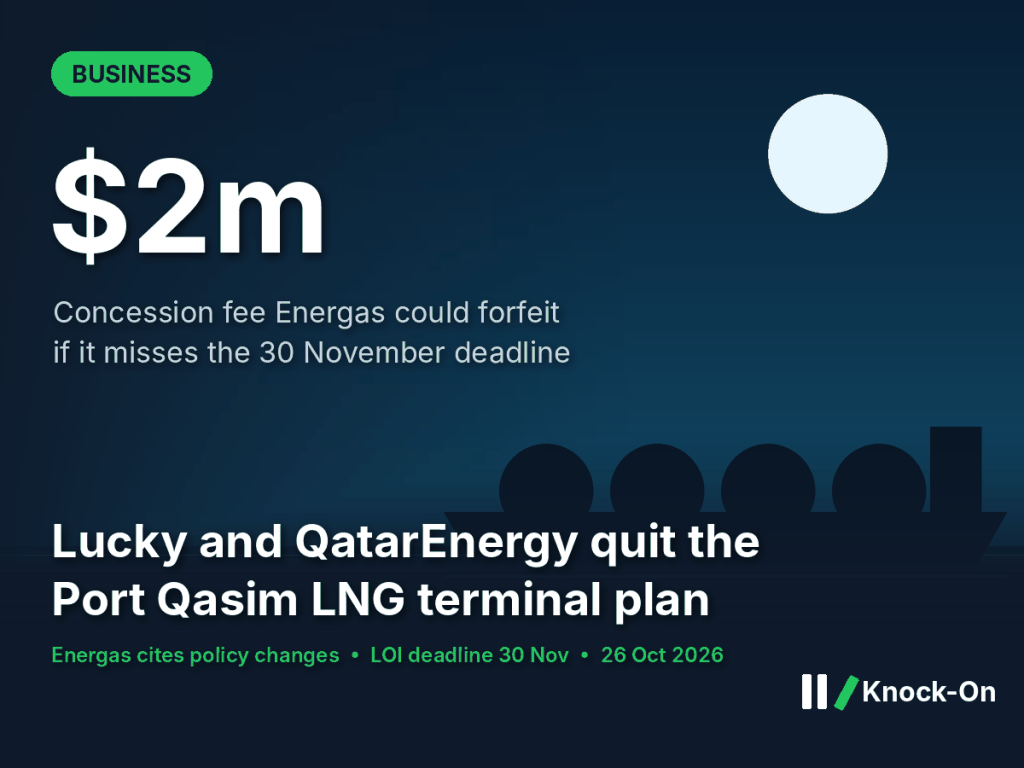
The Port Qasim LNG terminal planned by Energas, a consortium of Lucky Group and QatarEnergy, has been abandoned, Dawn reported on 26 October. The consortium blames “fundamental changes” in Pakistan’s energy policy and years of unresolved tax and pipeline issues. The Port Qasim Authority (PQA) says it will terminate the project’s letter of intent, and keep a $2m concession fee, unless Energas gives “unconditional acceptance” by 30 November 2026. For business, the signal matters more than the money: a large local group and a Gulf state energy company have stepped back from a gas project they had funded themselves.
The short version
- Energas has dropped its Port Qasim LNG terminal, citing a change in national energy policy and unresolved fiscal issues.
- The port says the $2m initial concession fee will be forfeited if Energas does not give unconditional acceptance by 30 November.
- Energas has asked the Prime Minister for a refund, saying it committed no contractual lapse.
- Qatar had offered extra LNG at about 10.2% of Brent, according to sources quoted by Dawn.
What happened
Energas chairman Muhammad Ali Tabba wrote that the consortium cannot proceed because of “a fundamental change in national energy policy and requirements”, which he called a “clear frustration of purpose”, and “persistent and longstanding unresolved policy and fiscal matters” with the government, the PQA and other bodies. He said the government had committed to resolving these matters after talks with Qatar, but they remain open. Energas points to the government’s own Integrated Energy Study of March 2025, which it says found no new LNG terminals were needed over the next five years.
Energas also says the five-year tax holiday offered under the LNG Policy 2011, in place when its provisional letter of intent was issued in May 2020, was withdrawn for new terminals in June 2021. It attributes that change to IMF conditions. The PQA’s position is that the $2m is a partial concession fee under the Project Guidelines 2019, not a refundable advance, and that pipeline capacity, gas transport agreements, third-party access exemptions and the tax issue were the developer’s responsibility. Dawn reported no government response to the refund request.
Why it matters
The terminal was tied to a supply offer. According to sources quoted by Dawn, QatarEnergy had booked terminal capacity and committed to supply extra LNG at about 10.2% of Brent, close to the rate in its second-term contract with Pakistan State Oil. In return, Qatar wanted pipeline capacity from the terminal, a level playing field for marketing LNG, and an exemption from rules that reserve part of a private terminal’s capacity for government entities. With Brent at $114.70 on 26 October, a price linked to oil at that slope is not cheap gas, as the chart shows. That is part of why Pakistan is now also exploring long-term US LNG contracts.
At 10.2% of Brent, today’s oil price means LNG near $11.70
Implied LNG price at a 10.2% Brent slope, $ per mmBtu, at different Brent levels
The knock-on effects
First order: a $2m dispute with the port
The immediate question is the fee. The PQA says paragraph 27 of the final letter of intent requires forfeiture if acceptance is not received by 30 November. Energas says the delay was caused by the government and factors beyond its control. Unless the Prime Minister’s office intervenes, the money is likely to stay with the port.
Second order: no new private LNG route
A private terminal backed by a supplier would have given industry another way to import gas outside government channels. Without it, winter supply still depends on existing terminals and government cargo decisions, which were already running weeks late. Dawn notes that Pakistan sought to divert contracted LNG cargoes after the 28 February attacks on Iran, the closure of the Strait of Hormuz and the suspension of Qatar’s LNG production.
Third order: the investment message
Energas’s complaint is that incentives changed after it committed money. Foreign investors watch such cases closely, at a time when Pakistan is already debating profit repatriation and weak net FDI. How the refund request is handled will be read as a test of policy consistency.
Who could benefit
- Existing LNG terminals: they face no new private competitor at Port Qasim for now.
- Port Qasim Authority: it keeps the $2m fee if the deadline passes, under its reading of the contract.
- Government planners: they avoid adding import capacity that their own energy study, as cited by Energas, said was not needed.
Who may face pressure
- Lucky Group and QatarEnergy: self-funded project costs and the $2m fee are at risk.
- Industrial gas users: one possible source of privately marketed LNG is gone.
- Pakistan’s investment pitch: other foreign energy investors may ask for stronger guarantees before committing.
What to watch
- 30 November 2026: the PQA deadline for unconditional acceptance.
- Any reply from the Prime Minister’s office to the refund request.
- Winter LNG cargo decisions and progress on US LNG talks.
- Brent prices, which set the cost of oil-linked LNG.
Sources
- Dawn, Lucky Group, Qatar Energy consortium quits Port Qasim LNG terminal plan over ‘policy changes’, 26 Oct 2026
- Business Recorder (Reuters), Oil slips $2 a barrel but stays near six-month highs on Saudi attacks, 26 Oct 2026
This is analysis, not investment advice. Figures are as of 27 October 2026.

Leave a Reply