
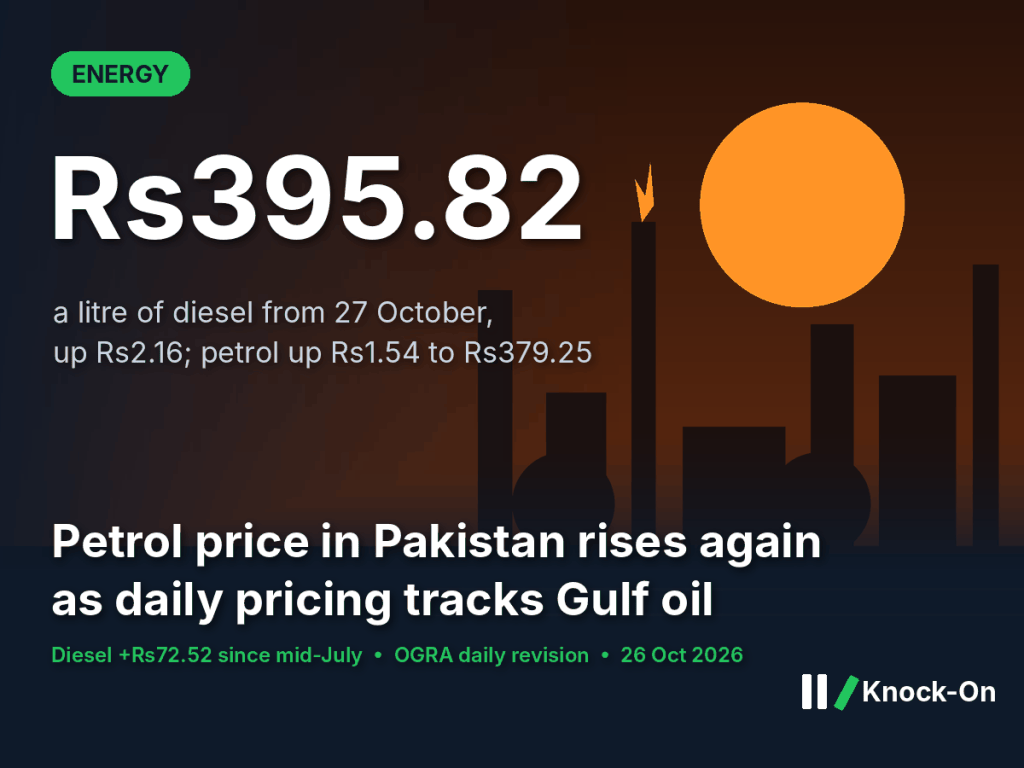
The petrol price in Pakistan goes up by Rs1.54 to Rs379.25 a litre from Tuesday, 27 October, and high-speed diesel rises by Rs2.16 to Rs395.82, the Petroleum Division said on Monday night. It is the fifth diesel increase in a row under the government’s daily pricing system, and it came on a day when Brent crude actually fell. For transporters, farmers and factories, the message is that pump prices now move with Gulf oil costs almost in real time.
The short version
- Petrol: Rs377.71 to Rs379.25 a litre (+Rs1.54). Diesel: Rs393.66 to Rs395.82 (+Rs2.16). Effective 27 October.
- OGRA cited “global developments, including changes in Platts rates”, premiums and incidental costs.
- Since daily pricing began after mid-July, petrol is up Rs68.54 and diesel Rs72.52 a litre, ProPakistani reports.
- Diesel, the fuel of freight and farming, is rising faster than petrol.
What happened
According to a Petroleum Division notification reported by APP and Business Recorder, the Oil and Gas Regulatory Authority (OGRA) revised ex-depot prices under the federal government’s pricing mechanism. The new petrol price in Pakistan is Rs379.25 a litre and diesel is Rs395.82. No changes were reported for kerosene or light diesel oil. On Friday, the government had raised diesel by Rs1.91 and left petrol unchanged.
Prices are now revised daily. ProPakistani’s record shows diesel was cut by Rs7.69 on 19 October, then raised in each of the five revisions since: by Rs0.53, Rs0.31, Rs1.64, Rs1.91 and now Rs2.16. Petrol has moved both ways over the same period. Both fuels are still slightly below their 16 October levels (petrol Rs386.30, diesel Rs396.96).
Both fuels cost about 22% more than in mid-July
Pump price, rupees per litre: 11–17 July 2026 vs from 27 October 2026
Why it matters
Brent fell $2.03 to $114.70 a barrel on Monday on hopes of easing US–Iran tensions, Business Recorder reported, yet pump prices still rose. Pakistan prices fuel off Platts product rates and import premiums, not the headline crude price, so relief from the Makkah pact Iran talks in Tehran will reach pumps only if refined-product costs follow. Diesel matters most to business: it moves goods, runs tractors and tubewells, and backs up power for many factories. It is also the fuel behind the price pressure dealers flagged last week.
The knock-on effects
First order: a higher petrol price in Pakistan hits running costs
A truck that burns 100 litres of diesel a day now pays Rs216 more per day than on Monday, and about Rs7,252 more than in mid-July (Knock-On calculation). Motorcycle commuters and delivery riders feel the petrol rise directly.
Second order: freight and food prices
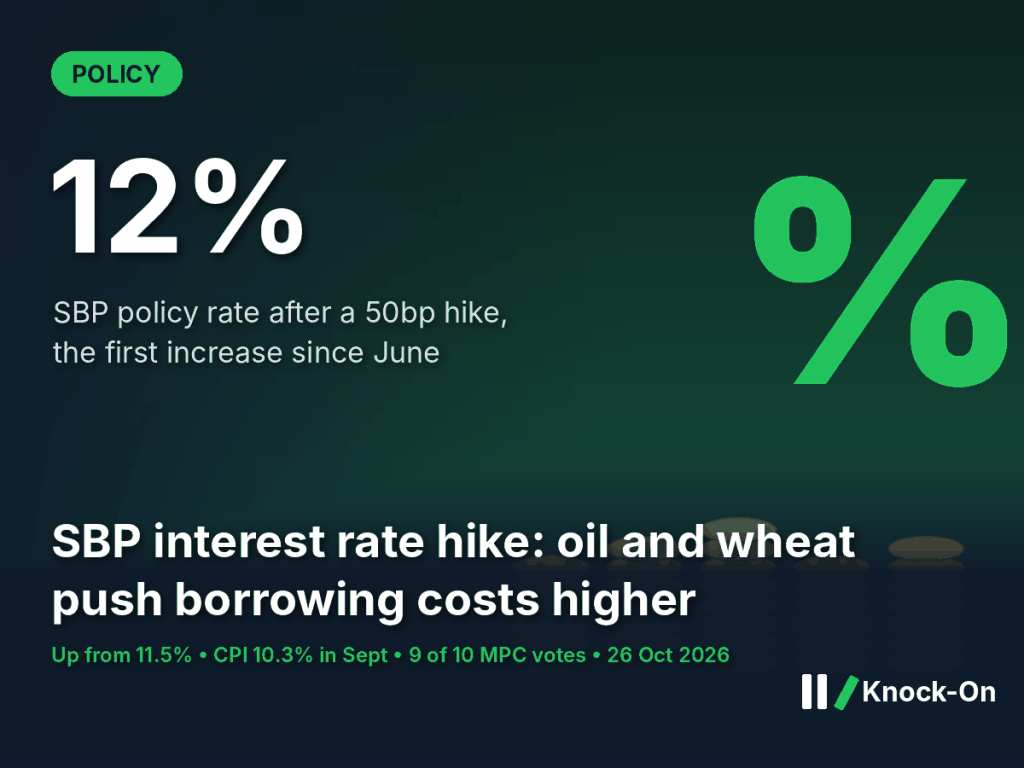
Transporters tend to pass fuel costs into freight rates, which feed into food and retail prices. That matters because the State Bank has just raised the SBP interest rate to 12%, citing energy prices among its inflation concerns.
Third order: planning under daily prices
Daily revisions make monthly fuel budgets and fixed-price delivery contracts harder to set. Businesses may push for fuel-indexed clauses, and buyers may hold off on long-term transport deals until oil settles.
Who could benefit
- Fuel retailers and oil marketing companies: rising prices can lift the value of stock already held, depending on how margins are set.
- CNG, EV and solar suppliers: a wider gap with diesel strengthens the case for switching.
- Logistics firms with fuel-indexed contracts: they can pass costs through faster.
Who may face pressure
- Truckers and goods transporters on fixed-rate contracts.
- Farmers running tractors and diesel tubewells during the wheat sowing season.
- Factories relying on diesel generators for backup power.
- Households, through transport fares and food prices.
What to watch
- The next daily revision: whether Monday’s fall in crude feeds through.
- US Federal Reserve decision, Wednesday 28 October: dollar moves affect import costs.
- Iran diplomacy and Houthi attacks on Saudi facilities: the main driver of Gulf product prices.
- The next weekly SPI inflation reading, for the first sign of fuel costs in food prices.
Sources
- APP, Diesel price rises by Rs2.16, petrol by Rs1.54 per litre, 26 Oct 2026
- Business Recorder, Govt increases diesel price by Rs2.16, petrol by Rs1.54 per litre, 26 Oct 2026
- ProPakistani, Another Fuel Price Bomb Hits Nation, 26 Oct 2026
- Yahoo Finance / Euronews, Oil plunges more than 6% from near wartime highs as diplomacy over Iran seemingly gathers pace, 26 Oct 2026
This is analysis, not investment advice. Figures are as of 26 October 2026.

Leave a Reply