
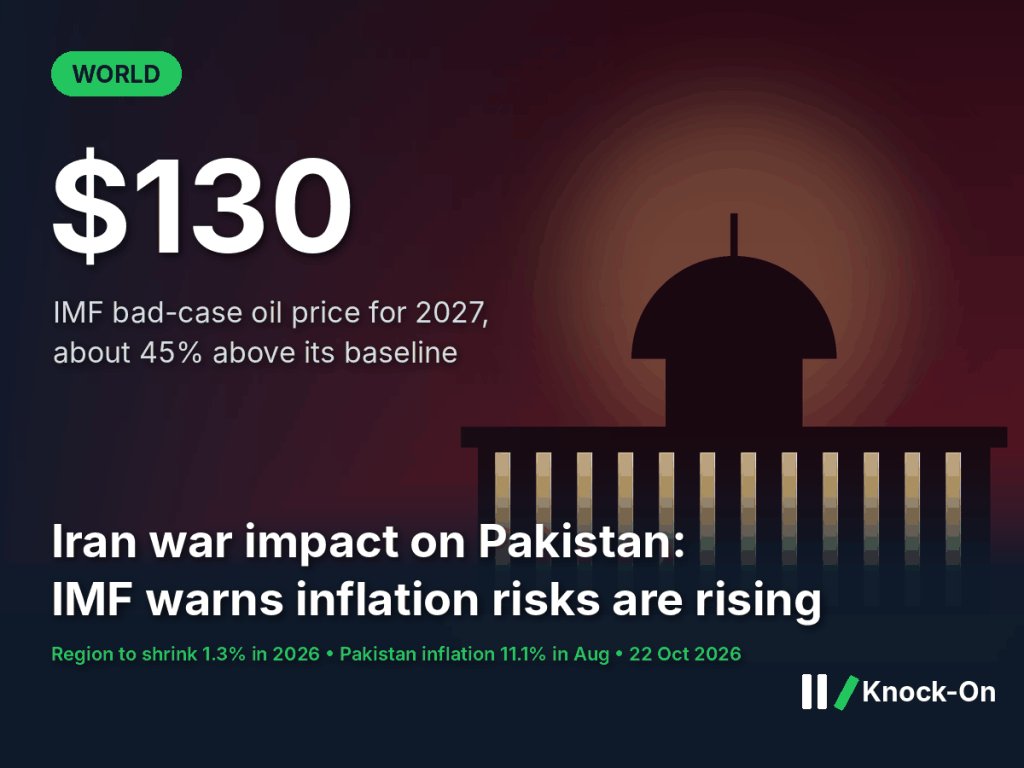
The Iran war impact on Pakistan is now being measured by the International Monetary Fund. In its regional outlook released in Dubai on Thursday, 22 October, the IMF said inflation among the region’s oil importers rose most sharply in Egypt and Pakistan, and warned that central banks should be ready to tighten policy if price risks grow. Its worst case, a war that runs into mid-2027, would put oil at about $130 a barrel next year. For Pakistani businesses, the report is a guide to what fuel, borrowing and import costs could look like if the Gulf conflict does not ease.
The short version
- The IMF expects output in the Middle East, North Africa and Pakistan region to shrink 1.3% in 2026, then grow 6.6% in 2027.
- Pakistan’s inflation reached 11.1% year on year in August, the IMF says, second only to Egypt’s 14.5% among the region’s oil importers.
- If fighting continues through the second quarter of 2027, oil could average about $130 a barrel in 2027, roughly 45% above the IMF’s baseline.
- Brent crude already closed at $112.17 on 22 October, its highest since May.
What happened
The IMF’s October 2026 Regional Economic Outlook: Middle East and Central Asia blames the US-Israeli-led war against Iran for disrupting energy production, shipping, tourism, trade and confidence across the region, according to Reuters. Oil exporters were hit hardest. Oil importers such as Pakistan proved more resilient, the IMF said, helped by remittances, tourism, favourable financial conditions and prompt policy responses.
The headline forecast is for the region as a whole; the reports seen by Knock-On do not give a separate Pakistan growth number from this outlook. The IMF’s World Economic Outlook on 13 October put Pakistan’s growth for 2026-27 at 3.5% and raised its Pakistan inflation forecast to 9.9%, from 8.4%.
On Pakistan specifically, Business Recorder reports that the IMF found GDP growth in the first half of 2026 broadly in line with late 2025, net remittances broadly stable as a share of GDP, and that Pakistan was the only country in the region with a flexible exchange rate to raise interest rates after the conflict began. Over the medium term, it warned, the external position could weaken as imports rise and remittances ease.
Why it matters
Pakistan imports most of its fuel, so the Iran war impact on Pakistan travels mainly through the oil price. The IMF’s baseline assumes the conflict eases in early 2027. Its adverse case is the one businesses should note: oil about 45% above baseline, regional output about 3.8% lower on average, and inflation about 1.25 percentage points higher in 2027. Brent is already well above the level implied by the IMF baseline.
Oil is already closer to the IMF’s bad case than its baseline
Oil price, US dollars a barrel: IMF 2027 scenarios vs Brent close on 22 Oct 2026
The knock-on effects
First order: fuel and freight costs
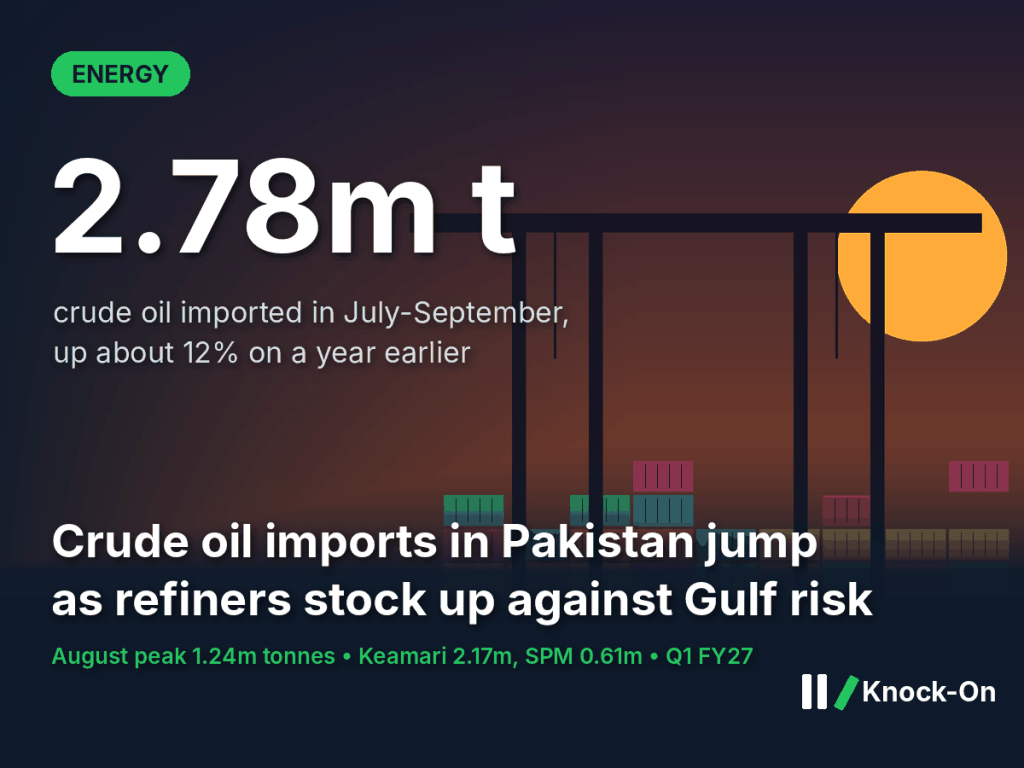
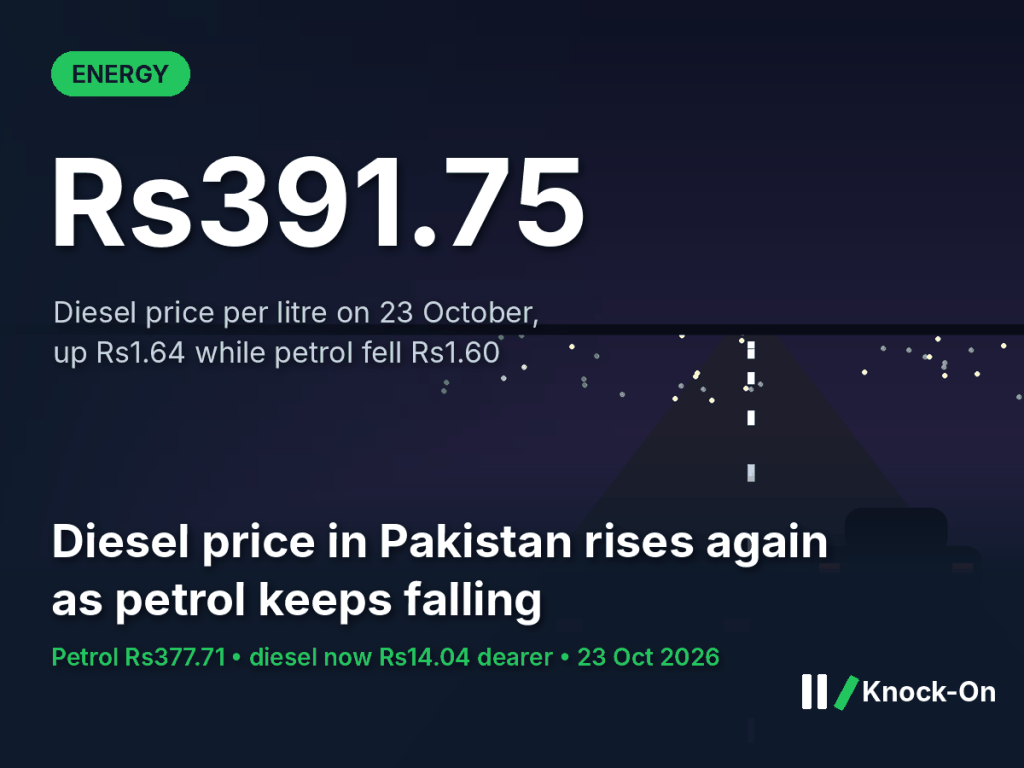
Every sustained move in crude feeds into Pakistan’s fortnightly and daily fuel pricing. Earlier Knock-On analysis estimated that Pakistan’s oil import bill could rise by up to $1.2bn a quarter at current prices. A move towards $130 would add to that.
Second order: interest rates stay higher
The IMF said countries “should stand ready to tighten monetary policy, particularly where inflation is already above target.” That puts extra weight on the SBP interest rate decision on 26 October, where analysts are split between a hold and a hike. Cheaper working capital looks less likely while oil stays high.
Third order: the external account and remittances
Gulf countries are a major source of Pakistan’s remittances. The IMF’s warning that imports may rise while remittances ease points to pressure on the current account and the rupee over the medium term, which would raise costs for any business that imports inputs.
Who could benefit
- Oil and gas producers: higher crude prices lift the value of local output.
- Banks and savers: a higher-for-longer rate outlook supports interest income and deposit returns.
- Exporters with dollar revenue: any rupee weakness would raise their earnings in rupee terms.
Who may face pressure
- Transport, logistics and farming: diesel is their largest variable cost.
- Borrowers and SMEs: a rate rise or a long hold keeps financing expensive.
- Households dependent on Gulf remittances: exposed if jobs or transfers from the region weaken.
- Airlines and power producers using imported fuel: higher fuel bills feed through to fares and tariffs.
What to watch
- 26 October: the State Bank of Pakistan’s monetary policy decision.
- Early November: October inflation data from the Pakistan Bureau of Statistics.
- Gulf shipping: further attacks on tankers or Saudi oil sites, which the IMF lists as the main risk to its forecast.
- Brent crude: whether it holds above $110 a barrel.
Sources
- Business Recorder, IMF flags rising inflation risks for Pakistan amid Middle East conflict, 22 October 2026
- Arab News (Reuters), IMF sees 1.3% contraction in Middle East, North Africa and Pakistan in 2026, 22 October 2026
- Express Tribune (Reuters), Oil jumps on escalating Middle East conflict, 22 October 2026
- Express Tribune, IMF raises inflation forecast to 9.9%, 13 October 2026
This is analysis, not investment advice. Figures are as of 23 October 2026. Knock-On is not affiliated with any political party.


Leave a Reply