
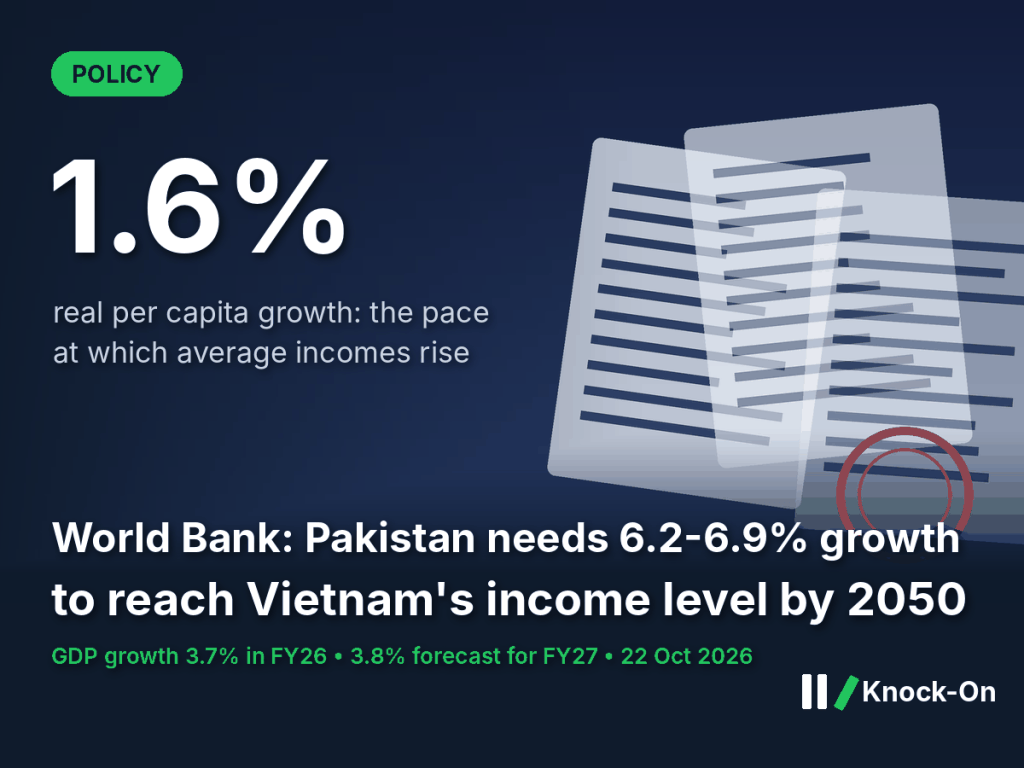
World Bank Pakistan growth projections released on Thursday put the economy on course for about 3.8% growth this fiscal year, a little faster than last year’s 3.7%. The bank’s new Pakistan Development Update says stability has returned and markets have noticed, but the income of the average Pakistani is rising only about 1.6% a year. To reach Vietnam’s current income level by 2050, it says, growth would need to run at 6.2% to 6.9% a year, backed by reforms that bring in far more private investment.
The short version
- The World Bank’s baseline forecast for FY27 is 3.8% real GDP growth, after 3.7% in FY26 and 3.2% in FY25.
- Real per capita growth, the pace at which average incomes rise, is “stuck at around 1.6 percent”.
- Faster structural reforms could roughly triple incomes per person by 2050, the bank says.
- A longer Middle East conflict is the biggest near-term risk, through oil and gas import costs.
What happened
The report, titled Attaining Escape Velocity, credits Pakistan with a record primary fiscal surplus of 2.9% of GDP in FY26, lower energy subsidies (0.8% of GDP, down from 1.1%) and a $3bn Eurobond issued after rating upgrades from S&P and Moody’s. “Pakistan has made real progress in restoring stability, and markets have taken notice,” said Bolormaa Amgaabazar, the World Bank’s country director for Pakistan, as reported by Dawn and Business Recorder. “But real per capita growth… remains stuck at around 1.6%,” she added, saying reforms “are now urgently needed”.
Lead author Sebastian Essl said “structural reform to encourage private investment is the necessary next step towards higher living standards”. The bank’s list covers the business environment, the tax system, the state’s role in the economy and access to finance, building on power tariff changes, the National Tariff Policy and the PIA sale.
Pakistan’s growth is well short of the pace the World Bank says it needs
Real growth rates, % a year
Why it matters
The World Bank Pakistan growth outlook confirms what firms are already feeling: the economy is stable but slow. Growth near 4% with a population still rising leaves little room for household spending to climb, which caps sales for consumer businesses. The bank’s figures sit close to the official numbers we covered when Pakistan GDP growth was revised to 3.65%. The reform list also overlaps with what the IMF wants, including trimming Rs2.35trn of tax exemptions.
The knock-on effects
First order: oil is the near-term risk
According to Geo News, the report notes that petroleum and gas made up about a quarter of FY25 imports, or 3.7% of GDP, with around 80% coming from Gulf states. The crude oil import bill rose 46.4% year on year from January to June 2026. A longer conflict would widen the current account gap and squeeze reserves, a risk we flagged in our look at Pakistan’s oil import bill.
Second order: farming and climate
The bank’s scenario analysis shows zero growth in crop output would cut FY27 growth to 3.6%. It says this is a conditional scenario, not the forecast, and points to a stronger El Niño as a risk to harvests.
Third order: who pays for reform
Tax reform and a smaller state role mean fewer exemptions and fewer protected markets. Firms that rely on concessions would lose them, while exporters and new entrants could gain from lower tariffs and better access to finance.
Who could benefit
- Exporters, if tariff liberalisation lowers the cost of imported inputs.
- Private investors, if the state steps back from more sectors and privatisation continues.
- Small firms, if access to finance improves as the bank recommends.
Who may face pressure
- Protected industries that depend on high tariffs or tax exemptions.
- Fuel-intensive businesses, if Gulf supply disruption keeps energy prices high.
- Consumer-facing firms, while per person income growth stays near 1.6%.
What to watch
- The SBP’s monetary policy decision on 26 October, with oil prices pushing inflation risks up.
- The IMF’s own regional outlook, which sees output in the Middle East, North Africa and Pakistan region contracting 1.3% in 2026.
- Progress on DISCO and other privatisations, which the World Bank counts as part of the reform path.
Sources
- Business Recorder, Pakistan can triple incomes by 2050 with faster reforms: World Bank, 22 Oct 2026
- Dawn, Faster reforms could triple Pakistan’s incomes by 2050, says World Bank, 22 Oct 2026
- Geo News, World Bank warns Middle East conflict could strain Pakistan’s economy, 22 Oct 2026
- 24NewsHD, World Bank sees Pakistan economic growth hovers around 3.8% in 2027, 22 Oct 2026
- Business Recorder (Reuters), IMF sees 1.3% contraction in Middle East, North Africa and Pakistan in 2026, 22 Oct 2026
This is analysis, not investment advice. Figures are as of 22 Oct 2026.


Leave a Reply