
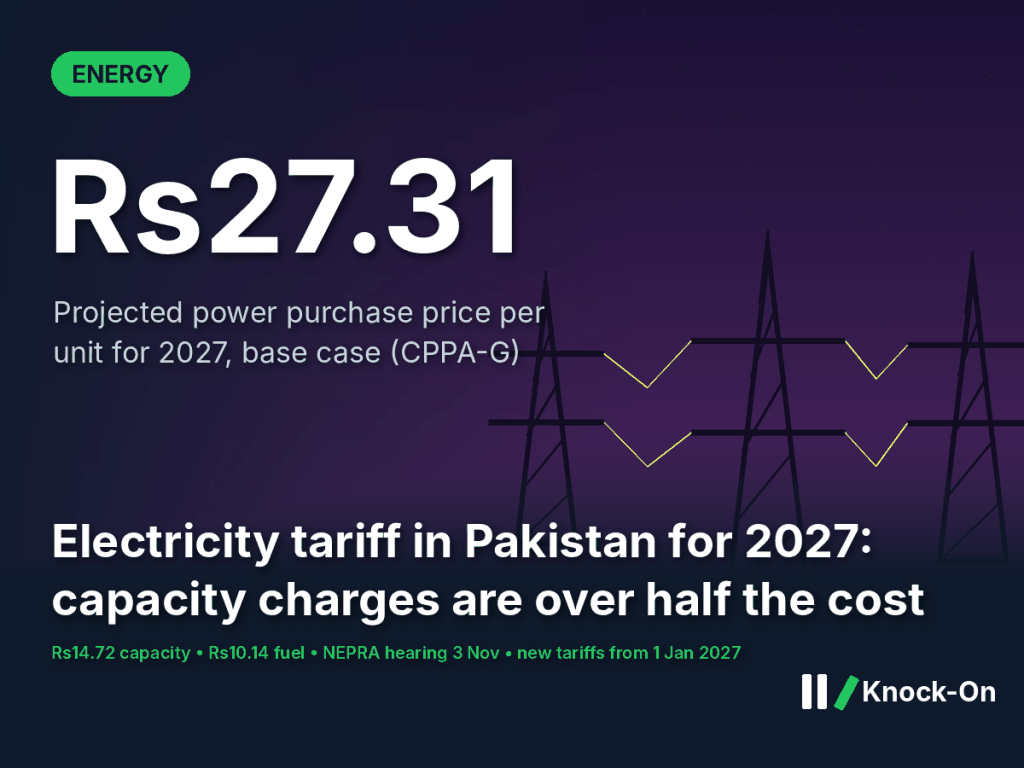
The next electricity tariff in Pakistan will be built on a projected power purchase price of Rs27.309 per unit for 2027, the Central Power Purchasing Agency (CPPA-G) has told the regulator. More than half of that, Rs14.717, is capacity payments that power companies receive whether or not their plants run. NEPRA will hold a public hearing on 3 November, and the result feeds into rebased consumer tariffs from 1 January 2027.
The short version
- CPPA-G’s base case puts the 2027 power purchase price for distribution companies at Rs27.309 a unit, within six scenarios from Rs25.883 to Rs29.255.
- Capacity charges are Rs14.717 a unit (about 54%); fuel is Rs10.141.
- The base case is above the Rs25.69–26.69 range CPPA proposed for 2026.
- NEPRA’s hearing is on 3 November; rebased tariffs are due from 1 January 2027.
What happened
CPPA-G, which buys power from generators for the distribution companies, filed its 2027 forecast with NEPRA, Business Recorder reported on 20 October. In the base case, it expects to buy 130,081 GWh at a total cost of Rs3.552trn. Capacity charges make up Rs1.914trn of that, fuel Rs1.319trn, transmission and market charges Rs248.3bn and variable operating costs Rs70.6bn.
Capacity payments are the biggest slice of every unit
Base-case 2027 power purchase price by component, Rs per kWh (total Rs27.309)
The base case assumes demand growth of 2.6%, an exchange rate of Rs279 to the dollar, KIBOR at 11.7% and local inflation of 8.2%. Two worst cases assume Rs290 to the dollar and higher fuel costs, taking the price to Rs28.835 and Rs29.255. A scenario with more gas and RLNG lowers it to Rs26.441; in the ideal case it is Rs25.883.
Why it matters
The power purchase price is the largest part of what every home, shop and factory pays per unit. A higher reference price at rebasing feeds straight into the electricity tariff for 2027, on top of the monthly fuel adjustments that have already pushed up bills, such as the Rs2.56 a unit fuel charge proposed for November. Because capacity payments are fixed, the cost per unit rises when demand is weak. CPPA-G’s low-demand scenario, with 0.7% growth, lifts the price to Rs27.568.
The 2027 base case sits above last year’s whole range
CPPA-G power purchase price proposals, Rs per kWh
The knock-on effects
First order: pressure on the 2027 electricity tariff
If NEPRA accepts something close to the base case, the reference price used for January’s rebasing rises. Whether consumers see a higher base tariff will also depend on government decisions on subsidies and how costs are spread across consumer groups.
Second order: industry weighs captive power and solar
Factories comparing grid power with their own generation or rooftop solar will see fixed capacity costs make up most of the grid price. Every unit that leaves the grid spreads those fixed costs over fewer remaining buyers.
Third order: privatisation and circular debt
Distribution companies preparing for sale, such as IESCO with its 54% tariff hike request, need tariffs that cover costs. Any gap between the approved price and what consumers pay adds to dues already owed to generators, such as the Rs498bn reportedly owed to CPEC power plants.
Who could benefit
- Solar and storage suppliers: higher grid prices strengthen the case for self-generation.
- Gas and RLNG suppliers: CPPA-G’s own scenario shows more gas would lower fuel costs.
- Generators: capacity payments are built into the forecast in full.
Who may face pressure
- Manufacturers and exporters: power is a major input cost.
- Households and shops: base tariffs reset from January.
- The federal budget: any decision to hold tariffs below cost needs a subsidy.
What to watch
- 3 November 2026: NEPRA public hearing on the CPPA-G forecast.
- NEPRA’s decision on the reference power purchase price.
- 1 January 2027: rebased consumer tariffs due to take effect.
- The rupee against the base-case assumption of Rs279 to the dollar.
Sources
- Business Recorder, DISCOs: CPPA-G sees average PPP at Rs27.309/kWh for CY27, 20 Oct 2026
- Profit (Pakistan Today), NEPRA to review 65 paisa FCA reduction for October and Rs25.69 to Rs26.69 power purchase price for 2026, November 2025
This is analysis, not investment advice. Figures are as of 21 October 2026.

Leave a Reply