
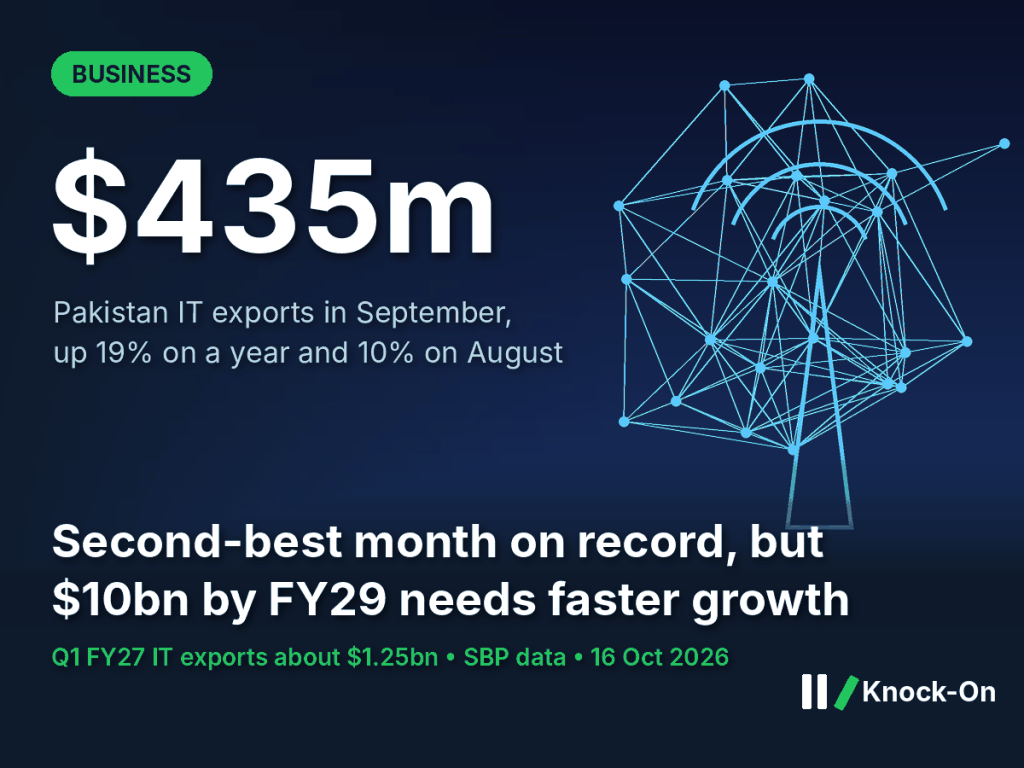
Pakistan IT exports reached $435 million in September 2026, the second-highest monthly figure on record and only $2 million below the $437 million earned in December 2025, according to State Bank of Pakistan (SBP) data reported on Friday. The figure was up 19% on September 2025 and 10% on August, ProPakistani reported. For a country that has just posted a $356 million monthly current account deficit, steady dollar earnings from software and services are one of the few external numbers moving the right way.
The short version
- IT exports were $435 million in September, up 19% year on year and 10% month on month.
- July–September IT exports were about $1.25 billion; trailing 12-month exports reached $4.8 billion, up 20%.
- Net IT exports, after IT imports, were $364 million in September, up 10%.
- The government’s $10 billion annual target for FY29 needs about 27.8% compound growth a year.
What happened
Khurram Schehzad, adviser to the finance minister, announced the September figure on X, Business Recorder reported, putting the year-on-year growth at 18%. ProPakistani, using SBP services data, put it at 19% and said Topline Securities linked part of the 10% monthly rise to more working days in September. Pakistan IT exports totalled about $1.25 billion in the first quarter of FY27.
IT services and freelancers earned about $1.246 billion in the quarter, up about $187 million or 17%, and made up more than 45% of all services exports, ProPakistani said. Total services exports rose to $2.719 billion from $2.214 billion a year earlier.
September nearly matched the record, but sits below the level the target needs
Pakistan monthly IT exports, US$ million
Why it matters
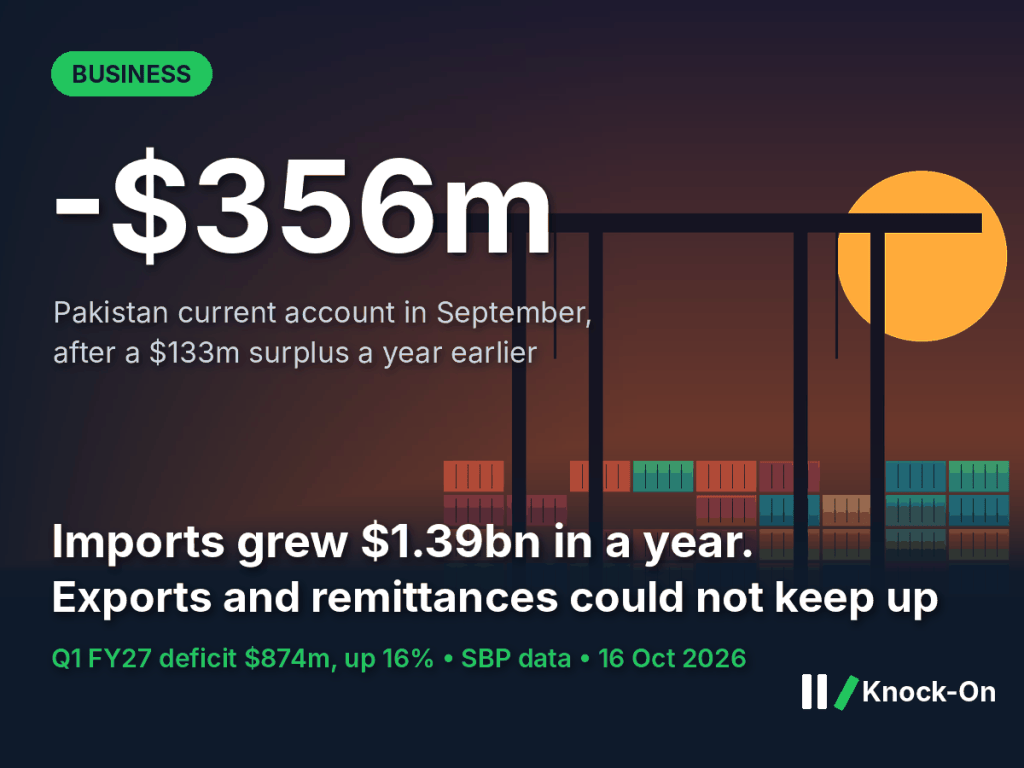
IT exports are among the few sources of dollars that need little imported input. That matters because, in the same month, imports of goods and services grew by $1.39 billion on a year, as our story on the current account deficit in Pakistan shows. The gap to the target is also clear: trailing 12-month IT exports of $4.8 billion would need to roughly double to reach $10 billion in FY29, and experts quoted by ProPakistani say monthly receipts would need to reach about $450–500 million to support that pace.
The knock-on effects
First order: steadier dollar inflows
Higher IT receipts add to the services side of the external account and partly offset the goods trade gap. They join remittances and diaspora flows, such as the Roshan Digital Account inflows, as support for the rupee.
Second order: competition for tech talent
Rising export orders tend to push up pay for skilled developers and freelancers. Local firms that hire the same people for domestic work may face higher costs.
Third order: policy attention shifts to services
With traditional exporters such as textiles warning of a weak quarter, as covered in our report on textile exports, IT is likely to draw more attention in policy on tax, internet quality and payment channels.
Who could benefit
- Software and IT services firms earning in dollars, including listed technology companies.
- Freelancers, who are counted in the IT services and freelancers category.
- Banks and payment providers that handle export receipts.
Who may face pressure
- Domestic firms hiring tech staff, if export demand pushes up salaries.
- Policymakers, as the gap between current growth of about 20% and the 27.8% needed for the target becomes harder to close.
What to watch
- October IT export data, due with the next SBP services release, and whether monthly receipts break the $437 million record.
- Whether growth moves closer to the 27.8% annual rate the FY29 target needs.
- Telecom service quality, which the PTA said on 16 October it is monitoring more closely nationwide.
Sources
- ProPakistani, Pakistan IT Exports Hit 9-Month High, 16 Oct 2026
- Business Recorder, Pakistan’s IT exports hit $435mn in September, second-highest ever, 16 Oct 2026
- Business Recorder, PTA says intensified nationwide monitoring, measures to improve telecom services, 16 Oct 2026
This is analysis, not investment advice. Figures are as of 16 October 2026.

Leave a Reply