
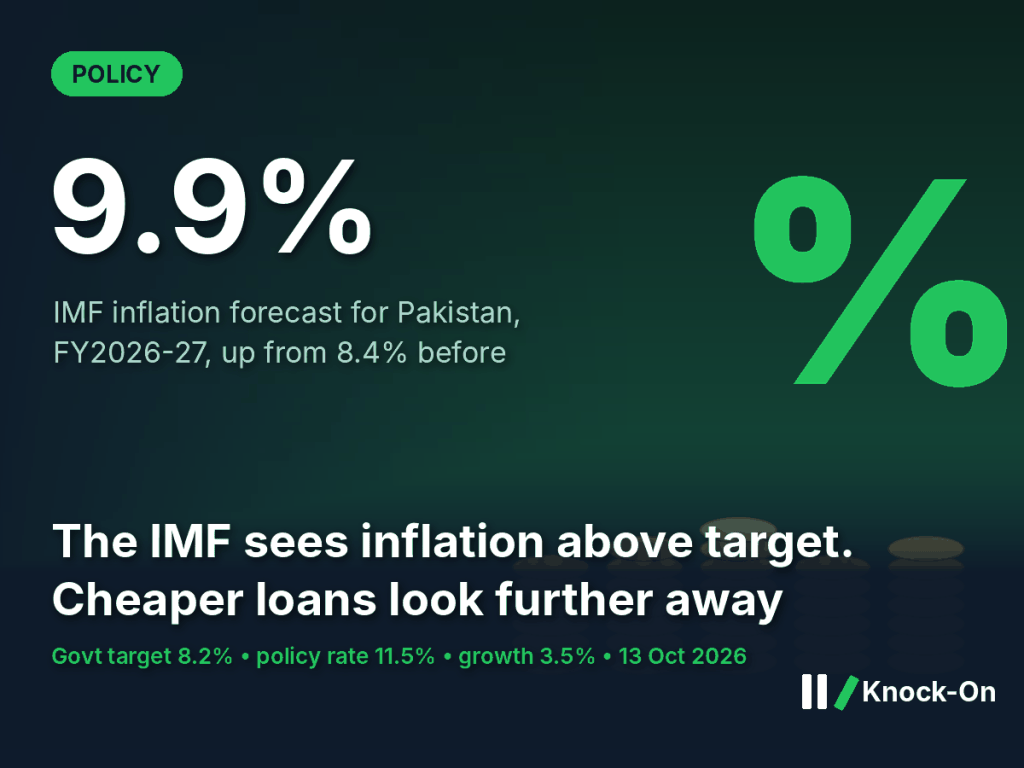
The IMF inflation forecast for Pakistan has moved up again. In its World Economic Outlook, released on Tuesday, 13 October, the fund projected consumer prices to rise 9.9% in the 2026-27 fiscal year, up from the 8.4% it had pencilled in since April and above the government’s 8.2% target. Its growth forecast stayed at 3.5%. For businesses, the signal is that cheaper borrowing is harder to justify and that fuel and food costs will keep feeding through.
The short version
- The IMF now expects inflation of 9.9% in FY2026-27, up from its earlier 8.4% and above the official 8.2% target.
- Growth is still forecast at 3.5%, below Finance Minister Muhammad Aurangzeb’s expectation of more than 4%.
- The current account is projected to swing to a deficit of 1% of GDP, about $4.4bn, after a small surplus last year.
- With the policy rate at 11.5%, the forecast leaves a gap of only about 1.6 percentage points between interest rates and expected inflation (Knock-On calculation).
What happened
The World Economic Outlook was published on the sidelines of the IMF and World Bank annual meetings. According to Business Recorder, the fund puts Pakistan’s inflation at 4.5% in 2025 and 7.1% in 2026, rising to 9.9% in 2027 (the IMF’s label for the fiscal year that runs to June 2027). The Express Tribune reports that the previous forecast of 8.4% was set in April and kept in July.
The fund also expects the current account to move from a surplus of 0.5% of GDP to a deficit of 1% of GDP, which the Tribune puts at about $4.4bn, roughly $450m more than its previous projection. Global inflation, by contrast, is projected at 4.1% for 2027, less than half Pakistan’s rate.
The Pakistan Bureau of Statistics put September’s consumer price inflation at 10.26%, down from 11.15% in August, ProPakistani reported.
The IMF’s new inflation forecast sits above every official target
Inflation targets, forecasts and the latest reading for Pakistan, % a year, as of 13 Oct 2026
Why it matters
The State Bank of Pakistan held its policy rate at 11.5% on 14 September and said the stance was appropriate to bring inflation to its 5–7% medium-term target, according to ARY News. If inflation averages 9.9%, the real interest rate would be about 1.6 percentage points (Knock-On calculation). That thin cushion makes a rate cut harder to argue for. Businesses hoping the IMF staff-level agreement would bring cheaper loans have another reason to wait.
The government is more optimistic on growth. Aurangzeb told Reuters, as reported by Dawn, that “we should clock north of 4pc”, a gap we looked at in our piece on the Pakistan growth forecast. The Tribune adds that the IMF objected to the fuel relief scheme of Rs2,000 a month for motorcyclists and Rs3,000 for small car owners.
The knock-on effects
First order: borrowing stays expensive
Companies that roll over working-capital lines or plan to borrow for expansion should not count on lower rates soon. Floating-rate loans tied to KIBOR are likely to stay close to current levels while inflation runs near 10%.
Second order: costs keep rising
Fuel remains a big driver. Petrol is Rs395.37 a litre and diesel Rs396.85 from 13 October, according to Business Recorder, and our petrol price tracker shows how far both have climbed since daily pricing began. Higher transport and input costs push suppliers to reprice contracts.
Third order: demand and the rupee
Prices rising faster than incomes squeeze household spending, which hits retailers and consumer brands. A wider current account deficit also means more demand for dollars, which can add pressure on the rupee and make imports dearer again. These are risks, not certainties.
Who could benefit
- Banks may keep earning wide margins while the policy rate stays high.
- Savers and holders of short-term government debt keep higher returns for longer.
- Exporters could gain some price competitiveness if pressure on the current account weakens the rupee.
Who may face pressure
- Leveraged companies, including builders and manufacturers with large working-capital loans.
- Retailers and consumer brands selling to households whose real incomes are shrinking.
- Importers of fuel, machinery and raw materials, if the rupee comes under pressure.
What to watch
- The SBP’s next monetary policy decision, and whether it signals any change from 11.5%.
- October inflation data from the Pakistan Bureau of Statistics, due in early November.
- IMF executive board approval of the staff-level agreement, tentatively in late November, after which the staff report is published.
- Daily fuel prices and Brent crude, which the Gulf conflict continues to drive.
Sources
- Business Recorder, IMF sees Pakistan’s inflation rising to 9.9% in 2027 as growth slows, 13 Oct 2026
- The Express Tribune, IMF raises inflation forecast to 9.9%, 13 Oct 2026
- Dawn (Reuters), Economy holds up amid oil shock, 13 Oct 2026
- ProPakistani, Inflation remains high after 3 months, 1 Oct 2026
- ARY News, Monetary policy: SBP retains interest rate 11.5 percent, 14 Sep 2026
- Business Recorder, Govt decreases petrol price by Rs2.93, increases diesel’s by Re0.61 per litre, 12 Oct 2026
This is analysis, not investment advice. Figures are as of 13 October 2026.






Leave a Reply