
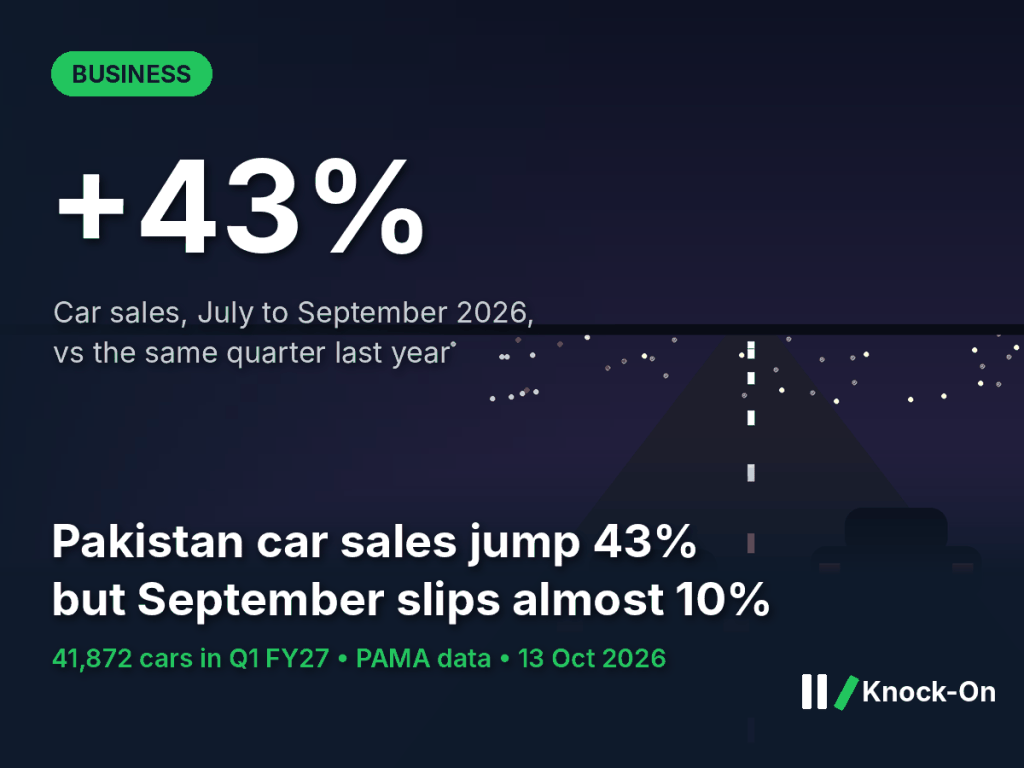
Pakistan car sales rose 43% to 41,872 units in July to September, the first quarter of the 2026-27 financial year, according to Pakistan Automotive Manufacturers Association (PAMA) data released on Tuesday. The quarterly number hides a weaker finish. Car sales fell almost 10% in September from a year earlier, and the industry says uncertainty over the new auto policy is making both assemblers and buyers hold back. For dealers, parts makers and car financiers, demand is clearly back, but not yet on a footing anyone wants to invest behind.
The short version
- Car sales rose 43% year on year to 41,872 units in July to September. Including jeeps and pickups, which fell 34%, the total rose 19% to 50,480.
- September car sales fell to 10,939 from 12,126 a year earlier, a drop of almost 10%.
- Toyota maker Indus Motor was the only major assembler to grow in September. Pak Suzuki’s September sales fell 46%.
- PAMA blames the hesitation on the missing auto policy. A Topline analyst points to delayed clarity on sales tax for hybrid and plug-in hybrid cars.
What happened
PAMA’s figures for the July to September quarter show car sales up 43% to 41,872 units, trucks up 53% to 2,516, farm tractors up 38% to 4,109, and motorcycles and rickshaws up 28% to 553,994, Business Recorder reported. Jeeps and pickups fell 34% to 8,608 and buses slipped 5% to 211.
Dawn’s company breakdown shows where the Pakistan car sales growth came from. Pak Suzuki remains the biggest seller, but Honda Atlas and Indus Motor grew much faster over the quarter, while Hyundai Nishat and Sazgar sold less than a year earlier.
Suzuki still sells the most, but Honda and Toyota grew fastest
Units sold, July to September 2026 (change on a year earlier)
September was weaker. Industry sales of cars, SUVs, pickups and vans fell 12% from a year earlier and 3% from August to 15,104 units, Dawn reported. Indus Motor’s sales rose 31% to 4,142, while Pak Suzuki’s fell 46% to 4,862 and Honda Atlas’s fell 8% to 2,128. Sania Irfan of Topline Securities told Dawn the drop reflected delayed clarity on the sales tax policy for hybrid and plug-in hybrid cars, which restricted companies’ invoicing.
Why it matters
PAMA Director General Razi ur Rahman credited easing inflation and a better macroeconomic environment for the rebound, but said assemblers and buyers are reluctant to make investment decisions while the auto policy is unclear. That matters beyond the showroom. The same policy will decide how far used car imports, which jumped to 2,276 in September, keep competing with local assembly. Rahman also warned that rising imports of fully built cars could pressure the balance of payments and prompt action from the State Bank.
The inflation tailwind may not last. The IMF now forecasts Pakistan’s inflation rising to 9.9%, which would push cheaper car loans further away.
The knock-on effects
First order: assemblers and dealers
Higher quarterly volumes help assemblers spread fixed costs, and dealers benefit from faster stock turnover. But September shows that sales can stall quickly when tax treatment is unclear, especially for hybrids.
Second order: parts makers and car finance
Local vendors depend on assembly volumes, and they are already dealing with higher duties on some imported parts. Banks offering car loans gain from the rebound in demand, but higher inflation would limit how far borrowing costs can fall.
Third order: dollars and policy
If demand keeps rising while the policy is pending, more of it could be met by imported cars. That would raise demand for dollars, which is the risk PAMA has flagged to the government.
Who could benefit
- Indus Motor and Honda Atlas, which grew fastest over the quarter.
- Tractor and truck makers, with tractor sales up 38% and trucks up 53%.
- Motorcycle sellers, as two- and three-wheeler sales rose 28%.
Who may face pressure
- Pak Suzuki, after a 46% drop in September sales.
- Hyundai Nishat and Sazgar, whose quarterly sales fell.
- Sellers of hybrids, until the sales tax treatment is settled.
What to watch
- Cabinet approval of the auto policy, including tariffs on fully built imports.
- The sales tax decision on hybrid and plug-in hybrid cars.
- PAMA’s October data, expected around mid-November, to see whether September’s slowdown continues.
- Inflation and interest rates, which drive car financing costs.
Sources
- Business Recorder, Pakistan car sales rise 43% in Q1 FY2026-27, 13 October 2026
- Dawn, Quarterly auto sales rise despite sluggish September, 14 October 2026
- Trade Chronicle, Pakistan auto sales rise 19% YoY in 1QFY27 despite September dip, 13 October 2026
This is analysis, not investment advice. Figures are as of 14 October 2026.






Leave a Reply