
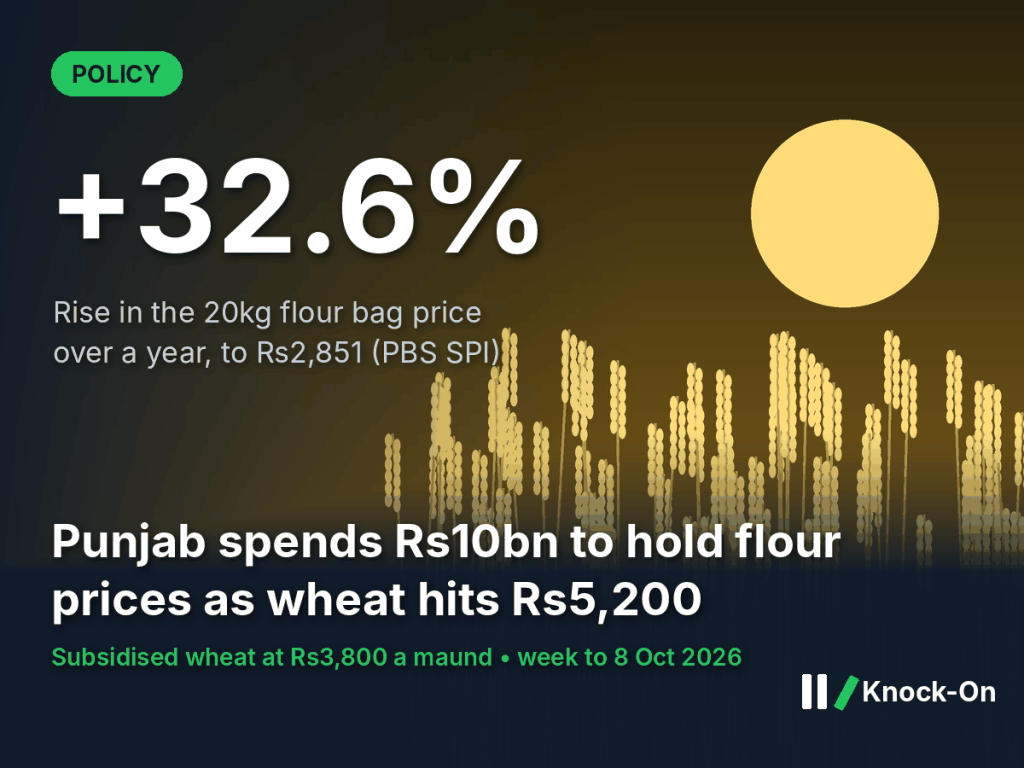
The flour price in Pakistan has risen 32.6% in a year, and a sharp jump over the past fortnight has pushed Punjab’s government into a Rs10 billion subsidy. According to the Pakistan Bureau of Statistics’ weekly price index, the average 20kg bag cost Rs2,851 in the week to 8 October, up from Rs2,150 a year earlier. For bakers, restaurants, food manufacturers and employers, flour is now a cost and wage issue as much as a household one.
The short version
- Wheat flour was the biggest weekly mover in the PBS Sensitive Price Indicator for the week to 8 October: up 5.69% in a week and 32.6% in a year.
- Punjab Chief Minister Maryam Nawaz approved a Rs10bn subsidy on 10 October and raised the quota of government wheat sold to mills at Rs3,800 per maund.
- Open-market wheat in Punjab reached Rs5,200 per 40kg, according to Daily Pakistan.
- Prices vary widely by city: a 20kg bag cost Rs3,400 in Karachi, Peshawar and Islamabad but Rs2,200-2,300 in Faisalabad and Lahore, according to an ARY News report.
What happened
Ms Nawaz chaired an emergency meeting by video link on 10 October and approved the Rs10bn package, Aaj News and Profit reported. The meeting decided to increase the quota of subsidised government wheat supplied to flour mills at Rs3,800 per maund and expressed concern over what it called an “artificial” rise in wheat and flour prices. The reports did not say how the Rs10bn will be disbursed or for how long.
The trigger was a fast market move. ARY News reported on 8 October that open-market wheat in Punjab rose from Rs4,700 to Rs5,300 per 40kg in a week. Daily Pakistan put the price at Rs5,200 on 10 October and reported that millers blamed delays of more than two weeks in releases of government wheat, which forced mills to buy at market rates. In Lahore, a 15kg flour bag rose Rs300 to Rs2,300, the same report said.
Other provinces describe the situation differently. Sindh Chief Minister Murad Ali Shah said on 10 October that the province had enough wheat and that there was no shortage, while accepting that flour costs Rs150-160 a kilo, according to Pakera.
Why it matters
Flour is the base cost of roti, naan, bread and bakery goods, and a large share of low-income household budgets. Daily Pakistan reported that naan in Karachi rose Rs5 to Rs30-35 a piece and that branded bread and bakery items rose 8-9%. Our analysis of wholesale inflation showed flour and fuel already pushing up producer prices; the latest SPI, with an annual rate of 11.97%, suggests the pressure is now reaching shop shelves.
Where Punjab’s notified price applies, flour is about a third cheaper
Price of a 20kg flour bag by city, rupees, as reported on 10 Oct 2026
The gap exists because Punjab sells government wheat to mills at a fixed rate in return for flour at notified prices. APP reported in August that about 850,000 to 900,000 bags of 10kg and 20kg flour were supplied daily across Punjab at notified prices of Rs1,100 and Rs2,200, and that government wheat met about 30% of the province’s daily requirement, according to a former flour mills association chairman.
The knock-on effects
First order: food businesses absorb a sharp input rise
Bakeries, tandoors, biscuit makers and restaurants face flour costs about a third higher than a year ago. Some is already being passed on, with branded bread 8-9% dearer in Karachi.
Second order: a two-price market invites leakage
With subsidised wheat at Rs3,800 a maund and the open market around Rs5,200, the gap is about Rs1,400 per maund (Knock-On calculation). That creates an incentive to divert subsidised supply. Enforcement, and whether releases reach mills beyond divisional headquarters, will decide how much of the Rs10bn reaches consumers.
Third order: weaker spending and wage pressure
Food inflation eats into spending on everything else, a risk flagged in our look at the World Bank’s poverty warning and consumer demand. FMCG and discretionary retailers may see weaker volumes, and employers can expect pressure on wages. Higher freight costs, which Sindh’s chief minister blamed in part, link this to daily petrol and diesel pricing.
Who could benefit
- Consumers in Punjab’s large cities, where notified-price flour is available.
- Flour mills with larger subsidised quotas, if they secure allocations on time.
- Wheat growers and stockists selling into the open market at higher prices.
Who may face pressure
- Bakeries, restaurants and food processors, especially outside Punjab.
- Mills in smaller towns without subsidised wheat, which must buy at market rates.
- The Punjab budget, which carries the Rs10bn cost.
- Low-income households in provinces without an equivalent subsidy.
What to watch
- The next weekly PBS SPI release, for whether flour prices stabilise.
- Details of how the Punjab subsidy is disbursed and how long it lasts.
- Any federal decision on wheat imports, which Punjab’s Food Department has said rests with the federal government.
- Whether Sindh, Khyber Pakhtunkhwa or Balochistan announce their own measures.
Sources
- Profit, Pakistan’s weekly inflation rises 0.57%, annual rate climbs to 11.97%, 10 Oct 2026
- Profit, Punjab approves Rs10bn flour subsidy amid rising wheat prices, 11 Oct 2026
- Aaj News, Punjab approves Rs10bn subsidy to keep flour prices affordable, 10 Oct 2026
- Daily Pakistan, CM Maryam Nawaz approves Rs10 Billion Subsidy as Flour price hits Rs5,200 per 40kg, 10 Oct 2026
- ProPakistani, Punjab Approves Rs. 10 Billion Subsidy for Affordable Flour, 10 Oct 2026
- ARY News, Flour price rises in Punjab as wheat cost surges sharply, 8 Oct 2026
- APP, Punjab secures wheat supplies until next harvest, 10 Aug 2026
- Pakera, Sindh CM: Enough Wheat Stock, Flour Rs 150 to 160 a Kg, 12 Oct 2026
This is analysis, not investment advice. Figures are as of 12 October 2026.






Leave a Reply