
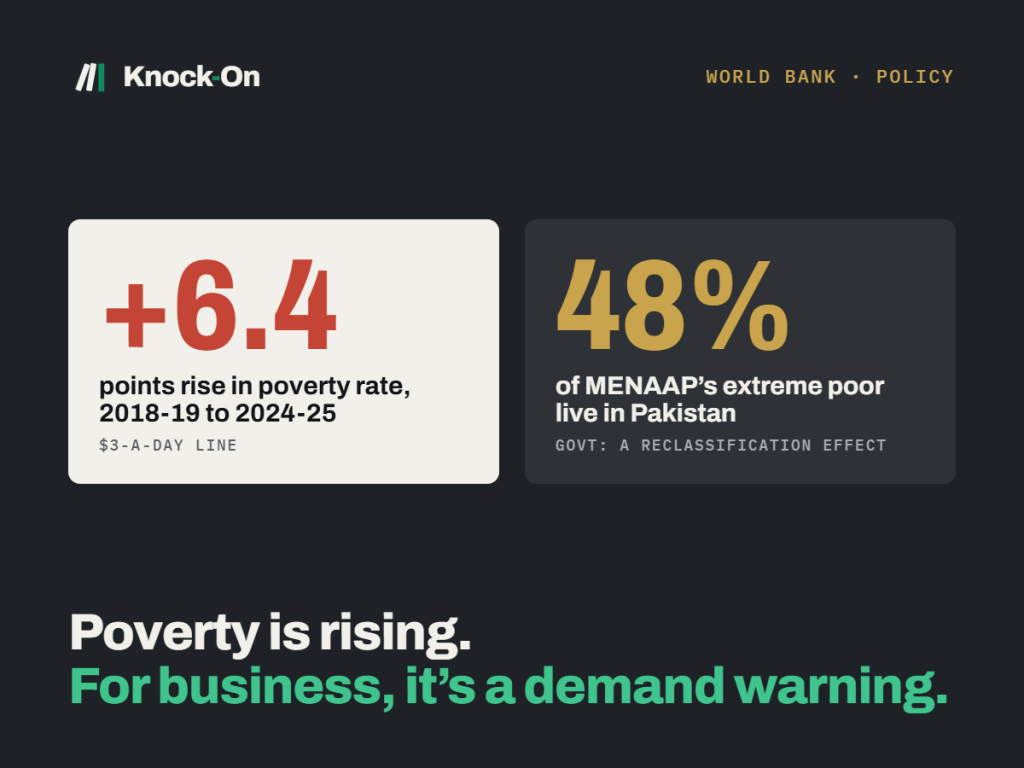
A World Bank report released this week has put poverty back at the centre of Pakistan’s economic debate. The government has pushed back on how the figures were presented. Whatever the framing, the underlying trend matters to every business that sells to households: a larger share of the population has less to spend.
The short version
- The World Bank says Pakistan’s poverty rate at the $3-a-day line rose 6.4 percentage points between 2018-19 and 2024-25, and 3.2 points at the $4.20 line.
- Pakistan accounts for about 48% of the extreme poor in the Bank’s new Middle East, North Africa, Afghanistan and Pakistan (MENAAP) region.
- The finance ministry’s adviser says the 48% figure mainly reflects Pakistan being moved into a new reporting region.
- The Bank projects growth of 3.8% in 2027, below the government’s 4% target, with inflation rising.
What happened
The World Bank’s October MENAAP Economic Update, titled From Divide to Opportunity: AI, Jobs, and Growth, said the region is the only one where poverty remains above pre-pandemic levels and is still rising, with Pakistan driving much of the deterioration. It attributed Pakistan’s rise in poverty to COVID-19, the 2022 floods, high inflation, currency depreciation and a long economic adjustment that weakened incomes and jobs.
Khurram Schehzad, adviser to the finance minister, called the report misleading. He said Pakistan’s inclusion in MENAAP is an administrative and statistical reclassification that changes regional totals but not Pakistan’s identity as a South Asian country or its income classification. Because Pakistan’s population is large relative to many Middle Eastern economies, he said, regional figures would naturally look different. He also said poverty had risen more sharply in countries including Lebanon, Argentina and Iran.
Why it matters
Both points can be true. The 48% share depends on which countries are in the region. The 6.4-point rise in Pakistan’s own poverty rate does not. That rise is what matters for demand.
Household budgets remain under pressure. Consumer inflation was 10.26% in September, and transport costs were up 27.43% from a year earlier. The Bank notes that petrol and diesel prices have risen by 40% or more.
The knock-on effects
First order: spending shifts to essentials
When incomes fall behind prices, households cut back on discretionary items first. Spending moves toward food, fuel and utilities and away from durables, eating out and brand upgrades.
Second order: smaller packs and cheaper brands
Consumer companies typically respond with smaller pack sizes, lower price points and promotions. Retailers see a shift toward value ranges and credit-based sales.
Third order: policy choices
The Bank recommends targeted cash transfers over broad fuel and food subsidies. That choice matters for the budget and the IMF programme. Broad subsidies cost more and are harder to remove, while targeted support protects the poorest at lower fiscal cost.
Who could benefit
- Value brands and discount retailers, as shoppers trade down.
- Microfinance and buy-now-pay-later providers, if they manage credit risk well.
Who may face pressure
- Premium consumer brands and durable-goods sellers.
- Businesses in rural and low-income markets, where purchasing power is weakest.
What to watch
- October inflation data from the Pakistan Bureau of Statistics, due early November.
- The SBP policy decision on 26 October, and what it signals about inflation.
- Any expansion of targeted support through the Benazir Income Support Programme.
Sources
- Profit, World Bank says 48% of MENAAP region’s extreme poor live in Pakistan, 7 October 2026
- ProPakistani, Nearly half of region’s poorest people live in Pakistan: World Bank, 7 October 2026
- Business Recorder, Govt says World Bank poverty figures reflect regional reclassification, 8 October 2026
- Express Tribune, Govt contests World Bank poverty report, 9 October 2026
- Arab News (Reuters), Cargo piles up as Pakistan seizes containers to block capital routes (September inflation figures), 3 October 2026
This is analysis, not investment advice. Figures are as of 9 October 2026.


Leave a Reply