
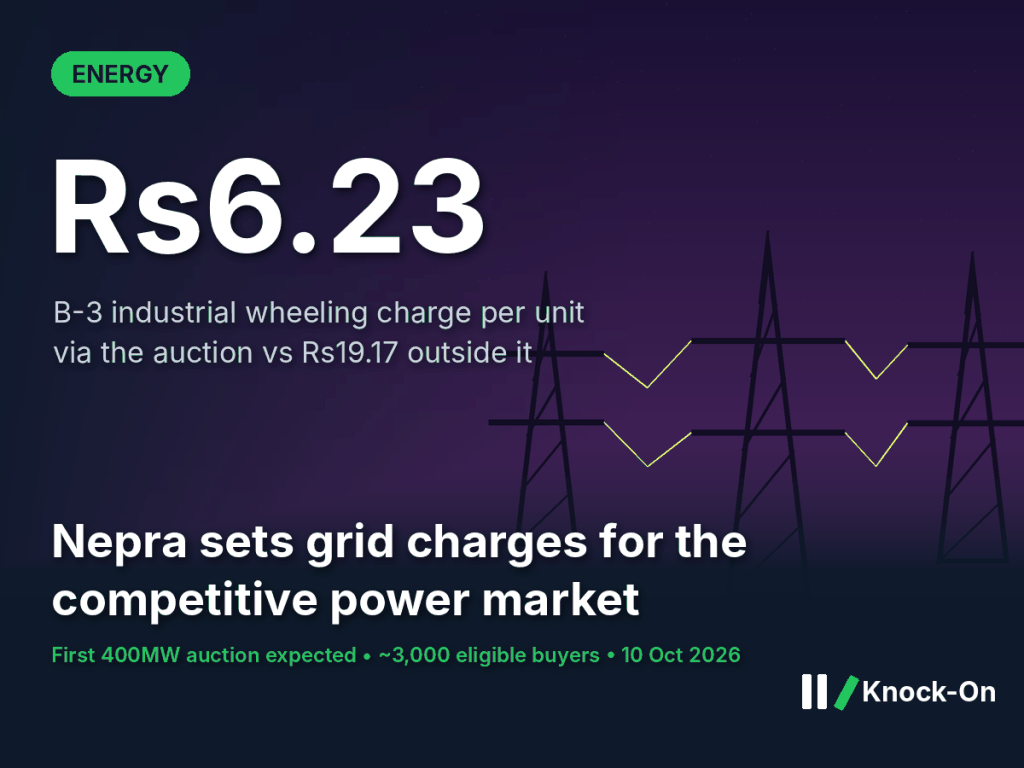
Pakistan’s biggest electricity users are a step closer to buying power from someone other than their distribution company. The National Electric Power Regulatory Authority (Nepra) has cleared the “use-of-system” charges that bulk buyers will pay to move privately bought electricity over the national grid. That clears the way for the first 400MW power auction, delayed since June. For industry, the key number: a B-3 factory that buys through the auction pays Rs6.23 a unit to use the grid; one that bypasses the auction pays Rs19.17.
The short version
- Nepra has set uniform wheeling (use-of-system) charges for the competitive power market, applying across all distribution companies and K-Electric.
- Buyers who come through the auction pay Rs6.23 to Rs19.62 a unit; those who do not pay Rs19.17 to Rs32.56.
- The first auction, for 400MW out of 800MW allocated over five years, is expected within the next couple of months.
- Only about 3,000 bulk power consumers are eligible, so most businesses stay on regulated tariffs for now.
What happened
Dawn and ProPakistani reported on 10 October that Nepra has cleared the charges for the Competitive Trading Bilateral Contract Market (CTBCM). Business Recorder reported that the regulator’s decision was issued on 7 September, on a federal government motion filed on 25 May. The charges cover transmission and distribution costs, a fixed grid charge and a cross-subsidy. They are paid on top of whatever generation price a buyer agrees with a private supplier. A fixed grid charge of Rs1 per kilowatt a month, based on sanctioned load, applies to every buyer.
The auction route is much cheaper. B-3 industrial users pay Rs6.23 a unit through the auction against Rs19.17 outside it; B-4 industrial users pay Rs9.09 against Rs25.45. For general-supply users in A-2 and A-3 the figures are Rs19.14 and Rs32.08, and for agriculture Rs6.72 and Rs19.66. According to Business Recorder, the difference is a “stranded cost” component of Rs12.94 a unit for consumers connected at 11kV and Rs16.35 for those at 132kV or 66kV.
Skipping the auction roughly triples the grid charge for factories
Use-of-system charge, Rs per unit, by consumer category, as cleared by Nepra (October 2026)
Any extra charge needed to cover cost differences between distribution companies and K-Electric will be spread across all consumers, not just those buying on the open market.
Why it matters
Electricity is one of the largest costs for Pakistani manufacturers, and the competitive market is the first real chance for large users to negotiate their own supply instead of accepting a regulated tariff. The market’s commercial operation date was declared on 22 January 2026, but the first auction slipped from June because these charges had not been set. ProPakistani notes that the IMF programme timeline had targeted January 2026 for Nepra’s approval of uniform wheeling charges, so the decision arrives late.
The design pushes buyers towards the auction. Even inside it, industry still carries part of the system’s cross-subsidy. Of the B-4 charge of Rs9.09, Business Recorder puts Rs5.05 down to cross-subsidy, or about 56% (Knock-On calculation). For B-3, cross-subsidy is Rs2.63 of Rs6.23.
The knock-on effects
First order: a scramble for limited capacity
Only 400MW is on offer in the first phase. With around 3,000 eligible bulk consumers, many will not secure auction volumes, and bids will be fixed for one year with no upper or lower limits.
Second order: a new sales channel for power suppliers
Suppliers able to sell directly to bulk buyers gain customers outside the regulated system. Whether factories save money depends on the generation prices bid, which are not yet known.
Third order: who carries the fixed costs
If large users gradually leave distribution companies, the cost of the existing system falls on fewer regulated customers. The stranded-cost charge and the shared K-Electric differential are Nepra’s attempt to stop that shift; how well they work will shape regulated tariffs over time, including in Karachi, where K-Electric’s tariff dispute and the subsidy bill are already in play. Power-sector reform is also part of the timeline agreed under the IMF programme.
Who could benefit
- Large factories that win auction volumes: grid charges of Rs6.23 to Rs9.09 a unit, with prices fixed for a year.
- Power suppliers with spare capacity: a direct route to bulk buyers.
- Exporters: potentially more predictable energy costs, if bid prices are competitive.
Who may face pressure
- Bulk consumers who miss the auction, facing Rs19.17 to Rs32.56 a unit in grid charges alone.
- Distribution companies, which risk losing some of their largest customers over time.
- Regulated consumers, who share any extra charge covering K-Electric and inter-company cost differences.
What to watch
- The Independent System and Market Operator’s auction calendar and procedures, expected shortly.
- The first 400MW auction, expected within the next couple of months.
- Whether generation bids plus grid charges come in below current regulated industrial tariffs.
- An energy-differential adjustment mechanism, which Nepra wants developed before the next review of these charges.
Sources
- Dawn, Nepra clears use-of-system charges for competitive power market, 10 October 2026
- ProPakistani, NEPRA Sets Wheeling Charges, Clearing Way for Pakistan’s First 400MW Power Auction, 10 October 2026
- Business Recorder, Nepra greenlights UoSC for bulk consumers, 8 September 2026
This is analysis, not investment advice. Figures are as of 10 October 2026.






Leave a Reply