
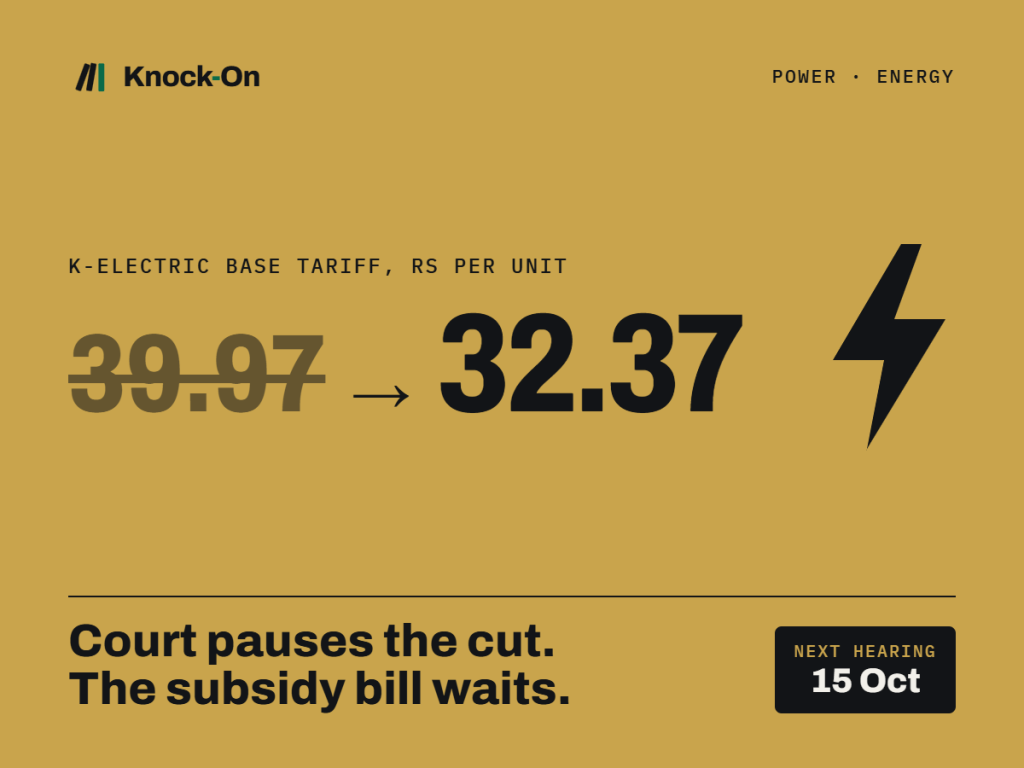
K-Electric has won temporary relief in its long dispute with the power regulator. The Sindh High Court has suspended orders that would have cut the utility’s base tariff sharply. For Karachi households and businesses the immediate effect is small, because they pay the same tariff as the rest of the country. The real stakes are the federal subsidy bill and the utility’s ability to fund investment.
The short version
- On 23 September NEPRA’s Appellate Tribunal dismissed KE’s appeals, upholding a Rs7.60 per unit cut that lowers KE’s average base tariff from Rs39.97 to Rs32.37.
- On 7 October the Sindh High Court suspended the challenged orders and notifications on an interim basis. The next hearing is reported for 15 October.
- Karachi consumers pay the national uniform tariff, so their bills are not directly affected.
- A lower KE tariff would reduce the subsidy the government pays to cover the gap. KE says the decision is “not financially sustainable.”
What happened
The dispute concerns KE’s multi-year tariff for 2023-24 to 2029-30, its transmission tariff and its seven-year investment plan. NEPRA set KE’s tariffs in May 2025, reviewed them on 20 October 2025 after petitions from KE and others, and notified the reviews on 23 September 2026. The same day its Appellate Tribunal dismissed KE’s appeals. The Power Division issued further notifications on 27 September.
The upheld tariff of Rs32.37 per unit is made up mainly of power purchase costs of Rs27.83, with transmission at Rs2.40 and distribution at Rs2.90. NEPRA recalculated KE’s allowed revenue for 2023-24 at about Rs519 billion.
KE petitioned the Sindh High Court, which on 7 October suspended the orders and notifications under challenge. KE disclosed the order to the Pakistan Stock Exchange on 8 October. The interim order does not decide the case.
Why it matters
Pakistan charges consumers the same tariff across the country. When a distribution company’s approved cost of supply is higher than that uniform tariff, the government pays the difference as a subsidy. A lower approved tariff for KE therefore means a smaller subsidy. The Nation reported that the government was likely to save billions of rupees a year from the cut.
For KE, the allowed tariff determines the revenue it can recover for buying power, running the network and investing in it. The company says the cut has a substantial adverse effect on its multi-year tariff.
The knock-on effects
First order: the subsidy
While the suspension holds, the lower tariff cannot take effect, and the government’s expected saving is on hold.
Second order: investment in Karachi’s grid
KE’s investment plan covers distribution and transmission upgrades. If the cut is eventually enforced, KE may scale back or slow that spending, which affects reliability and losses on the network that Karachi’s industry depends on.
Third order: investor sentiment
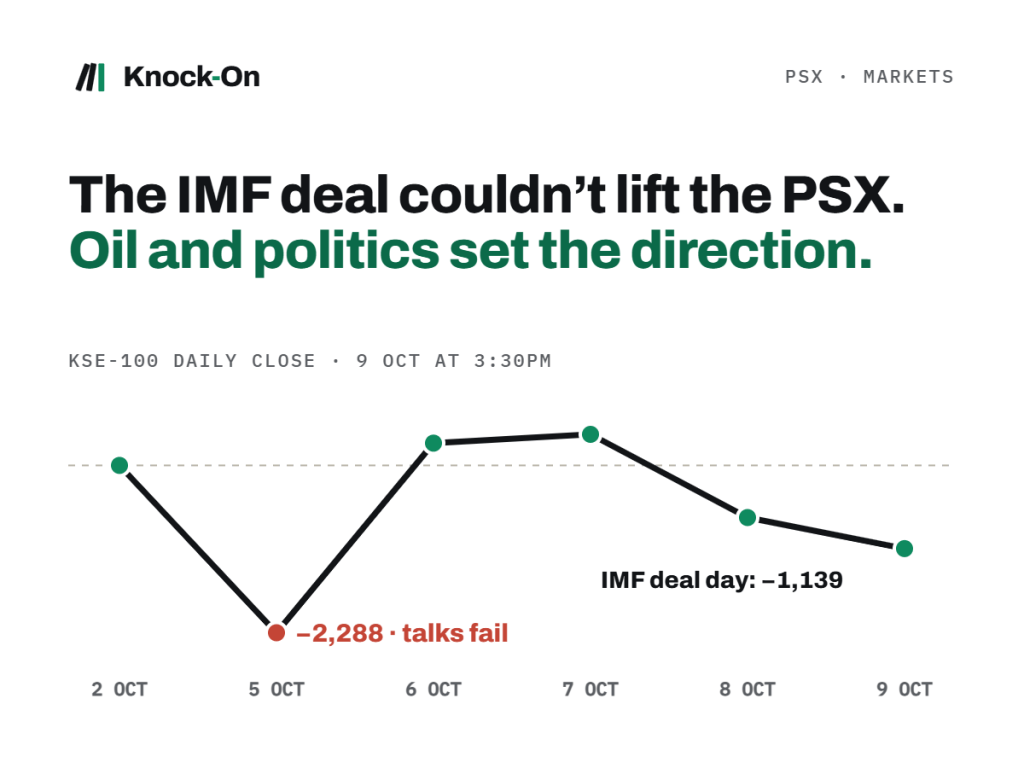
KE was the most actively traded share on the PSX on 8 October, with about 30 million shares changing hands. Legal uncertainty over its revenue makes the stock a bet on the outcome of the case.
Who could benefit
- KE and its shareholders, while the suspension holds.
Who may face pressure
- The federal budget, if the expected subsidy saving is delayed.
- Karachi businesses, if a prolonged dispute delays grid investment.
What to watch
- The Sindh High Court hearing, reported for 15 October.
- Whether NEPRA or the Power Division appeals the interim order.
- Any change to KE’s investment plan or load-shedding pattern.
Sources
- Business Recorder, KE secures interim relief from Sindh High Court in NEPRA tariff dispute, 8 October 2026
- ProPakistani, Court temporarily suspends NEPRA ruling against K-Electric, 8 October 2026
- The Nation, Govt set to save billions as NEPRA upholds Rs7.60/unit cut in KE’s tariff, 24 September 2026
- Business Recorder, KSE-100 sheds over 1,100 points on selling pressure, 8 October 2026
This is analysis, not investment advice. Figures are as of 9 October 2026.


Leave a Reply