
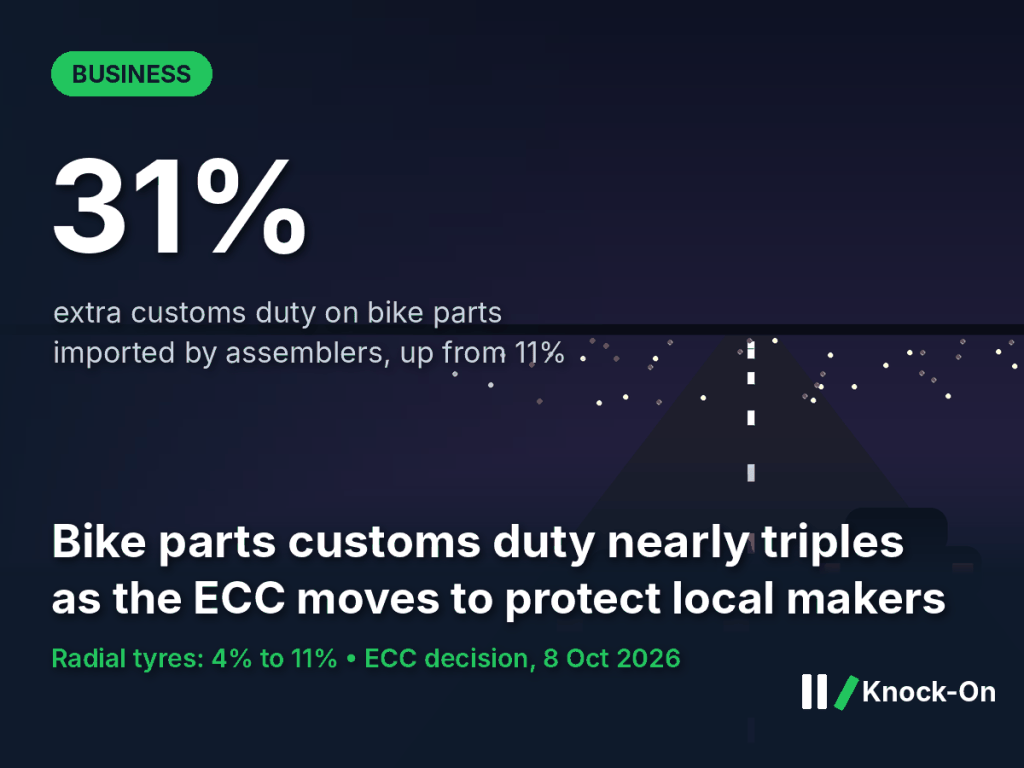
The government has raised import duties on tyres and motorcycle parts to protect local manufacturers. The old auto policy lapsed in June and a new one is still awaited. For motorcycle assemblers that import parts which are also made in Pakistan, the extra duty has nearly tripled. Critics, including a member of the government’s own Tariff Policy Board, say the decision runs against its plan to cut tariffs.
The short version
- The Economic Coordination Committee (ECC) on 8 October raised additional customs duty on imports of locally made radial tyres and motorcycle parts from 4% to 11%.
- Additional customs duty on motorcycle parts imported by local manufacturers rose from 11% to 31%.
- According to The Express Tribune, parts imported from China remain at zero duty under the free trade agreement.
- The same meeting approved a State Bank framework offering first-loss cover of up to 20% on loans to SMEs.
What happened
The ECC, chaired by Finance Minister Muhammad Aurangzeb, amended SRO 693(I)/2006, which sets duties on parts that vehicle makers import in kit form. Dawn reports that the government’s stated aim is to support domestic manufacturing.
The extra duty on bike parts for assemblers nearly triples
Additional customs duty, % of import value, before and after the ECC decision of 8 October 2026
The Express Tribune lists the parts on the 31% schedule as including licence plates, brackets, side reflectors, foot plates, wheel assemblies, windshields, seats and toolboxes. An FBR spokesman told the paper the proposal came from the Ministry of Industries and was developed by the Engineering Development Board. The Ministry of Commerce said it supported the change in principle, that the Tariff Policy Board decided on 6 June that auto-sector SROs fall outside the National Tariff Policy, and that the tyres concerned are made locally by Service Long March.
Why it matters
The National Tariff Policy is meant to lower protection over time. The Express Tribune describes this as the first decision since that policy was approved that adds a barrier rather than removing one. Dr Rubina Athar, a Tariff Policy Board member, called it a wrong decision and said it had not come to the Board before going to the ECC. With no auto policy currently in force, the duty schedule is doing the work a policy would normally do. As a simple illustration, on a listed bike part that an assembler imports for Rs10,000, the additional duty alone rises from Rs1,100 to Rs3,100 (Knock-On calculation).
The knock-on effects
First order: costlier imported parts
Assemblers that import listed parts from non-Chinese suppliers pay more at the port. Importers of radial tyres face a higher landed cost.
Second order: orders shift to local vendors and China
Local parts makers and the domestic tyre maker gain a wider price advantage. If Chinese parts do stay duty-free, sourcing may tilt further towards China rather than towards local factories.
Third order: policy signals for investors
Investors weighing the auto sector now see protection rising in one SRO while the wider tariff policy points the other way. Carmakers are separately asking the government to shut the door on surging commercial used-car imports, and assemblers are buying at a time when wholesale prices are rising faster than shop prices. The new auto policy will show which direction prevails.
Who could benefit
- Local makers of listed motorcycle parts, through a larger price gap with imports.
- Domestic radial tyre production, which the Ministry of Commerce names as the reason for the tyre change.
- Suppliers in China, if their duty-free access continues.
Who may face pressure
- Motorcycle assemblers that rely on imported listed parts from outside China.
- Tyre importers and dealers, through higher landed costs.
- Motorcycle buyers, if higher costs reach showroom prices.
What to watch
- The FBR notification of the amended SRO and its effective date.
- Cabinet approval of the new auto policy, which an adviser said on 8 October could come within about two weeks.
- Motorcycle and tyre price changes announced by assemblers and dealers.
- Any response from the Tariff Policy Board on whether it will review the decision.
Sources
- Dawn, Economic Coordination Committee raises duty on tyre, bike parts import, 9 October 2026
- The Express Tribune, Auto import duties face criticism, 10 October 2026
- ProPakistani, Prices of imported tyres and bike parts set to rise, 9 October 2026
- Business Recorder, Cabinet may approve new auto policy within next two weeks: Haroon, 8 October 2026
This is analysis, not investment advice. Figures are as of 10 October 2026.






Leave a Reply