
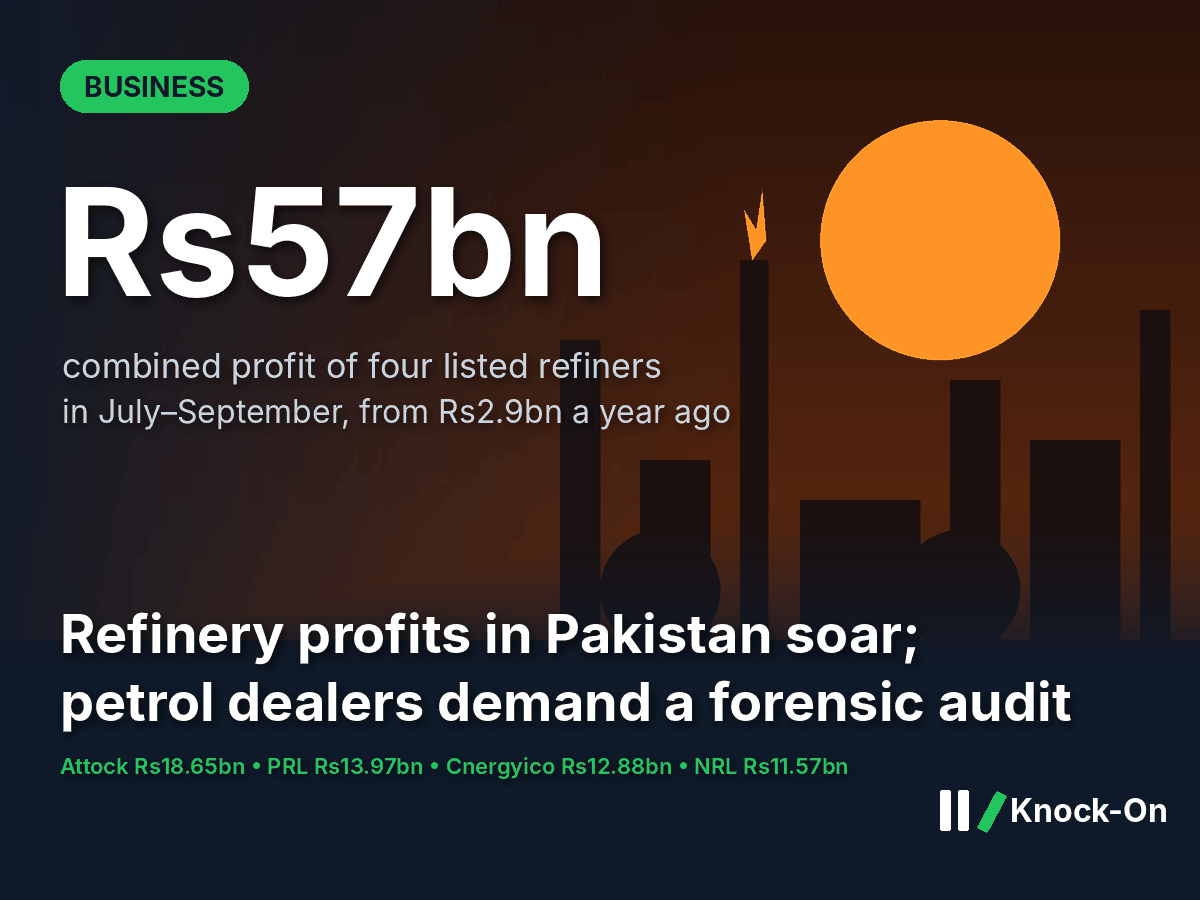
Refinery profits in Pakistan have jumped about twentyfold in a year. The four refiners listed on the Pakistan Stock Exchange earned a combined profit of more than Rs57bn in July–September, against Rs2.9bn a year earlier, as the US-Iran war pushed up refining margins. Petrol dealers now say a forensic audit of those earnings could cut pump prices by Rs40–50 a litre. The question for businesses is whether this windfall will be shared, taxed or simply competed away as oil falls.
The short version
- Attock Refinery, Pakistan Refinery, Cnergyico and National Refinery together earned over Rs57bn in the September quarter, Nikkei Asia reported.
- Topline Securities puts sector profitability at Rs32.2bn in 1QFY27, up from Rs1.6bn a year earlier, on its own measure.
- The Pakistan Petroleum Dealers Association wants a forensic audit and says prices could fall Rs40–50 a litre.
- Refineries are already funding Rs15bn of fuel relief over 30 days under a government arrangement.
What happened
According to Nikkei Asia, as reported by Report.az on 2 November, Attock Refinery led the September-quarter results with a profit of Rs18.65bn, followed by Pakistan Refinery at Rs13.97bn, Cnergyico at Rs12.88bn and National Refinery at Rs11.57bn. Three of the four grew profit by more than 1,000%; Cnergyico made a loss a year earlier. Nikkei Asia linked the jump to higher refining margins after the outbreak of the US-Iran conflict and the closure of the Strait of Hormuz.
Refinery profits in Pakistan rose about twentyfold in a year
Combined and individual net profit of PSX-listed refiners, July–September, Rs billion
Topline Securities, quoted by Dawn on 4 November, put refinery sector profitability at Rs32.2bn in the first quarter of FY27, from Rs1.6bn a year earlier and Rs1.1bn in the previous quarter, “mainly due to higher Gross Refining Margins (GRMs) amid the US-Iran war.” The two sets of figures use different measures, but both show the same direction.
Why it matters
Refinery profits in Pakistan now sit at the centre of the fuel-price debate. The Pakistan Petroleum Dealers Association, led by chairman Malik Khuda Bakhsh, has called for an “immediate, transparent and comprehensive forensic audit” of all refineries, covering crude procurement, production costs and product sales, and says this could cut prices by Rs40–50 a litre. That figure is the dealers’ claim; the government has not endorsed it. The dealers also cite the petroleum minister as saying refineries earned in three months what they would normally earn in a year. Meanwhile, under an arrangement announced on Monday, refineries are bearing a cumulative Rs15bn for 30 days so that consumers get a Rs14.71 cut, Dawn reported. We covered how that petrol levy cut is being paid by refineries last week.
The knock-on effects
First order: pressure on pump prices
Petrol is Rs362 a litre from 5 November after three daily cuts, and the government still collects about Rs114 a litre in taxes and duties (Dawn). With refiners visibly profitable, the government has more room to ask them to absorb a larger share of relief. Our petrol price Pakistan tracker follows each daily change.
Second order: tax and regulation
High profits invite scrutiny. Refiners are already among the companies asking the court to keep tax year 2022 out of the super tax review. An audit, if ordered, could also reopen how refinery prices are set.
Third order: the margin may not last
Refining margins widened because the war disrupted supply. As oil falls, with Brent down 8.6% on Wednesday after the US midterm results, margins and inventory gains could shrink quickly. Strong quarterly profits may help refiners fund upgrades, but they are not a guide to future earnings.
Who could benefit
- Motorists and transporters: if an audit or negotiation shifts more relief onto refiners.
- Refinery shareholders: a cash-rich quarter, subject to any new levies or tax claims.
- The government: stronger bargaining power over fuel pricing and relief costs.
Who may face pressure
- Refiners: calls for an audit, the Rs15bn relief contribution and a pending super tax case.
- Oil marketing companies and dealers: prices that change daily complicate stock planning.
- Upgrade plans: uncertainty over future margins could slow investment decisions.
What to watch
- Any audit decision: whether the petroleum ministry or OGRA responds to the PPDA demand.
- The 30-day refinery arrangement: it started on Monday 2 November; watch for renewal or changes in early December.
- Daily OGRA prices: whether cuts continue as Brent falls.
- Next results: refiners’ October–December earnings, which will show how much of the margin survived the fall in oil.
Sources
- Dawn, Refinery audit may cut prices by Rs40-50/litre, 4 Nov 2026
- Report.az (citing Nikkei Asia), Pakistan’s largest oil refineries increase profits by over 1,860%, 2 Nov 2026
- Dawn, Petrol price dropped by Rs7.06 per litre, high-speed diesel by Rs3.71, 4 Nov 2026
This is analysis, not investment advice. Figures are as of 5 November 2026.

Leave a Reply