
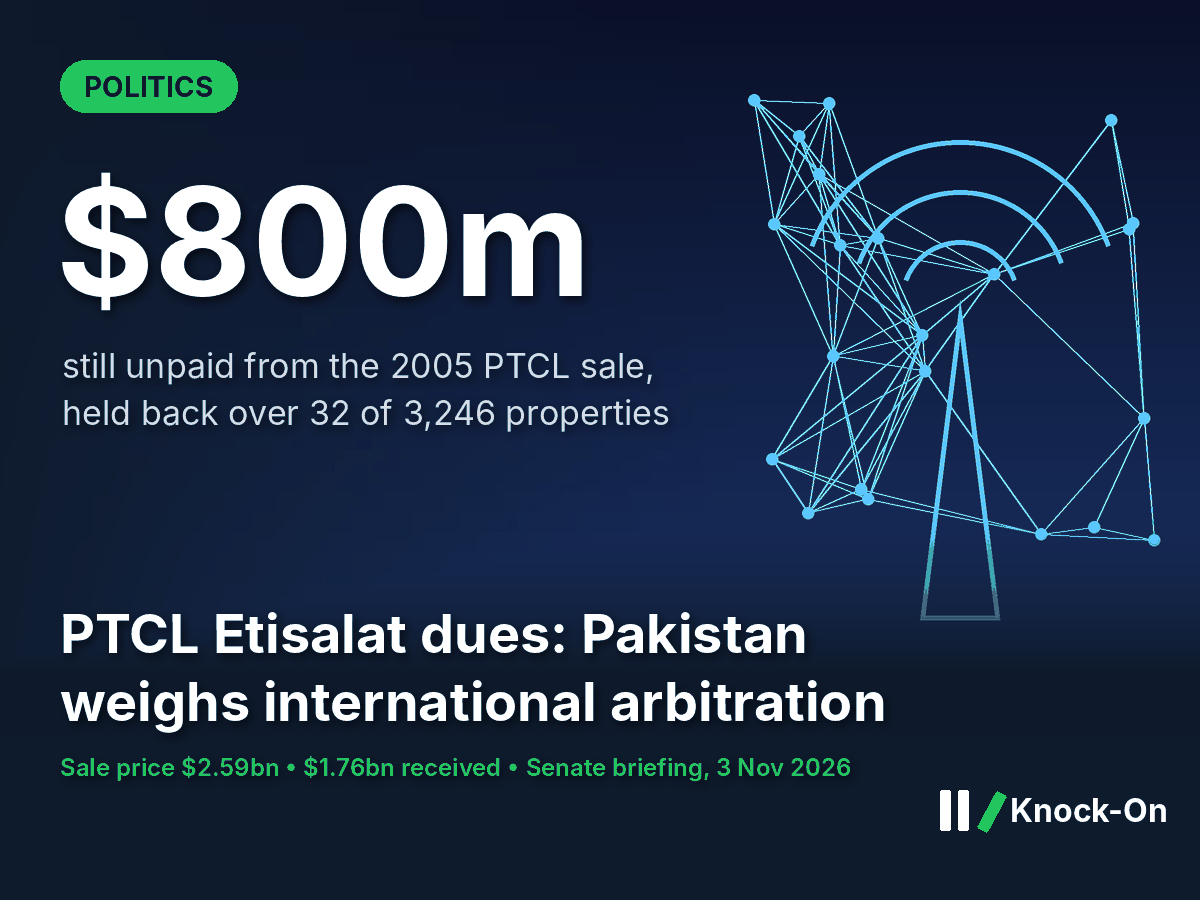
The PTCL Etisalat dues are heading towards a courtroom. The federal government is weighing international arbitration to recover about $800m that Etisalat, now known as e&, has not paid for its 2005 purchase of a controlling stake in Pakistan Telecommunication Company Ltd (PTCL), according to a Ministry of Privatisation briefing to senators reported by Dawn. The claim would also seek the opportunity cost since 2008 and damages. For a government trying to sell state companies and raise every dollar it can, a 20-year-old unpaid bill is more than a legal footnote.
The short version
- Pakistan sold 26% of PTCL, with management control, to Etisalat in 2005 for $2.59bn. It received $1.76bn; about $800m is still unpaid.
- Etisalat has withheld the money because 32 of PTCL’s 3,246 properties were never transferred to the new management.
- A government committee formed in July 2026 recommended international arbitration under the sale agreement; a summary went to the federal cabinet.
- The Attorney General must first assess the case and seek approval from the prime minister or federal government before any notice is sent to Etisalat.
What happened
On Tuesday, 3 November, a joint meeting of the Senate standing committees on privatisation and on information technology was told that the Office of the Attorney General had been directed to implement the federal cabinet’s decision on the PTCL Etisalat dues “under Rule 24 of the Rules of Business, 1973, at the earliest”, Dawn reported. The meeting was jointly chaired by Senator Dr Afnanullah Khan and Senator Palwasha Khan.
According to the ministry’s briefing, the payment was tied to the transfer of PTCL’s properties to the new management. About 99% were transferred, but 32 of 3,246 were not, and Etisalat has withheld the remaining $800m on that basis. The government says it has tried committees and negotiations since 2015 without a settlement. In July 2026 a new committee, headed by the prime minister’s adviser on privatisation and including the IT and law ministries and the Attorney General’s office, cited the “20-year history of the dispute” and recommended arbitration to recover the $800m plus opportunity cost since 2008 and applicable damages.
Nearly a third of the PTCL sale price is still outstanding
2005 sale of 26% of PTCL to Etisalat, US$ billion, as briefed to senators on 3 Nov 2026
Senators also complained that they were not given the sale purchase agreement, and the item was taken up in camera after the IT secretary called it “sensitive”. One senator said parliament should be informed about sales of national assets “rather than depending upon bureaucrats and officers.”
Why it matters
On the ministry’s figures, roughly 31% of the price (Knock-On calculation) has been held back over about 1% of the properties. That gap is why the PTCL Etisalat dues have become a test case for how Pakistan enforces privatisation contracts. The same ministry is now trying to sell other state assets, including PIA, where the Rs135bn privatisation now depends on an airline turnaround. Buyers and the government will both be watching how a two-decade dispute over property transfers is finally settled. The money itself would also matter: the government’s books are tight, as interest payments are growing far faster than tax revenue.
The knock-on effects
First order: a legal process, not a quick payment
Nothing has been filed yet. The briefing says the Attorney General should first assess the strength of the case and its prospects, then seek approval from the prime minister or the federal government before issuing a Notice of Intent to Etisalat. International arbitration typically takes years, so any recovery is unlikely to help this fiscal year’s budget.
Second order: pressure on the property question
The dispute turns on the 32 untransferred properties. A credible arbitration threat could push both sides to settle the transfer issue directly, which would remove a long-running overhang for PTCL, a major fixed-line and broadband operator. Businesses that depend on PTCL’s network, which was recently hit by slow internet during the AAE-1 cable repair, have an interest in its owners and the state working on investment rather than litigation.
Third order: signals to Gulf investors
Etisalat is UAE-based, and Pakistan is courting Gulf capital for privatisations and projects. How the government frames and runs the case, and whether it ends in a settlement or an award, will be read by other foreign buyers as a sign of how contract disputes are handled after a sale.
Who could benefit
- The Treasury: a recovery of up to $800m, plus any opportunity cost or damages awarded, would be a meaningful non-tax inflow.
- Future privatisation buyers: a clear ruling on post-sale obligations could make contract terms easier to price.
- Legal and advisory firms: international arbitration needs specialist counsel on both sides.
Who may face pressure
- PTCL’s management and shareholders: a formal dispute between the company’s controlling owner and the government could distract from investment plans.
- The Privatisation Ministry: senators are pressing for access to sale agreements and more parliamentary oversight of asset sales.
- Pakistan–UAE commercial ties: both governments will want the case kept separate from wider investment talks.
What to watch
- The Attorney General’s assessment of the case’s strength and prospects.
- Whether the prime minister or cabinet approves a Notice of Intent to Etisalat.
- Any response from e&, and whether talks on the 32 properties resume.
- Senate demands for the sale purchase agreement and for a law on reporting asset sales to parliament.
Sources
- Dawn, Govt weighs options to recover $800m from Etisalat, 4 November 2026
This is analysis, not investment advice. Figures are as of 4 November 2026. Knock-On is not affiliated with any political party.

Leave a Reply