
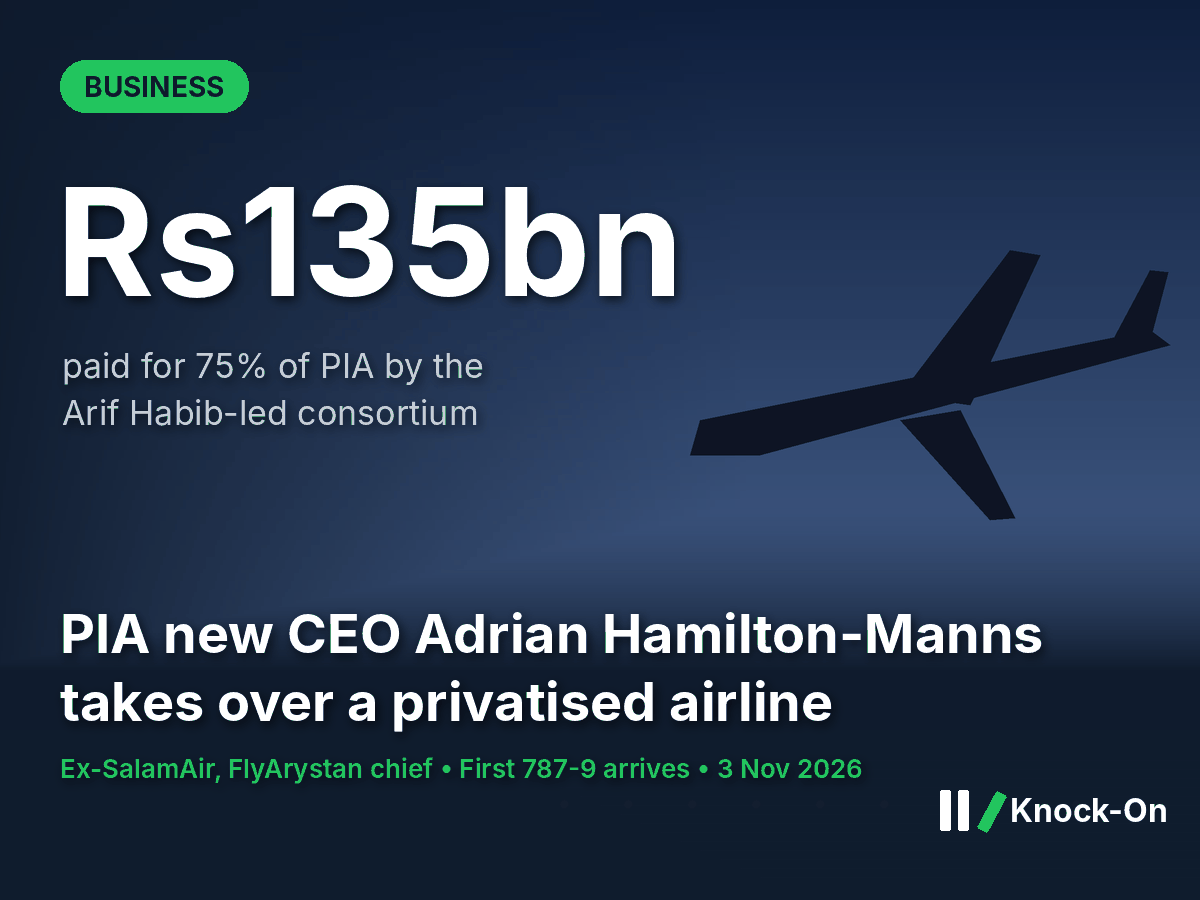
PIA’s new CEO is Adrian Hamilton-Manns, a foreign airline executive who previously ran Oman’s SalamAir and Kazakhstan’s FlyArystan. The board of Pakistan International Airlines announced the appointment on Monday, 2 November, replacing Air Vice Marshal Amir Hayat after a tenure of four and a half years. It is the clearest sign yet that the private consortium which bought control of the national carrier wants a commercial turnaround specialist, not a caretaker, in charge.
The short version
- Adrian Hamilton-Manns has been named PIA chief executive, PIA’s board said on 2 November.
- PIA says he has run three airlines and has over 30 years of experience.
- An Arif Habib-led consortium paid Rs135bn for 75% of PIA and took charge in June.
- PIA’s first leased Boeing 787-9 Dreamliner arrived in Islamabad on Sunday.
What happened
According to Dawn, the PIA new CEO appointment was announced in a press release in which the consortium and management board thanked the outgoing chief executive. PIA described Hamilton-Manns as a “world expert” in transforming and reviving airlines. Citing Forbes Middle East, Dawn reported that he was previously CEO of SalamAir and FlyArystan, both low-cost carriers, and held roles at South African Airways and Virgin Australia.
PIA was privatised through an auction in December last year. A consortium led by Arif Habib Corporation won 75% of the shares with a bid of Rs135bn, and took charge in June, promising operational restructuring, fleet expansion and better customer service. The appointment came a day after the airline’s first Boeing 787-9, leased last month, flew into Islamabad from London as PK786. We covered the plan behind that aircraft in PIA’s Dreamliner lease for UK flights.
The winning bid values all of PIA at about Rs180bn
PIA equity value implied by the December 2025 auction, Rs billion
Why it matters
The PIA new CEO decision is the first big test of whether privatisation changes how the airline is run. Investors who paid Rs135bn need PIA to fill seats, expand routes and control costs. Hamilton-Manns’ background in budget carriers suggests a focus on aircraft utilisation and lean operations. For Pakistani business, a more reliable national airline matters for exporters shipping air cargo, for the diaspora that sends remittances home, and for the government’s wider privatisation programme, which moves to power distribution companies next.
The knock-on effects
First order: a commercial reset at PIA
A chief executive from outside the military and civil service is likely to review routes, fleet use and staffing. Specific plans have not been announced.
Second order: competition on key routes
If PIA adds wide-body capacity, as the 787-9 lease suggests, it could compete harder with Gulf and private Pakistani carriers on UK and Middle East routes, which could put pressure on fares.
Third order: a signal for other privatisations
A visible turnaround would strengthen the case for selling other state firms. A stumble would give critics of privatisation fresh arguments.
Who could benefit
- Travellers and the diaspora: more direct long-haul capacity and better service, if the plans deliver.
- Exporters: more wide-body belly space can help air cargo of perishables and textiles.
- Airport and travel suppliers: catering, ground handling and travel agents gain from more flights.
Who may face pressure
- Rival airlines: a revived PIA could compete on price on busy routes.
- PIA staff: restructuring, which the consortium has promised, often involves cost cuts.
- The consortium: it must show returns on a Rs135bn bet while leasing new aircraft.
What to watch
- The new CEO’s first route and fleet announcements.
- When the 787-9 enters scheduled UK service.
- Any restructuring or staffing plan from the board.
- Progress on the next privatisations, starting with the power distribution companies in early 2027.
Sources
- Dawn, Adrian Hamilton-Manns appointed new PIA chief executive officer, 2 Nov 2026
- Dawn, Foreign expert to lead PIA, 3 Nov 2026
This is analysis, not investment advice. Figures are as of 3 November 2026.



Leave a Reply