
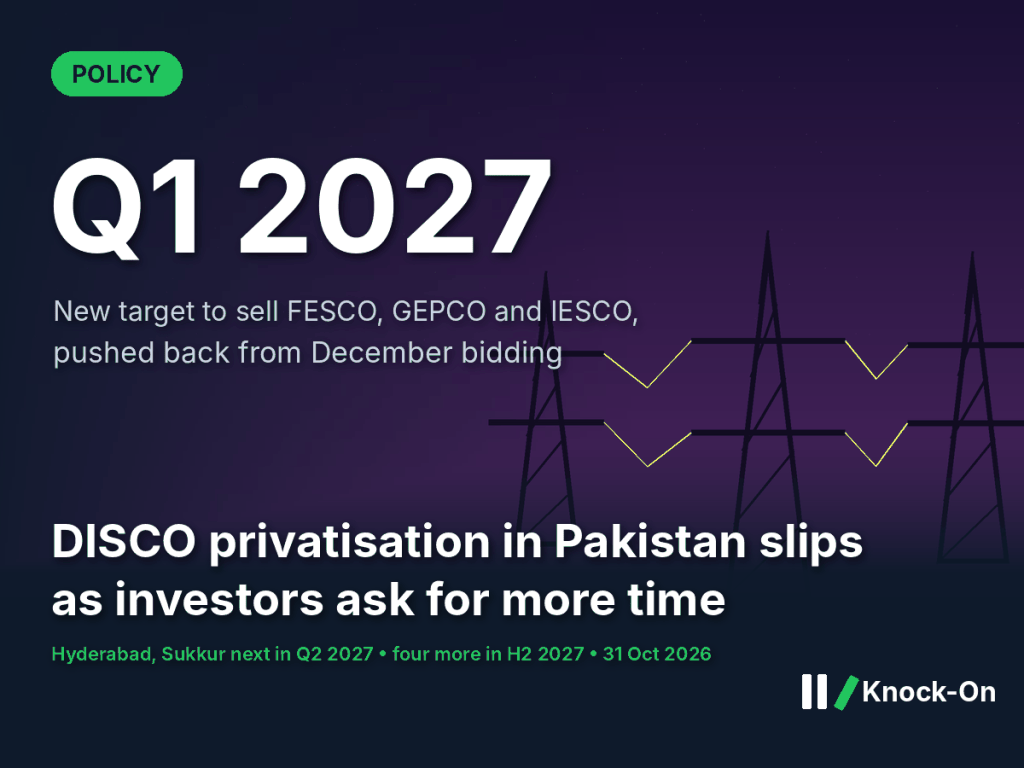
DISCO privatisation in Pakistan will take longer than planned. Bidding for the first three state-owned electricity distribution companies, Faisalabad (FESCO), Gujranwala (GEPCO) and Islamabad (IESCO), is now targeted for the first quarter of 2027 rather than December, the Prime Minister’s Adviser on Privatisation, Muhammad Ali, said in an interview on Saturday, 31 October. Investors asked for more time for due diligence. For industry, banks and the power-sector supply chain, the new timetable sets out when private owners could start running the grids that serve most of Punjab, Sindh and Khyber Pakhtunkhwa.
The short version
- Bidding for FESCO, GEPCO and IESCO moves from December 2026 to the first quarter of 2027, because investors wanted more time.
- Hyderabad and Sukkur are expected to follow in the second quarter of 2027, and Lahore, Multan, Peshawar and Hazara in the second half.
- Buyers would earn inflation-linked rupee returns, with tariffs and investment plans fixed before bidding and penalties for missed targets.
- The first batch reported far smaller losses last year than the companies being sold later.
What happened
Muhammad Ali, who also chairs the Privatisation Commission, told state news agency APP that due diligence on the three companies is under way. The government had planned to take bids in December, but investors asked for more time, so the target is now the first quarter of next year. He said transactions for the Hyderabad (HESCO) and Sukkur (SEPCO) companies are expected to be completed in the second quarter of 2027, and for the Lahore, Multan, Peshawar and Hazara companies in the second half of 2027.
The Privatisation Commission has prepared a reform paper, which the government will share with the public by mid-November, covering tariffs, investment plans and a competitive electricity market with a supplier of last resort. Under the proposed terms, buyers would be paid returns in rupees, linked to inflation and calculated with the capital asset pricing model. Multi-year tariffs and investment plans would be settled before bidding, and companies would face penalties if they miss performance benchmarks. Employees would be protected for a set period with no adverse action. The adviser added that Pakistan State Oil, Sui Southern Gas and Sui Northern Gas are also being examined for privatisation, though PSO’s strategic activities may stay under government control.
Investor interest is already on record. Twelve parties expressed interest in FESCO by the 7 August deadline and 11 in GEPCO, including Pakistani groups such as Engro Energy, Hub Power Holdings and K-Electric, Turkish energy companies and a Saudi contractor, Bloom Pakistan reported in August. As Knock-On reported, IESCO privatisation now has 10 prequalified bidders.
Why it matters
The order of sale tracks the companies’ finances. The three companies going first reported losses of Rs1bn to Rs6bn each in FY2025-26, according to figures from the Power Minister’s written reply to parliament reported by Bloom Pakistan. Peshawar and Quetta each reported more than Rs80bn. DISCO privatisation in Pakistan is therefore starting where buyers face the least risk, and the harder sales come later. The government’s case for selling is the cost of the status quo, as set out in our report on why DISCO privatisation needs no fresh CCI approval.
The first DISCOs for sale are the ones losing least
Losses reported for FY2025-26, Rs billion (green = first sale batch, Q1 2027)
The knock-on effects
First order: a later start for DISCO privatisation in Pakistan
A delay of a few months keeps FESCO, GEPCO and IESCO in state hands into 2027. Bidders get more time to study accounts and the tariff terms, which should mean better-informed bids; the government gets its first proceeds later than planned.
Second order: tariffs and investment plans before the sale
Because multi-year tariffs and investment plans must be fixed before bidding, the regulator’s decisions over the coming months become central. IESCO is already seeking a large increase, as covered in our report on the IESCO tariff hike request. Inflation-linked rupee returns would protect buyers, but the cost would sit in consumer tariffs.
Third order: the harder sales and the wider energy sell-off
If the first sales succeed, they set the template for Lahore, Multan, Peshawar and Hazara later in 2027, and for any move on PSO and the two gas utilities. If they stall, the high-loss companies, which cost the most, would be pushed further back.
Who could benefit
- Bidders: more time for due diligence, and returns linked to inflation under the proposed terms.
- Advisers and banks: a longer transaction pipeline running through 2027, with acquisition financing likely to be needed.
- Equipment and grid suppliers: fixed investment plans could bring firmer orders for meters, transformers and network upgrades.
Who may face pressure
- The federal budget: later sale proceeds, while losses continue in the meantime.
- Consumers: tariffs set to give buyers inflation-linked returns could keep electricity bills high.
- DISCO staff: protection is promised only for a set period.
What to watch
- Mid-November 2026: publication of the Privatisation Commission’s power-sector reform paper.
- Before bidding: multi-year tariff and investment-plan decisions for FESCO, GEPCO and IESCO.
- January to March 2027: bidding for the first three companies.
- April to June 2027: target to complete the HESCO and SEPCO transactions.
Sources
- APP, Govt plans to privatise three DISCOs in first quarter of 2027: Privatisation Adviser, 31 October 2026
- Business Recorder, Pakistan plans to privatise three DISCOs in first quarter of 2027: adviser, 31 October 2026
- Bloom Pakistan, 11 Investors Eye Gepco as Govt Advances Power Sector Privatisation, 22 August 2026
- Profit (Pakistan Today), Government plans Rs250 billion SPV for FESCO, GEPCO and IESCO privatisation, 21 August 2026
This is analysis, not investment advice. Figures are as of 31 October 2026.

Leave a Reply