
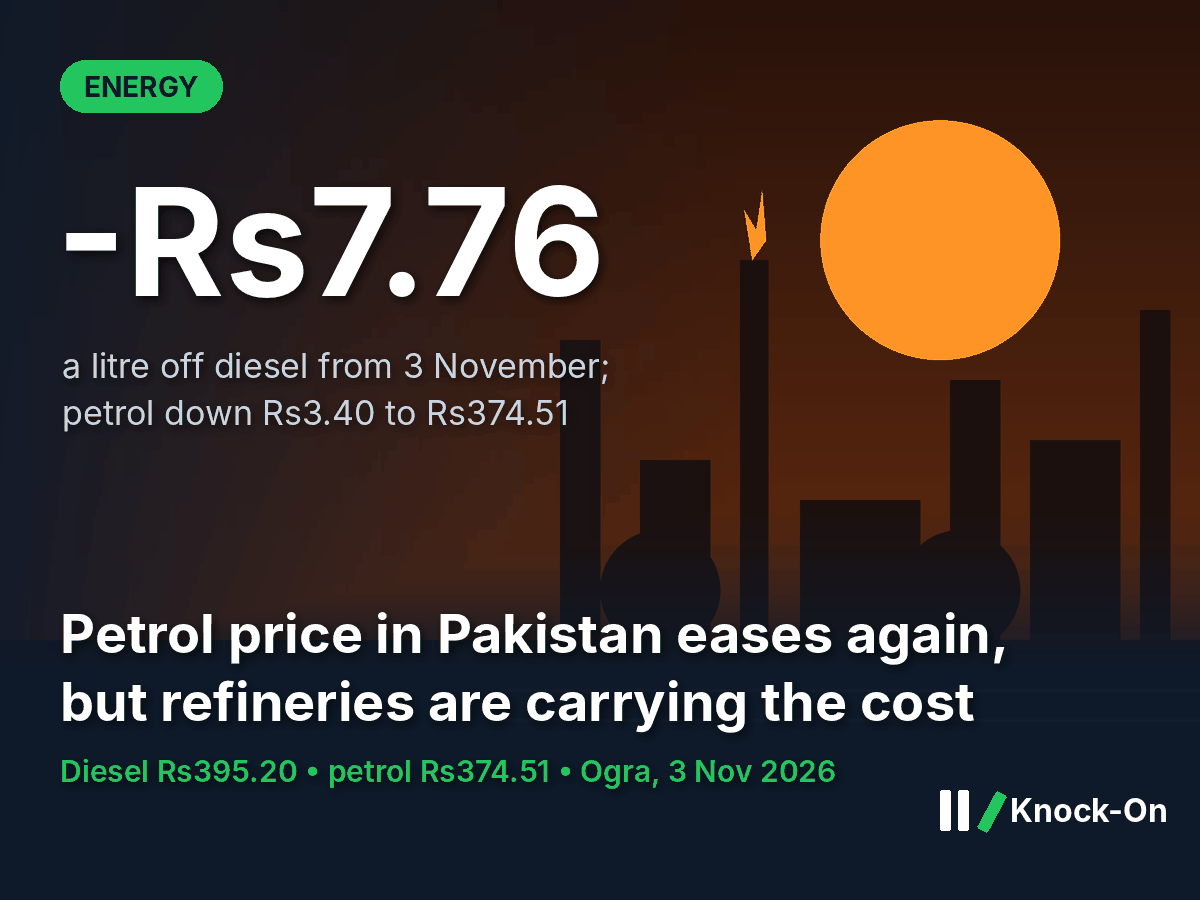
The petrol price in Pakistan fell by Rs3.40 a litre to Rs374.51 from Tuesday, 3 November, and high-speed diesel by Rs7.76 to Rs395.20, under an Ogra notification. The cut is small next to this year’s swings, but diesel is the fuel that moves goods, so the bigger diesel cut matters most for business costs. Both prices remain about 40% above where they stood before the US–Iran war began on 28 February.
The short version
- Petrol: down Rs3.40 to Rs374.51 a litre. Diesel: down Rs7.76 to Rs395.20, effective 3 November.
- The government says refineries are bearing about Rs15bn a month so that petrol sells about Rs15 a litre below international parity.
- Prices are now set daily by Ogra, so the overnight fall in world oil could feed through quickly.
- Diesel is down 24% from its April peak, but still about 41% above its pre-war level (Knock-On calculation).
What happened
The government announced the cut on Monday, Dawn reported, after a press conference in Islamabad by Petroleum Minister Ali Pervaiz Malik and Information Minister Attaullah Tarar. Earlier the same day the ministers said refineries would bear a burden of “approximately Rs15 billion” a month, allowing petrol to sell Rs15 a litre cheaper than it otherwise would. Malik said a Rs15 increase that was due on Friday had been averted with the refineries’ help, and that refineries had increased their throughput and made profits from it over the last three months. He said the refinery premium, $5 a barrel before the crisis, now has a $20 limit.
Since 17 July, Ogra has fixed fuel prices daily based on international trends; before that, prices were revised weekly from early March. Diesel peaked at Rs520.35 and petrol at Rs458.41 on 3 April.
Pump prices are well off the April peak, but still about 40% above pre-war
Rupees per litre: before the war, at the 3 April 2026 peak, and from 3 November 2026
Why it matters
Diesel powers trucks, tractors, buses and many generators, so the petrol price in Pakistan gets the headlines but the diesel price drives freight and farm costs. Petrol and diesel together sell about 700,000 to 800,000 tonnes a month, Dawn reported. Fuel and transport have kept inflation high: October CPI eased to 9.6%, but, as our October inflation analysis showed, fuel was still rising far faster than the headline rate.
The way the relief is funded also matters. Instead of cutting the petroleum levy further, the government has leaned on refiners, as covered in our report on refineries paying for the levy cut. That protects tax revenue, but leaves refiners’ margins exposed if world prices rise again.
The knock-on effects
First order: lower running costs for transport
A Rs7.76 cut is about 1.9% off the diesel price (Knock-On calculation). Goods transporters and farmers preparing for wheat sowing see the most direct saving, though fares and freight rates rarely fall as quickly as fuel prices.
Second order: refineries’ margins and supply
With refineries absorbing about Rs15bn a month, their profitability depends on world oil and product prices. Monday’s 7% fall in Brent, driven by Iran peace talks with Qatari mediators, would ease that burden if it lasts.
Third order: inflation and politics of the levy
Lower fuel prices help bring inflation down, which matters after the State Bank raised its policy rate to 12% last week. Pressure for bigger relief continues: Jamaat-i-Islami chief Hafiz Naeemur Rehman has said his party would march to Islamabad in mid-November against the petroleum levy if no major relief is announced, Dawn reported.
Who could benefit
- Goods transporters and logistics firms, through the larger diesel cut.
- Farmers running tractors and tube wells during sowing.
- Motorcyclists and small-car owners, already covered by the fuel relief scheme since 17 September.
Who may face pressure
- Refineries, which carry an estimated Rs15bn a month of the relief.
- Oil marketing companies holding stock bought at higher prices.
- Businesses budgeting on further cuts: daily pricing means prices can rise as fast as they fall.
What to watch
- Ogra’s daily price notifications this week, after Brent’s fall to about $105.
- The joint government–Jamaat-i-Islami committee on widening the fuel relief scheme.
- Mid-November: Jamaat-i-Islami’s planned march against the petroleum levy.
- Austerity steps still in force, including 9pm market closures.
Sources
- Dawn, Govt slashes high-speed diesel price by Rs7.76 per litre, petrol by Rs3.40, 2 November 2026
- Dawn, Govt enlists oil refineries to shield citizens from global price hikes, 2 November 2026
- Dawn (Reuters), Oil prices drop over 7pc, 3 November 2026
- Dawn, Private sector turns net borrower, 3 November 2026
This is analysis, not investment advice. Figures are as of 3 November 2026.


Leave a Reply