
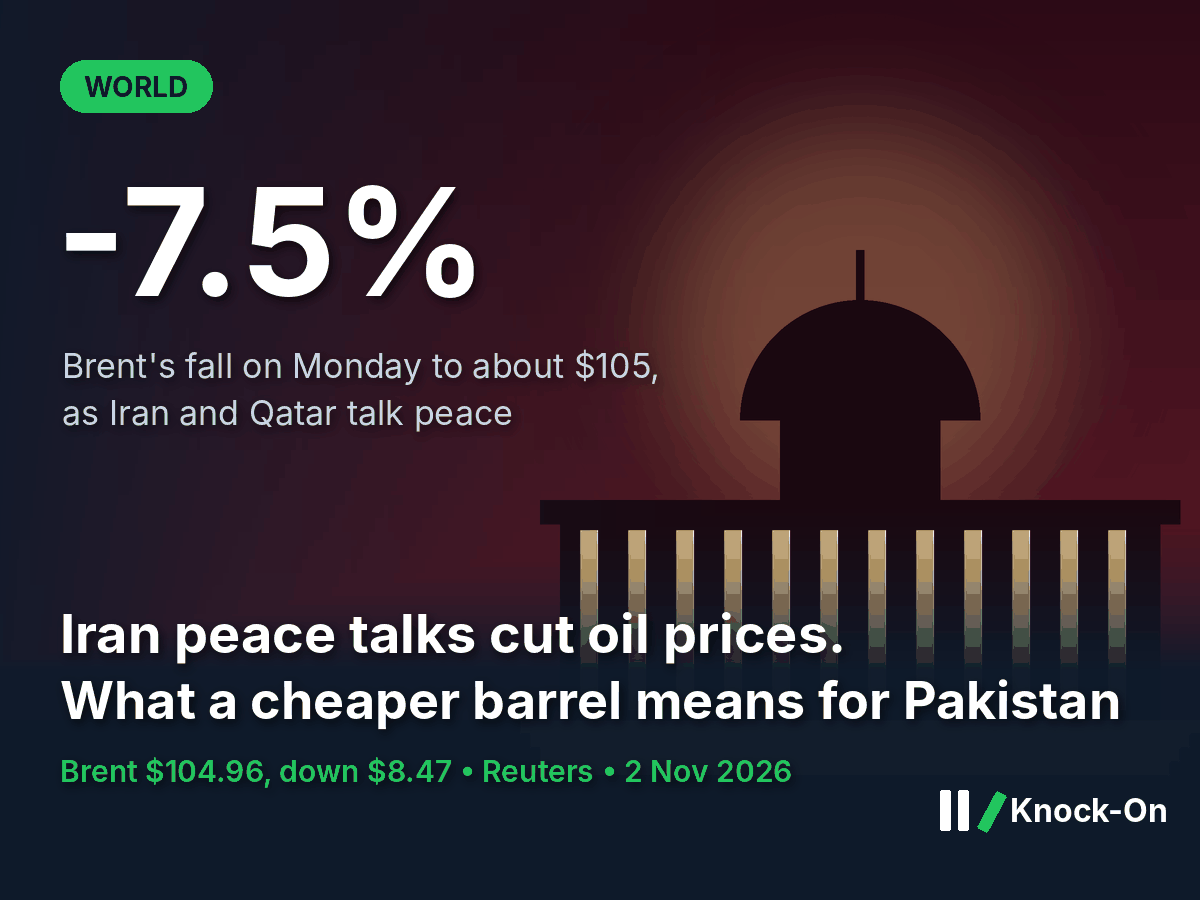
Iran peace talks moved oil markets more than anything else on Monday. Brent crude fell more than 7% after Iran’s president said the government had been given authority to negotiate and Iranian officials held days of talks with Qatari mediators. For Pakistan, which imports most of its fuel and buys LNG priced against Brent, a lower barrel is the quickest form of relief available, but only if it lasts.
Update, 4 Nov 2026, 9:00 am PKT: The slide has paused. Brent settled at $103.60 and WTI at $96.09 on Tuesday, their lowest in nearly four weeks, then rose about 1% in Asian trading on Wednesday to $104.61 and $96.83. A senior Iranian official told Reuters that Washington’s response to the latest mediator proposal was “not convincing”, and the US carried out limited strikes on Iran’s Qeshm island on Monday, according to reports compiled by Angel One (4 Nov). For Pakistan, that means the relief from cheaper crude is real but not yet secure.
The short version
- Brent fell $8.47, or 7.47%, to $104.96 a barrel on Monday, Reuters reported, after ending October at a six-month high.
- The trigger was progress in Iran’s talks with Qatari mediators; a draft proposal is circulating, according to an official briefed on the talks.
- Pakistan’s petroleum imports were $4.02bn in July–September, up 6.5% on a year earlier, so oil prices feed straight into the trade bill and the rupee.
- Analysts warn there have been many “false dawns”; the price could reverse on the next headline.
What happened
According to Reuters, as carried by Dawn, Brent crude futures fell $8.47 to $104.96 a barrel by 12:24pm New York time on Monday, 2 November, with a session low of $104.49. US WTI fell $7.50, or 7.2%, to $96.62. Earlier in Asian trading the fall had been about 3%, with Brent at $109.75.
The move followed remarks by Iranian President Masoud Pezeshkian, who said Supreme Leader Ayatollah Mojtaba Khamenei had granted the government “certain authorities” for peace talks and that Tehran “will try to resolve the problem with dialogue”. Iran’s negotiators have held days of talks with Qatari mediators, and a follow-up meeting is possible, Reuters reported. Raymond James analyst Pavel Molchanov said there were signs of progress but that scepticism was warranted after many “false dawns”. UBS analyst Giovanni Staunovo said the market was reacting “with extreme sensitivity to every headline out of the Middle East”. Brent had ended October at its highest in six months on fears the conflict could escalate after Tuesday’s US midterm elections.
Why it matters
Pakistan’s exposure to the Iran peace talks runs through its import bill. Pakistan Bureau of Statistics data, reported by The Nation, show the petroleum group cost $4.02bn in the first quarter of 2026-27. Crude and refined products made up about $3.3bn of that. LNG imports fell 41.6% to $418m, largely because Qatari supply has been disrupted; Knock-On has reported that Qatar has halted LNG deliveries until 29 December, leaving Pakistan short of winter gas.
Crude and fuel products are 82% of Pakistan’s petroleum import bill
Petroleum group imports, July–September 2026, US$ million
As a rough illustration, if Brent stayed 7.5% lower and volumes were unchanged, the crude and product imports of the last quarter would have cost about $250m less (Knock-On calculation). That is not a forecast: prices have swung widely all year, and freight and refinery premiums also matter.
The knock-on effects
First order: pump prices and the refinery burden
Ogra now sets fuel prices daily from international trends, so a lasting fall would reach the pump within days. It also eases pressure on refineries, which the government says are absorbing about Rs15bn a month to hold prices down, as covered in our report on the petrol levy cut being paid by refineries.
Second order: LNG, the rupee and reserves
Pakistan’s long-term LNG contracts are priced as a share of Brent, so cheaper crude lowers the cost of each cargo. A revised Qatar LNG deal at 11.96% of Brent is under discussion. A smaller oil bill also reduces dollar demand, which supports the rupee and reserves.
Third order: inflation and interest rates
The State Bank raised its policy rate by 50 basis points to 12% last week, Dawn reported. Fuel and transport have been among the main drivers of inflation; a sustained fall in oil would weaken the case for further rises, while a reversal would strengthen it.
Who could benefit
- Transporters and logistics firms, for whom diesel is the largest running cost.
- Power and fertiliser producers using RLNG, if Brent-linked cargo prices fall.
- Refineries, whose share of the relief burden would shrink.
- Importers generally, if a smaller oil bill eases pressure on the rupee.
Who may face pressure
- Oil and gas producers and marketers holding high-priced stock, which may book inventory losses.
- Businesses that locked in forward fuel purchases at October’s higher prices.
- Anyone planning on cheaper fuel: if the talks stall, prices could rebound quickly.
What to watch
- Tuesday 3 November: the US midterm elections, which traders had seen as a possible escalation point.
- Whether a follow-up meeting between Iranian negotiators and Qatari mediators takes place, and what the draft proposal contains.
- Ogra’s daily fuel price notifications this week.
- Any change to Qatar’s LNG supply halt, currently until 29 December.
Sources
- Dawn (Reuters), Oil prices drop over 7pc, 3 November 2026
- Business Recorder (Reuters), Oil prices ease 3% on optimism for Qatari-led talks on ending Iran war, 2 November 2026
- The Nation, Imports of petroleum group up 6.50pc in Q1, 27 October 2026
- Dawn, Private sector turns net borrower, 3 November 2026
- Dawn, Govt slashes high-speed diesel price by Rs7.76 per litre, petrol by Rs3.40, 2 November 2026
This is analysis, not investment advice. Figures are as of 3 November 2026. Knock-On is not affiliated with any political party.


Leave a Reply