
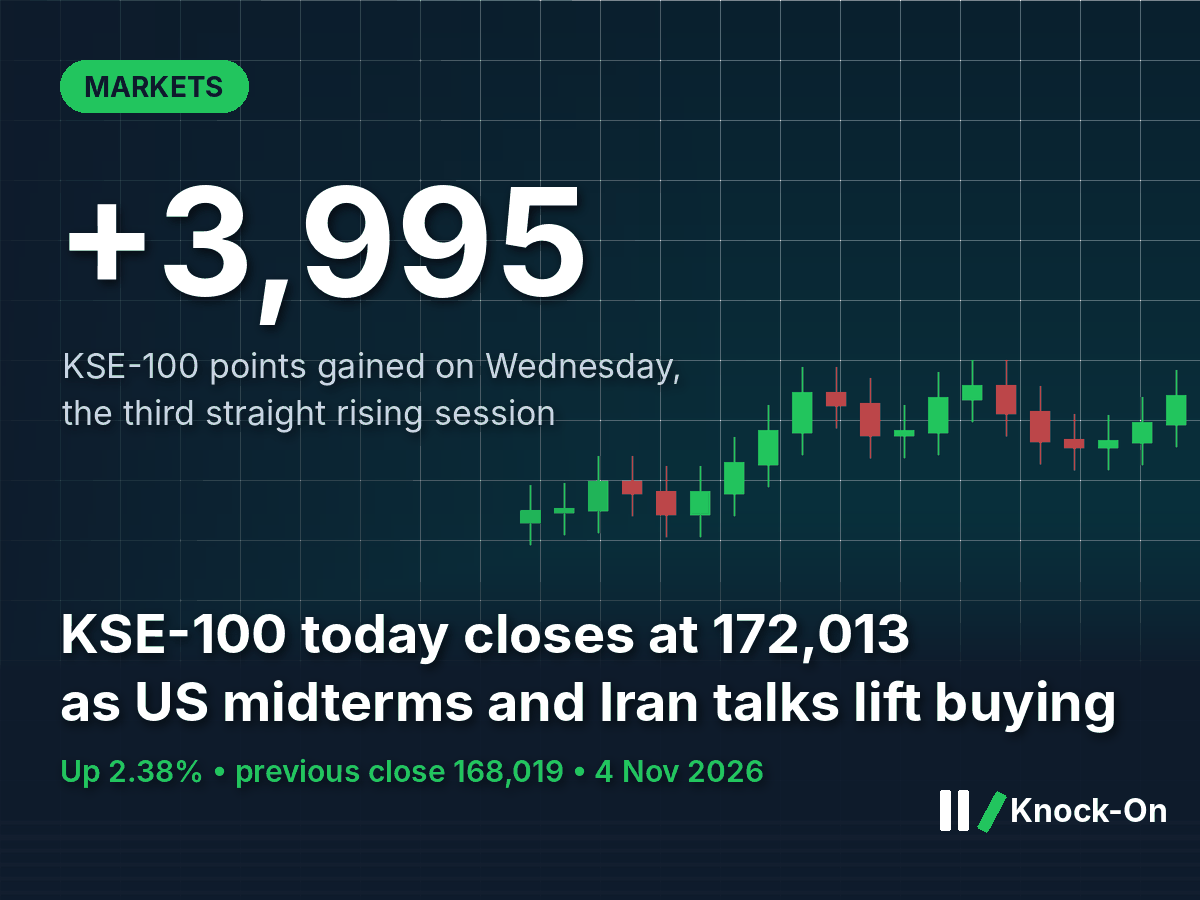
The KSE-100 today posted its biggest gain of the week, rising 3,994.62 points, or 2.38%, to close at 172,013.48 on Wednesday 4 November. Investors in Karachi bought heavily while most Asian markets fell, betting that early US midterm results and a US draft in talks with Iran point towards cheaper oil and easing inflation for Pakistan. It was the index’s third rising session in a row.
The short version
- The KSE-100 closed at 172,013.48, up 3,994.62 points (2.38%) from Tuesday’s 168,018.87.
- Analysts linked the rally to US midterm results, a US draft in talks with Iran, and oil holding near $103–104 a barrel.
- Institutions, especially mutual funds, did much of the buying, according to Arif Habib Limited.
- The PSX rose while Tokyo, Seoul and US stock futures fell, so the move was driven by Pakistan-specific hopes, not a global risk-on day.
What happened
The index crossed 170,000 early in the session, dipped around 11am, and then recovered to finish near its intraday high of 172,286.99, Business Recorder reported. By mid-morning, buying was spread across automobile assemblers, cement, commercial banks, oil and gas exploration companies, oil marketing companies, power generation and refineries, with ARL, HUBCO, MARI, OGDC, PPL, POL, MCB, MEBL, NBP and UBL among the heavyweights in the green.
Sana Tawfik, Head of Research at Arif Habib Limited, told Business Recorder that “buying has mainly come from institutions, particularly mutual funds”, and that oil prices “had risen to around $103 and have stabilised at that level”. She pointed to two US factors: unofficial midterm results showing “a visible shift”, and US-Iran talks “where the US has sent a draft”. Saad Hanif, Head of Research at Ismail Iqbal Securities, said investors “read a Democratic sweep as positive for regional geopolitics”, feeding expectations of lower global oil prices and easing inflation.
The US results were still coming in. Business Recorder reported that Democrats were favoured to win the House of Representatives, while control of the Senate remained a close state-by-state contest. This week’s gains follow a weak month: as Knock-On reported, the KSE-100 lost 3,560 points in October.
Each day this week the KSE-100 gained more than the day before
Daily change in the KSE-100, index points, 2–4 November 2026
Why it matters
Pakistan’s market is reacting less to US politics itself than to what it might mean for the Gulf and for oil. Brent was trading at $104.42 a barrel early on Wednesday, Profit reported, close to the level Arif Habib’s research head described as stable. For an oil importer, every step away from war-time prices eases the import bill, the pressure on the rupee and the pass-through into fuel and transport costs. On Tuesday, the KSE-100 rose on similar hopes, as covered in Knock-On’s KSE-100 report on the US-Iran talks.
The contrast with the region is notable. Japan’s Nikkei fell 3%, South Korea’s KOSPI fell 1.6% and US S&P 500 futures were down 0.8%, as investors worried that the midterm results could slow spending on AI data centres. Karachi went the other way because its main risks are oil and Middle East security, not technology valuations.
The knock-on effects
First order: a better window for listed companies to raise money
Higher share prices lower the cost of raising equity. Companies that have been waiting to issue rights shares, or sponsors hoping to sell stakes, now face a more receptive market, at least while sentiment holds.
Second order: KSE-100 today depends on oil staying calm
Much of the rally rests on expectations of lower oil prices and easing inflation, as Ismail Iqbal Securities’ research head described. If oil stays near current levels or falls, the benefit would reach fuel prices and inflation first; in time, that could also create room for lower interest rates, which would support bank lending and consumer demand.
Third order: geopolitics remains the swing factor
The gains are tied to talks that have not produced an agreement. Knock-On has previously reported claims that the Iran war’s impact on Pakistan could return after the US midterms. A setback in the US-Iran process could reverse sentiment quickly.
Who could benefit
- Mutual funds and their investors: institutions led the buying and gain most from higher prices.
- Banks and cement makers: both were among the sectors attracting buyers and would gain from lower rates and stronger construction demand.
- Brokerages: busier markets usually mean more trading commissions.
Who may face pressure
- Late buyers: a 5,600-point rise in three sessions leaves room for profit-taking if news disappoints.
- Oil and gas producers: OGDC, PPL and MARI rose today, but lower crude prices would reduce their revenue over time.
What to watch
- Final US midterm results, especially control of the Senate, over the coming days.
- Iran’s response to the US draft in the talks.
- Brent crude: whether it holds near $103–104 or moves lower.
- Thursday’s session: whether the index holds above 170,000.
Sources
- Business Recorder, PSX: KSE-100 accumulates nearly 4,000 points as investors bet on US midterms, Iran talks, 4 November 2026
- Profit by Pakistan Today, PSX surges over 2,200 points, crosses 170,000 as investors weigh US election results, Iran war, 4 November 2026
- Business Recorder, PSX: KSE-100 Index closes marginally higher as late buying offsets intra-day losses, 2 November 2026
This is analysis, not investment advice. Figures are as of 4 November 2026. Knock-On is not affiliated with any political party.

Leave a Reply