
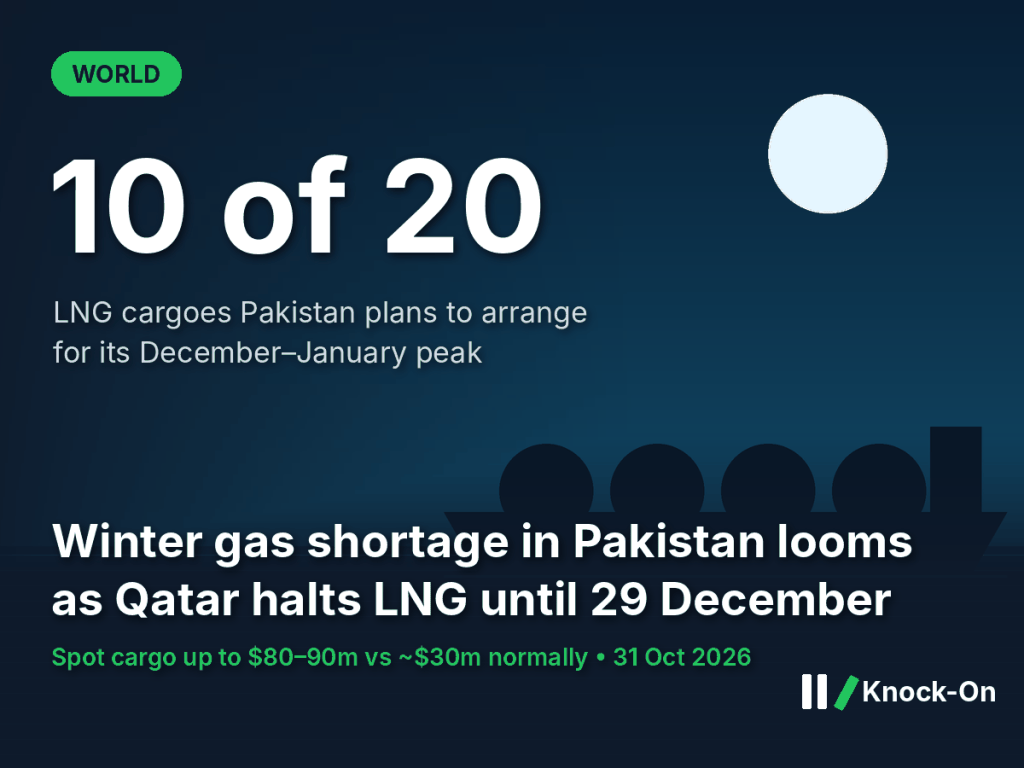
A winter gas shortage in Pakistan now looks likely after QatarEnergy extended its force majeure on liquefied natural gas (LNG) deliveries until 29 December, officials said on Saturday. Qatar supplied 35 of the 36 LNG cargoes Pakistan imported last winter. The government plans to arrange 10 cargoes for December and January against an estimated need of 20, and spot cargoes could cost two to three times as much. For industry, CNG stations and anyone who relies on piped gas, the next two months will be tighter and dearer.
The short version
- QatarEnergy has extended force majeure on LNG supply to Pakistan until 29 December, the petroleum minister confirmed.
- Pakistan plans 10 cargoes for December and January against an estimated requirement of 20.
- A cargo that normally costs about $30m could cost $80m to $90m on the spot market, an official said.
- Homes get priority; industry, cement and CNG are at the back of the queue.
What happened
Federal Petroleum Minister Ali Pervaiz Malik confirmed that “Qatar has extended its force majeure on LNG supplies until the end of December”, The News reported via Geo. Reuters had first reported on 27 October that Pakistani buyers were told the notices now ran to year-end, from an earlier early-December date. Qatar halted production and declared force majeure in March after attacks on its facilities during the US–Iran conflict, Pakistan Today reported.
The timing hurts. Last winter Pakistan took 6 cargoes in November, 10 in December, 12 in January and 8 in February, almost all from Qatar. Sui gas company officials told The News that household demand in Punjab and Khyber Pakhtunkhwa could rise from 500 to 1,500 million cubic feet a day (mmcfd) in December and January, and in Sindh and Balochistan from 300 to 600 mmcfd.
Pakistan has lined up half the LNG it needs for the peak
LNG cargoes for December and January combined
Why it matters
The winter gas shortage in Pakistan is a cost problem as much as a supply one. Imported LNG was about a fifth of total gas use between July 2025 and March 2026, according to the Economic Survey, as cited by Pakistan Today. Replacing Qatari contract gas on the spot market means paying far more: “A cargo which normally costs around $30 million can cost around $80 to $90 million,” an official told Arab News. The government must decide whether to absorb that, and officials said industrial, commercial and CNG users would bear a larger share. Not everyone sees a crisis: SSGC board chairman Asif Inam said a new 100 mmcfd field means the south needs “a very nominal cargo in January”, provided power plants do not run on LNG.
The knock-on effects
First order: supply cuts for industry and CNG
The priority order is homes first, then power and fertiliser, then cement and CNG, officials said. A senior ministry official said gas would be available for cooking, not for space or water heating, and that “some form of load-shedding” was possible. Mills on RLNG face both shorter supply and higher bills, after the RLNG price in Pakistan rose up to 15.3% for October.
Second order: fuel switching and fertiliser
Power plants may burn furnace oil instead, raising generation costs. Fertiliser looks safer: seven of ten plants are on dedicated gas networks and about 300,000 tonnes of urea is in stock, officials said, ruling out a shortage.
Third order: the Qatar deal and Iran diplomacy
The halt runs alongside talks on a revised Qatar LNG deal cutting Pakistan’s cargoes to 66 a year, and a search for other suppliers, including US LNG for Pakistan. How soon Qatari gas flows again depends on the Gulf conflict. An Iranian delegation held talks with Qatari mediators in Doha on Saturday, Reuters reported, and Iran’s foreign minister said Qatari and Pakistani mediators were continuing consultations on Tehran’s conditions, according to Al Jazeera.
Who could benefit
- Domestic gas producers: local fields such as SSGC’s new southern supply become more valuable.
- LPG and furnace oil sellers: demand rises as users switch away from piped gas.
- Fertiliser makers on dedicated networks: protected supply while rivals compete for LNG.
Who may face pressure
- Textile and other RLNG-based industry: rationing and costlier spot gas.
- CNG stations and cement: last in the supply queue.
- The gas utilities and budget: any spot cost not passed on adds to gas-sector arrears.
What to watch
- 3 November: whether the government approves PSO’s revised Qatar deal.
- November: awards and prices of spot LNG tenders for December and January.
- 29 December: the new end date of QatarEnergy’s force majeure.
- Doha talks: any agreement that reopens safe passage through Hormuz.
Sources
- Pakistan Today, Qatar LNG squeeze raises fears of winter gas crunch in Pakistan, 1 November 2026
- Arab News, Pakistan braces for winter gas crunch as Qatar halts LNG supply till end-December, 31 October 2026
- Geo News (The News), Pakistan faces winter gas crisis as Qatar extends LNG supply halt, 31 October 2026
- Arab News (Reuters), Edison, Pakistan gas buyers face QatarEnergy supply halt until year-end, 27 October 2026
- Spokesman-Review (Reuters), Iranian envoys meet Qatari mediators as threat looms of U.S. strikes after midterms, 31 October 2026
- Al Jazeera, Iran FM says US outreach a ‘positive step’ as delegation in Qatar for talks, 31 October 2026
This is analysis, not investment advice. Figures are as of 1 November 2026. Knock-On is not affiliated with any political party.

Leave a Reply