
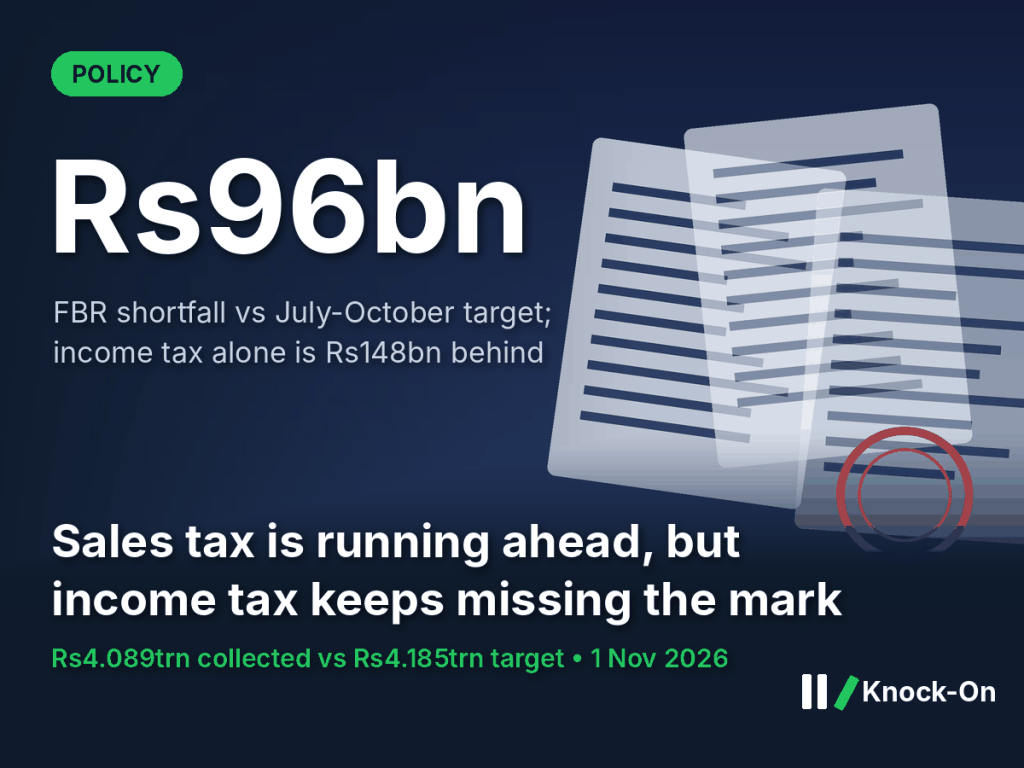
The FBR revenue shortfall reached Rs96bn in the first four months of the fiscal year, Dawn reported on Sunday. The Federal Board of Revenue collected Rs4.089trn in July–October against a target of Rs4.185trn. Income tax was the weak spot, falling Rs148bn short, while sales tax beat its target as inflation pushed up prices. For businesses, the pattern matters: when direct taxes lag, the pressure tends to land on enforcement, withholding and consumption taxes.
The short version
- FBR collection was Rs4.089trn in July–October, Rs96bn below target and 6% above last year’s Rs3.840trn.
- October alone was Rs102bn short, at Rs1.003trn against Rs1.132trn.
- Income tax missed by Rs148bn; sales tax beat its target by Rs76bn.
- To reach the Rs15.264trn annual target, the FBR now needs about Rs1.4trn a month (Knock-On calculation).
What happened
Provisional figures reported by Dawn show the FBR revenue shortfall widened in October. The month’s collection of Rs1.003trn was 5% higher than the Rs951bn of October 2025, but Rs102bn below the month’s target. Over four months, income tax brought in Rs1.861trn against Rs2.009trn, growth of only 4% on last year. Customs duty was Rs427bn against Rs449bn, just Rs4bn more than a year earlier. Federal excise duty met its Rs278bn target, up 7%.
Sales tax was the exception. It reached Rs1.524trn, Rs76bn above target and 12% higher than last year, because rising fuel and goods prices lift the tax collected on them, Dawn said. Higher-than-expected petroleum levy receipts also helped the government offset part of the gap, though the levy is not counted in FBR collection. Refunds and rebates rose 28.64% to Rs265bn, which reduces net collection.
Income tax is behind the whole shortfall; sales tax is ahead
Gap against target by tax, Rs bn, July–October FY27
Why it matters
The annual target is Rs15.264trn, roughly 17% more than the just over Rs13trn collected in FY26 (Knock-On calculation). After four months at 6% growth, the FBR needs about Rs11.18trn in the remaining eight months, or around Rs1.4trn a month, against Rs1.003trn in October (Knock-On calculation). Pakistan is in an IMF programme, with a staff-level agreement on its latest review reached on 8 October, so a widening FBR revenue shortfall would raise questions about how the gap is closed.
The weakness in income tax comes even as more people file. Returns reached 7.66m by 31 October against 5.94m a year earlier, Dawn reported, but as our tax return deadline story showed, the tax paid with those returns has not kept pace.
The knock-on effects
First order: tougher FBR enforcement
With income tax lagging, businesses can expect more notices, audits and data-matching, particularly for sectors seen as under-taxed. Schemes such as the retailers’ fixed tax scheme, which has fallen far short of its target, are likely to come under renewed focus.
Second order: refunds may slow
Refunds rose 28.64% to Rs265bn. When collection is short, exporters and manufacturers waiting on sales tax refunds often worry that payments will be slowed to protect the headline number. That is a risk to watch, not a reported decision.
Third order: reliance on fuel and consumption taxes
Sales tax and the petroleum levy are doing the heavy lifting because prices are high. That makes revenue sensitive to oil: if fuel prices fall or the government gives relief, as with the petrol levy cut, the cushion shrinks. Consumers and businesses carry more of the burden through prices rather than profits.
Who could benefit
- Compliant filers: tighter enforcement on non-filers can narrow the cost gap with competitors who avoid tax.
- Tax advisers and accountants: more notices and audits mean more demand for their services.
Who may face pressure
- Exporters: any slowdown in refunds ties up working capital.
- Retailers and traders: the most likely targets of new collection drives.
- Consumers: inflation-linked sales tax keeps lifting the price of everyday goods.
What to watch
- Early November: October inflation data, which drives sales tax receipts.
- IMF board: approval of the review agreed on 8 October, and any conditions on revenue.
- November collection: whether the monthly gap narrows from October’s Rs102bn.
- Any new revenue measures or enforcement drives announced by the FBR or Finance Ministry.
Sources
- Dawn, Four-month revenue target missed by Rs96bn, 1 November 2026
- Dawn, PSX sheds 3,560 points amid panic selling in jittery October (IMF staff-level agreement), 1 November 2026
This is analysis, not investment advice. Figures are as of 31 October 2026.


Leave a Reply