
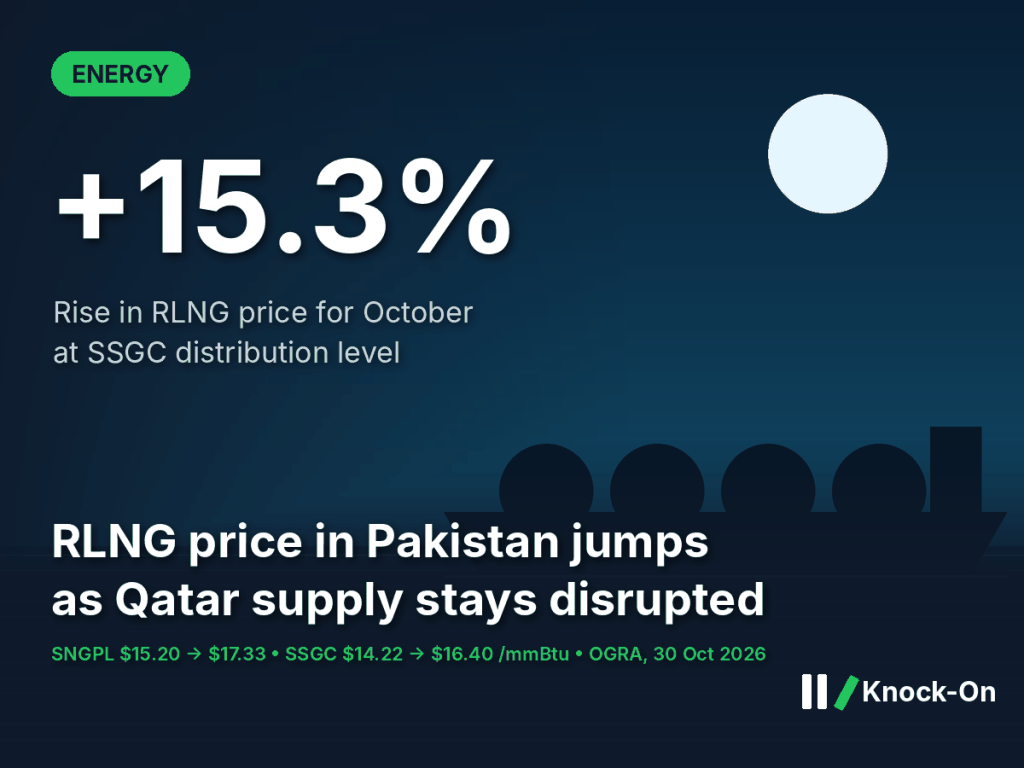
The RLNG price in Pakistan has gone up by as much as 15.3% for October, after the Oil and Gas Regulatory Authority (OGRA) notified new rates on Friday. Consumers on the SNGPL network now pay $17.33 per mmBtu at the distribution level, up from $15.196 in September. The cargoes behind that gas, however, cost Pakistan only about 7% more to land. The difference matters for every factory, power plant and gas station that runs on imported gas, and it arrives as Qatar’s supply disruption is extended into late December.
The short version
- OGRA raised October RLNG prices by 13.9% to 15.3%, depending on the network and supply level.
- The average delivered price of LNG cargoes rose from $10.06 to $10.75 per mmBtu, an increase of about 6.9% (Knock-On calculation).
- Higher system losses and import charges sit on top of the cargo price, widening the gap between what LNG costs and what consumers pay.
- Electricity from RLNG cost about Rs40 a unit in September, and the higher gas price is expected to reach power costs in December.
What happened
OGRA’s notification sets the RLNG price for October 2026 for both gas utilities, according to Dialogue Pakistan. For SNGPL, the distribution price rose 14% to $17.33 per mmBtu and the transmission price rose 13.9% to $15.94 from $13.99. For SSGC, the distribution price rose 15.27% to $16.396 from $14.22, and the transmission price rose 15.25% to $14.53 from $12.611.
The report says the rise is largely due to higher crude oil prices, because Pakistan’s long-term Qatar contracts are priced as a percentage of Brent. The October basket used two Qatar cargoes linked to 13.37% and 10.20% of Brent. The average delivered ex-ship price was $10.75 per mmBtu in October, compared with $10.06 in September, $12.12 in August and $18.96 in July.
Consumers pay up to 61% more than the cargo cost
October 2026 RLNG prices, US$ per mmBtu
Why it matters
The RLNG price in Pakistan rose roughly twice as fast as the cargo price. Part of the reason is what gets added on the way to the consumer. Importer charges, covering PSO and Pakistan LNG Ltd margins, retainage and port fees, came to 3.77% of the delivered price. System losses rose to 12.55% at SSGC from about 10.6%, and to 8.97% at SNGPL from 7.47% a year earlier, according to the report. Every unit of gas lost in the pipes is paid for by the units that arrive.
Supply is the other worry. The report says Qatar declared force majeure after the US attack on Iran and the closure of the Strait of Hormuz, a risk Knock-On has tracked in its coverage of how the Hormuz mines are pushing up diesel prices in Pakistan. Pakistan Observer reports that QatarEnergy has now extended that force majeure until 29 December, which could constrain supply in December and January, just as winter demand peaks.
The knock-on effects
First order: higher RLNG price for Pakistan’s gas users
Businesses and power producers that buy RLNG pay more for October gas straight away. For a buyer on SNGPL’s distribution network, each mmBtu now costs $2.13 more than in September (Knock-On calculation).
Second order: electricity costs follow
RLNG-fired power cost about Rs40 a unit in September, and the report expects the higher gas price to affect power costs in December. That would feed into monthly fuel charge adjustments on electricity bills, which have already risen for several months in a row, as Knock-On reported in its look at the electricity bill increase for November.
Third order: pressure on the gas contract talks
Rising losses and a wider price gap add weight to the debate over how much LNG Pakistan should buy and at what price. PSO has asked the government to approve a revised Qatar LNG deal that would cut cargoes to 66 a year by 3 November. The report notes that PSO’s contract allows up to 11 cargoes a month, but some supplies were diverted to the spot market even before the latest crisis.
Who could benefit
- Domestic gas producers: a higher imported gas price makes locally produced gas more valuable to the system.
- Efficient gas users: firms that have invested in efficient boilers or captive power can absorb a price rise more easily than rivals.
- Solar and alternative energy suppliers: each rise in gas and power costs strengthens the case for switching.
Who may face pressure
- Industries that run on RLNG: their input costs rise just as export markets remain difficult.
- Electricity consumers: RLNG-fired generation costs could show up in bills from December.
- SSGC and SNGPL: rising losses draw scrutiny of how much gas is lost or stolen in their networks.
What to watch
- 3 November: PSO’s deadline for government approval of the revised Qatar LNG deal.
- Early November: OGRA’s RLNG price notification for November, and the Brent price that drives it.
- December: whether higher RLNG power costs appear in the fuel charge adjustment.
- 29 December: the current end date of QatarEnergy’s force majeure.
Sources
- Dialogue Pakistan, Ogra notifies up to 15.3pc increase in RLNG prices, 30 Oct 2026
- Pakistan Observer, Pakistan increases LPG prices for November 2026, 31 Oct 2026
This is analysis, not investment advice. Figures are as of 31 October 2026.

Leave a Reply