
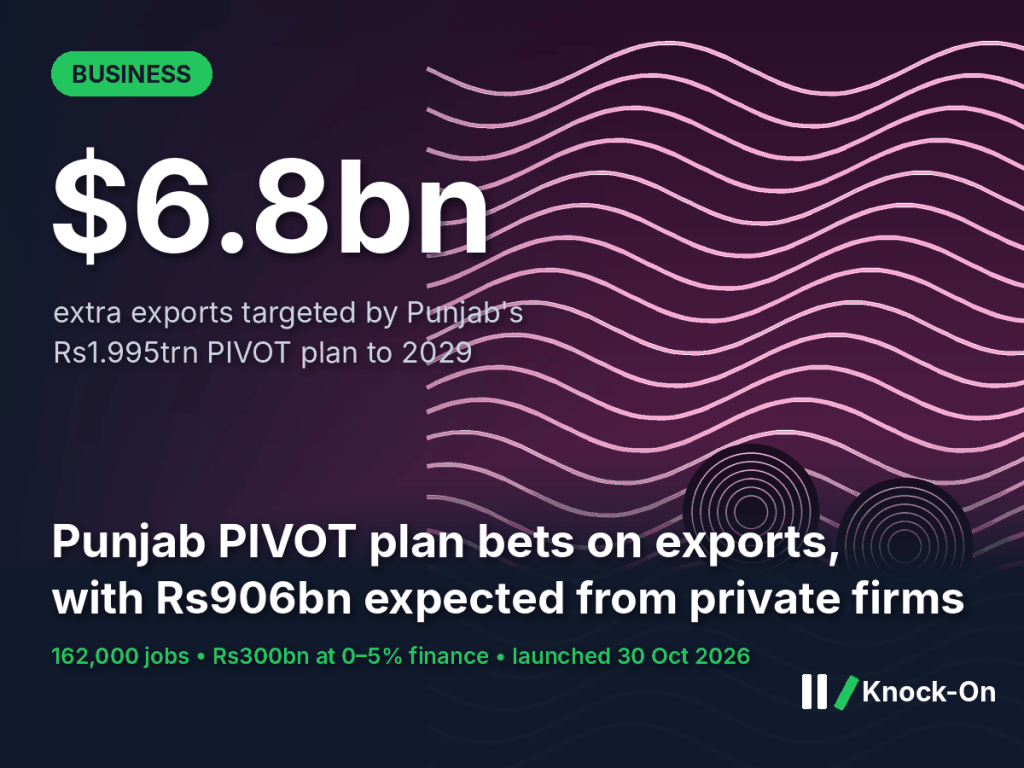
The Punjab PIVOT plan, a Rs1,995.3bn three-year programme launched by Chief Minister Maryam Nawaz Sharif in Lahore on Friday, sets a target of $6.8bn in additional exports and 162,000 new direct jobs by 2029. The Punjab PIVOT plan leans on the private sector for close to half of its money, and offers Rs300bn of concessional finance at 0–5% to get exporters moving. For textile, leather, sports goods and surgical instrument makers, the question is whether cheap credit and new industrial parks arrive fast enough to matter.
The short version
- Punjab launched the Rs1,995.3bn PIVOT plan for 2026–29, targeting $6.8bn in incremental exports and 162,000 direct jobs.
- Rs1,089bn is public investment; Rs906bn is a target for private investment, about 45% of the total (Knock-On calculation).
- A Strategic Trade Enhancement Programme (STEP) offers Rs300bn of financing at 0–5%, subject to programme terms.
- Officials say the plan will be operational within six months.
What happened
The Punjab Innovation, Value Addition and Economic Transformation (PIVOT) Plan 2026–29 was launched on 30 October, The Nation reported, with business leaders including Mian Mansha and Arif Habib and State Bank of Pakistan Governor Jameel Ahmad in attendance. The provincial cabinet had approved its key features on 20 October, according to The Express Tribune.
Rs753.7bn is earmarked for industrial output, value addition and export competitiveness. Rs50bn goes to solar installations and battery energy storage, and another Rs50bn to machinery duty reimbursements. The named value chains are garments and textiles, sports goods, leather and footwear, surgical instruments, pharmaceuticals, fans, cutlery, steel and ceramics. Four agro-processing parks are planned in Sargodha, Khanewal, Okara and Bhakkar, with horticulture authorities in 20 districts and training for 402,060 people over three years.
Private firms are expected to supply 45% of PIVOT’s money
Punjab PIVOT plan 2026–29, funding and selected allocations, Rs billion
Why it matters
Punjab accounts for 55.7% of national GDP and 53% of the population, Dawn noted in a June analysis of the plan, but it “produces at scale” without yet capturing value at scale. The Punjab PIVOT plan is an attempt to change that through exporters rather than the provincial budget alone, which matters at a time when exporters such as Interloop are already adding capacity and need cheaper, longer-term credit to keep going.
There are caveats. Dawn pointed out in June that the same provincial budget cut the annual development programme by nearly 40%, from Rs1.24trn to Rs752bn, to meet a cash surplus target tied to the IMF programme, and called the plan’s targets “projections, not results”. Dawn’s budget-stage figure for subsidised industrial financing was Rs193bn; the launch figure for STEP is Rs300bn, so the numbers appear to have been revised.
The knock-on effects
First order: cheaper credit for Punjab exporters
If STEP disburses on time through its new digital portal, small and mid-sized exporters in Sialkot, Faisalabad, Gujranwala and Lahore could borrow at 0–5%, far below commercial rates. Duty reimbursements on machinery would lower the cost of upgrading.
Second order: more private capex, if investors buy in
The Rs906bn private share is a target, not a commitment. Banks, industrial groups and equipment suppliers would benefit if firms invest, while cluster infrastructure such as effluent treatment and testing labs could help exporters meet buyers’ compliance demands. Federal reforms, such as the Companies Act amendments aimed at cutting duplicate business rules, would work in the same direction.
Third order: exports, jobs and the external account
If even part of the $6.8bn arrives, it would help the trade balance and the rupee. Agro-processing parks and horticulture market access could add to farm exports, alongside new routes such as the Pakistan China green channel for farm goods at Khunjerab.
Who could benefit
- Export SMEs: textile, leather, sports goods, surgical and cutlery makers eligible for 0–5% finance.
- Solar and battery suppliers: Rs50bn is set aside for installations and storage.
- Agro-processors: new parks in four districts and support for citrus, potato and mango access.
- Banks: likely channels for concessional and private lending.
Who may face pressure
- The provincial budget, which must fund Rs1,089bn while development spending is constrained.
- Firms outside the named value chains, which may compete for the same credit and land.
- Implementing departments, now measured on a public PIVOT dashboard and industry scorecard.
What to watch
- STEP portal rules: who qualifies, the actual rate, and how fast loans are approved.
- Operational start, which the chief secretary said would come within six months (by about April 2027).
- Whether private investment commitments are announced against the Rs906bn target.
- Punjab’s next development spending releases, the best test of whether the public share is funded.
Sources
- The Nation, Punjab CM launches historic Rs1.99 trillion Pivot economic plan, 31 October 2026
- The Express Tribune, Rs1,995b Punjab industrial, export plan approved, 20 October 2026
- Dawn, Punjab’s planned PIVOT, 22 June 2026
This is analysis, not investment advice. Figures are as of 31 October 2026.

Leave a Reply