
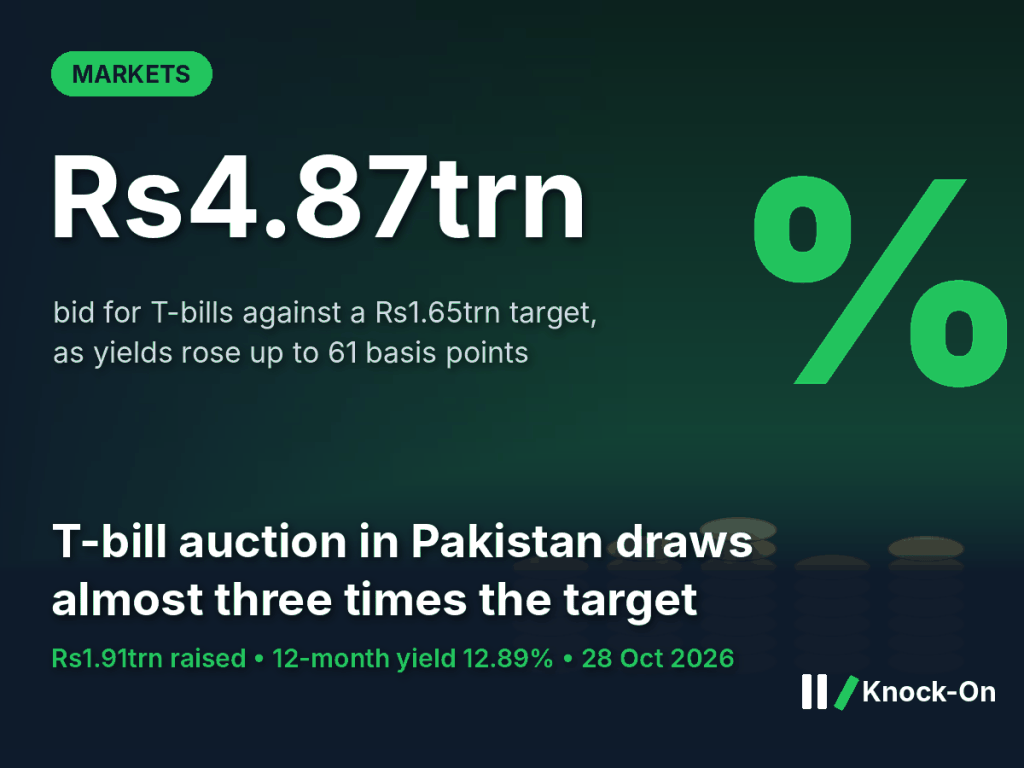
The T-bill auction in Pakistan on Wednesday drew bids of Rs4.87 trillion, almost three times the government’s Rs1.65 trillion target, two days after the State Bank raised its policy rate to 12%. The government took Rs1.91 trillion, more than it planned, and paid more for it: cut-off yields rose across all four tenors, by up to 61 basis points. For businesses, the message is that banks still have plenty of cash, and the safest home for it is government paper.
The short version
- Bids reached Rs4.867 trillion against a Rs1.65 trillion target; the government raised Rs1.913 trillion, Dawn reported.
- Cut-off yields now run from 12.10% (one month) to 12.89% (12 months).
- With Rs1.195 trillion maturing, the government borrowed about Rs718 billion in fresh money (Knock-On calculation).
- Higher risk-free returns make lending to private firms less attractive for banks.
What happened
According to Dawn, the government raised Rs1.913 trillion through market treasury bills on Wednesday, 28 October, against a target of Rs1.65 trillion and maturities of Rs1.195 trillion. Total bids were Rs4.867 trillion, a figure the newspaper called surprising. The amount raised includes Rs244.4 billion of non-competitive bids.
Most of the money went into short paper. The government took Rs473 billion in one-month bills at 12.10%, Rs783.5 billion in three-month bills at 12.42%, Rs169.5 billion in six-month bills at 12.65% and Rs242.7 billion in 12-month bills at 12.89%. Dawn linked the higher yields to the State Bank’s decision on 26 October to raise the policy rate to 12% from 11.5%.
The T-bill auction in Pakistan drew nearly 3x its target
Treasury bill auction of 28 October 2026, Rs billion
Why it matters
The rate hike has passed straight into government borrowing costs. Compared with the 14 October auction, when cut-offs ranged from 11.50% to 12.50%, yields are now between 25 and 60 basis points higher, with the sharpest rise at the short end. Every new rupee of short-term government debt now costs more, which adds to the interest bill in a year when the government has large financing needs.
Short-term T-bill yields rose the most after the rate hike
Change in cut-off yield, 14 Oct to 28 Oct 2026 auction, basis points
The size of the bids matters as much as the price. Dawn’s report attributes the heavy demand to financial institutions parking liquidity in risk-free government securities for better returns rather than lending to the private sector. That fits a pattern already visible in bank results: at the big lenders, deposits have grown far faster than loans. When a three-month T-bill pays 12.42% with no credit risk, a bank needs a clear premium to lend to a mid-sized manufacturer instead.
The knock-on effects
First order: T-bill auction in Pakistan resets borrowing costs
T-bill cut-offs feed into KIBOR, the benchmark most business loans are priced on. Higher yields mean running-finance and working-capital loans will reprice upward as they roll over, following the SBP interest rate hike to 12%.
Second order: private credit stays scarce
With the government taking more than its target, banks have an easy, well-paid use for their cash. Smaller firms without strong collateral are likely to find credit harder and more expensive to get, a forecast based on the incentives rather than new lending data.
Third order: a bigger interest bill
Higher yields on a large stock of short-term debt raise the government’s interest costs, leaving less room for development spending or tax relief. The global backdrop matters too: the US Federal Reserve’s latest decision shapes how far Pakistan’s rates can fall later.
Who could benefit
- Banks: higher yields on their large government securities holdings support income.
- Money market fund investors: funds that hold T-bills should see returns move up with yields.
- Savers: deposit and savings rates tend to follow T-bill yields, with a lag.
Who may face pressure
- Businesses on KIBOR-linked loans: working-capital costs rise as loans reprice.
- Small and medium firms: they compete with the government for bank lending.
- The federal budget: a heavier interest bill on rolling short-term debt.
What to watch
- Next T-bill auction: whether yields keep rising or settle near the new 12% policy rate.
- KIBOR fixings: the daily benchmark that passes these yields on to business loans.
- Early November: October inflation data, which will shape expectations for the next SBP decision.
- Private-sector credit data: whether bank lending to businesses slows further.
Sources
- Dawn, Govt raises Rs1.9tr, 29 Oct 2026
- Dawn, PSX extends recovery for third straight session, 29 Oct 2026
- Pakera, SBP T-Bill Auction 14 October 2026: Cut-Off 11.50-12.50%, Oct 2026
This is analysis, not investment advice. Figures are as of 29 October 2026.



Leave a Reply