
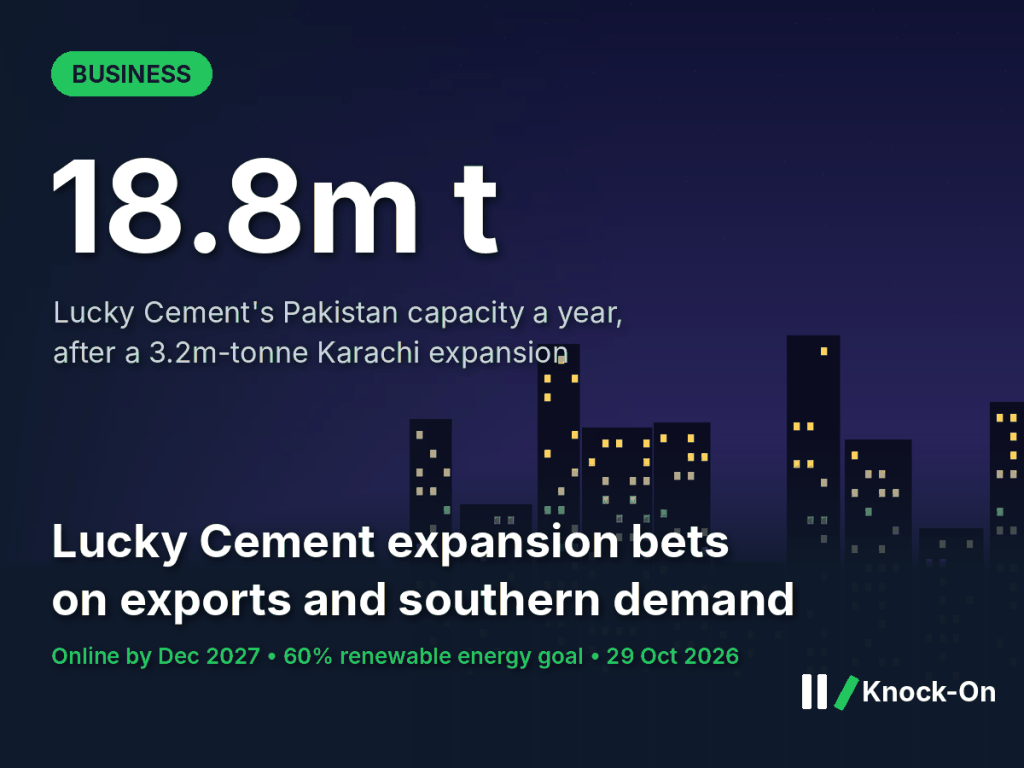
The Lucky Cement expansion approved this week will add 3.2 million tonnes a year of capacity at the company’s Karachi plant, lifting its installed capacity in Pakistan to 18.8 million tonnes by December 2027. The timing is notable: across the industry, plants are running at only about 60% of capacity, but demand in the south and exports by sea are growing fast while northern exports have stopped.
The short version
- Lucky Cement’s board approved a 3.2 million-tonne-a-year brownfield expansion at Karachi on 28 October, with commercial operations expected by December 2027.
- Pakistan capacity rises to 18.8 million tonnes a year; with its Congo plant, group capacity is expected to reach 26.65 million tonnes.
- New wind, solar, battery and waste-heat projects are meant to supply about 60% of the company’s energy needs.
- The bet is on the south: southern cement despatches rose about 30% in September, while northern exports were zero.
What happened
In a filing to the Pakistan Stock Exchange on Thursday, Lucky Cement said its board had approved, on 28 October 2026, a 3.2 million tonnes per annum (MTPA) brownfield expansion at its Karachi plant, Business Recorder reported. The new line will be integrated with a cement grinding facility already being installed there, taking the Karachi site’s capacity to 8.55 MTPA. The company expects commercial operations by December 2027.
The board also approved energy projects: 22.5MW of extra wind turbines and a 10MW waste heat recovery plant at Karachi, and a 15MW solar plant with a 15MW battery storage system at its Pezu plant. Taken together, renewables are expected to meet about 60% of the company’s energy needs. These are scheduled for completion between the fourth quarter of FY2027 and the second quarter of FY2028. The company cited domestic demand and growing export demand for cement and clinker.
The Lucky Cement expansion lifts Pakistan capacity by a fifth
Installed cement capacity, million tonnes a year (expansion due by December 2027)
Why it matters
The Lucky Cement expansion is a large vote of confidence at a time when the industry has spare capacity. Business Recorder’s research desk estimates industry utilisation at about 66% in September and about 60% for July–September, with northern plants at about 57%. National despatches in the first quarter of FY27 rose 3.9% to 13.14 million tonnes, with domestic sales up 7.8% but exports down 11.4%.
The split between north and south explains the choice of Karachi. Northern exports were zero in the quarter, compared with about 0.66 million tonnes a year earlier, which the research note links to the closed Afghan border. In the south, September despatches rose about 30%, and exports by sea climbed 36.3% to 0.83 million tonnes, the highest since January. A coastal plant can ship clinker and cement abroad without the land-border risk. Prices are also firm: the average bag sold for about Rs1,549 in September, around 10% higher than a year earlier, as covered in our look at why the cement price in Pakistan keeps rising.
The knock-on effects
First order: more export capacity on the coast
From 2028, Lucky will have more room to sell abroad from Karachi. That adds to Pakistan’s export earnings if overseas demand holds, and spreads fixed costs over more tonnes.
Second order: cheaper, steadier power for the plant
Energy is a large share of cement costs. Self-generated wind, solar, battery and waste-heat power reduce exposure to grid tariffs and imported fuel, the same logic behind Gul Ahmed’s renewable energy plan at Nooriabad.
Third order: pressure on smaller southern rivals
If domestic demand does not keep pace, more capacity in the south could mean sharper price competition once the line opens. That is a forecast risk, not a certainty, and depends on construction activity over the next two years.
Who could benefit
- Equipment and construction suppliers: a brownfield line plus wind, solar and battery projects means two years of contracts.
- Karachi port and shipping services: more clinker and cement for export would move by sea.
- Renewable energy installers: another large industrial buyer of captive clean power.
Who may face pressure
- Smaller cement makers in the south: more supply from the market leader if demand slows.
- Project financing: borrowing is costlier after the SBP interest rate rise to 12%.
- Northern exporters: they remain shut out of Afghanistan while southern rivals add sea-export capacity.
What to watch
- Early November: October cement despatch data from the industry association, especially southern exports.
- Q4 FY2027 to Q2 FY2028: completion of the wind, solar, battery and waste-heat projects.
- December 2027: planned start of commercial operations at the new Karachi line.
- The Afghan border: any reopening would revive northern exports.
Sources
- Business Recorder, Lucky Cement approves 3.2 million-tonne capacity expansion at Karachi plant, 29 Oct 2026
- Business Recorder (BR Research), Cement recovery remains uneven, 15 Oct 2026
- Dawn, PSX extends recovery for third straight session, 29 Oct 2026
This is analysis, not investment advice. Figures are as of 29 October 2026.

Leave a Reply