
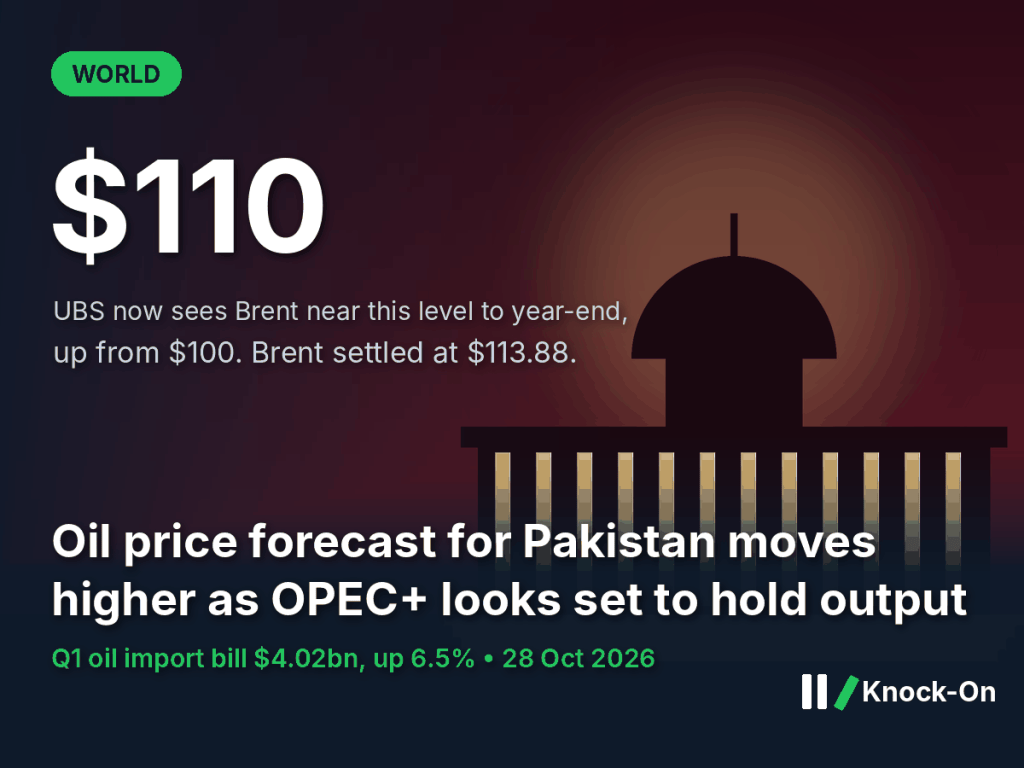
The oil price forecast for Pakistan has moved higher. Swiss bank UBS now expects Brent crude to stay near $110 a barrel through the end of the year, up from its earlier forecast of $100, Reuters reported on 28 October. At the same time, seven core OPEC+ producers look set to leave their December output targets unchanged at an online meeting on Sunday, 1 November. For a country that buys most of its fuel abroad and now resets pump prices every day, that combination points to expensive energy lasting into 2027.
The short version
- UBS raised its year-end Brent forecast to about $110 from $100. Brent settled at $113.88 on Tuesday, down $1.93 on the day.
- OPEC+ is likely to keep December output targets steady on Sunday, three sources told Reuters, so no extra supply is coming soon.
- Pakistan’s petroleum import bill rose 6.5% to $4.02bn in July–September, with crude imports up 23.1%.
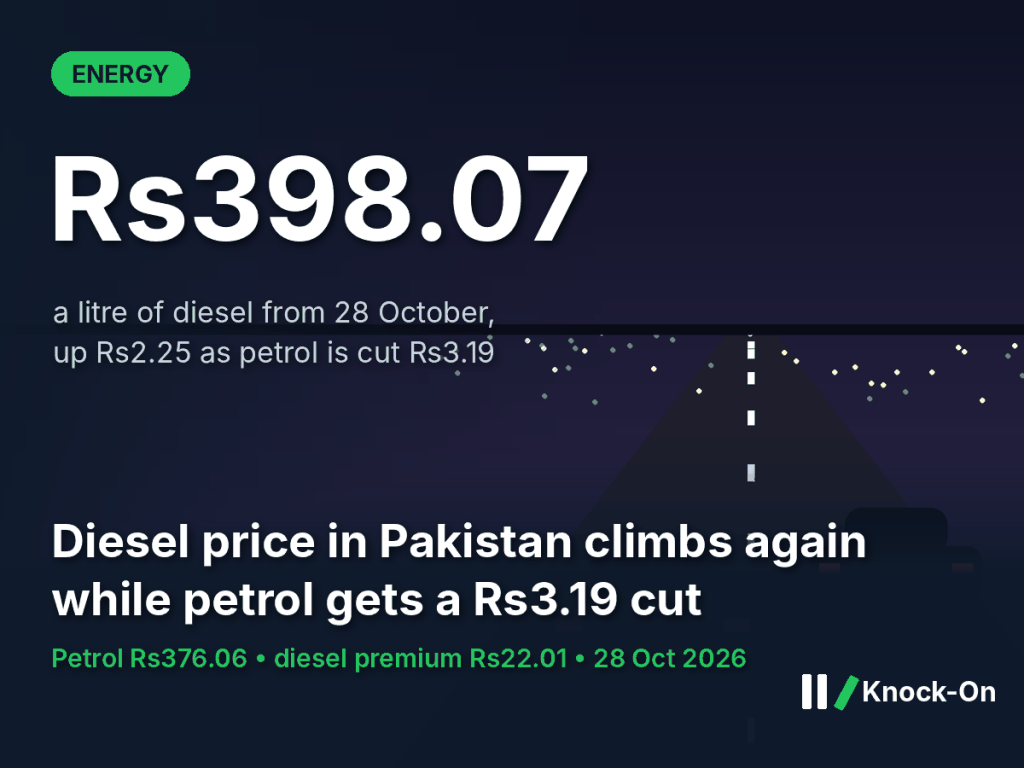
- Diesel is Rs398.07 a litre from 28 October, so a high oil price feeds straight into freight and farm costs.
What happened
Oil fell on Tuesday as traders focused on Middle East talks. Iran’s Security Council chief met Supreme Leader Mojtaba Khamenei a day after talks with Saudi Arabia, Turkey and Pakistan, and Iranian state media said the four countries agreed to keep talking about regional security, according to Reuters. Knock-On covered Pakistan’s role in the Makkah pact Iran talks in Tehran earlier this week.
The risks did not go away. Yemen’s Houthis said on 27 October that they hit Saudi Arabia’s Ras Tanura refinery with a ballistic missile; Saudi authorities had made no immediate comment, Anadolu Agency reported. Reuters, citing Washington Institute data, said October was the worst month this year for attacks on commercial shipping in and around the Strait of Hormuz. Swedish bank SEB said crude prices carry “a significant risk premium” linked to a possible US or Israeli attack on Iran.
UBS said the Middle East supply picture remains volatile: traffic through Hormuz has risen, but so have attacks on vessels. Most Gulf OPEC+ members are still pumping well below their targets as exports recover from months of war disruption, which is why the group is expected to hold rather than add barrels.
Pakistan’s crude bill jumped 23% as LNG imports fell
Petroleum group imports, US$ million, July–September FY27 vs FY26
Why it matters
Pakistan’s oil import bill is already rising. Official data reported by APP show petroleum group imports of $4.02bn in the first quarter of FY27, up from $3.78bn a year earlier. Crude imports rose 23.1% and petroleum products 11.6%; only a 41.6% fall in LNG imports kept the total increase to 6.5%. A Brent price that stays near $110 for the rest of the year, rather than easing towards $100, would keep that bill high in the second quarter too. Brent’s Tuesday settlement of $113.88 is already about 14% above UBS’s old $100 forecast (Knock-On calculation).
Since 17 July, pump prices have been reviewed and notified daily, The Express Tribune reports, so global moves now reach businesses within days. From 28 October petrol is Rs376.06 a litre and diesel Rs398.07, as Knock-On detailed in its story on the diesel price rise and petrol cut.
The knock-on effects
First order: the oil price forecast keeps fuel costs high
With OPEC+ expected to hold supply and banks raising their forecasts, there is little sign of a quick fall in the cost of crude. Under daily pricing, transporters, farmers running tractors and tube-wells, and factories using diesel generators carry that cost straight away.
Second order: dollars, the rupee and the trade gap
A larger fuel bill means more dollars leaving the country each month. That puts pressure on the current account and the rupee, even as reserves have recently improved. Cheaper LNG volumes have offset part of the crude increase so far, but that cushion depends on how much gas Pakistan buys this winter.
Third order: inflation and interest rates
The State Bank cited oil above $100 when it raised the SBP interest rate to 12% on 26 October. A forecast that keeps Brent above that level for longer makes an early rate cut less likely, which matters for any business that borrows.
Who could benefit
- Oil and gas producers: local exploration companies whose wellhead prices are linked to international crude.
- Solar and battery suppliers: high diesel prices strengthen the case for replacing generators.
Who may face pressure
- Freight and logistics firms: diesel is their largest running cost.
- Farmers: tractors and tube-wells run on diesel ahead of the wheat sowing season.
- Airlines and fuel-heavy manufacturers: fuel costs are hard to pass on quickly.
- The government’s budget: pressure to cut the petroleum levy grows when pump prices stay high.
What to watch
- Sunday, 1 November: the OPEC+ online meeting on December output targets, and any signal on 2027 quotas.
- Daily: Petroleum Division price notifications for petrol and diesel.
- Next few days: results of Israel’s election and follow-up talks between Iran, Saudi Arabia, Turkey and Pakistan. Knock-On has looked at the Israel election impact on Pakistan.
- Mid-November: October trade data, to see whether the oil bill kept rising.
Sources
- Business Recorder (Reuters), Oil falls almost USD2, 28 October 2026
- The Express Tribune (Reuters), Brent down 1.8% as Iran talks advance, 28 October 2026
- Reuters via 93.3 The Drive, OPEC+ oil producers set to keep output targets steady at Sunday meeting, sources say, 27 October 2026
- APP, POL import bill up by 6.50% to $4.02 bln in 1st Quarter, 26 October 2026
- The Express Tribune, Govt cuts petrol by Rs3.19, increases diesel by Rs2.25 for Oct 28, 27 October 2026
- Anadolu Agency, Yemen’s Houthis claim missile attack on Saudi Arabia’s Ras Tanura oil refinery, 27 October 2026
This is analysis, not investment advice. Figures are as of 28 October 2026. Forecasts are those of the banks named. Knock-On is not affiliated with any political party.


Leave a Reply